Plug-in Hybrid vs EV: Which Is Better for Your Driving?
Choose a plug-in hybrid if you cannot charge at home or work, or if your longest normal day regularly exceeds roughly 40 to 60 electric miles. Choose an EV if you can plug in daily and most of your driving fits the car’s real-world range. Pick wrong, and you may buy hardware you rarely use, or pay more for fuel and charging than you planned.
| Decision factor | Plug-in hybrid | EV | Winner |
|---|---|---|---|
| Daily charging flexibility | Can run on electricity for short trips, then switch to gasoline when needed | Must be charged to keep moving | Plug-in hybrid |
| Home charging dependence | Helpful, but not always required for daily use | Critical for convenient ownership | Plug-in hybrid |
| Typical electric driving distance | About 25-50 miles on electric power | Most models offer 250-350 miles on a full charge | EV |
| Road-trip convenience | No need to plan charging if gas is available | Best when routes and charging stops are planned | Plug-in hybrid |
| Running cost when plugged in daily | Low if electricity covers most miles | Usually lower energy cost than gasoline, especially with home charging | EV |
| Running cost when rarely plugged in | Efficiency drops and the gas engine carries more of the load | Still depends on charging, but no gasoline fallback | EV |
Plug-in hybrid vs EV: the core trade-off
The real choice is not “which is greener” or “which has the bigger number on the window sticker.” It is whether your normal life fits regular charging. A plug-in hybrid gives you an engine for backup. An EV gives you the longest electric driving distance, but only if charging is easy enough to stay ahead of use.
What a plug-in hybrid does when the battery runs out
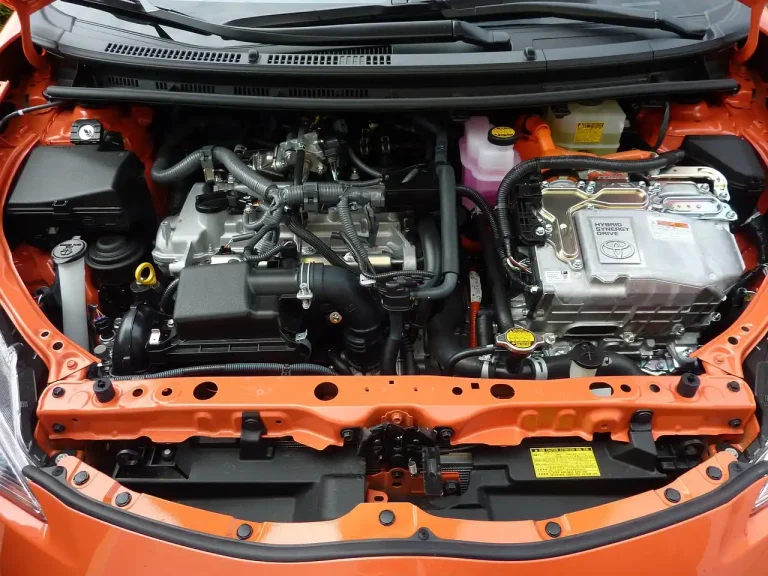
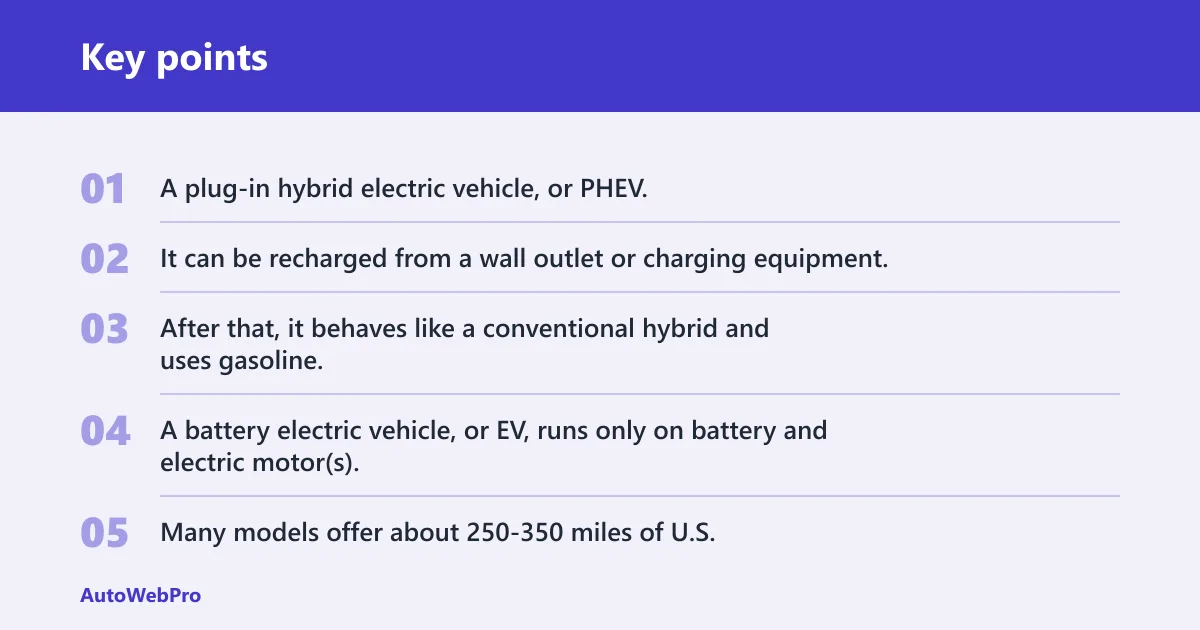
A plug-in hybrid electric vehicle, or PHEV, pairs a gasoline engine with a battery and electric motor(s). It can be recharged from a wall outlet or charging equipment, and it often drives about 20 to 50 miles on electricity before switching to hybrid operation. After that, it behaves like a conventional hybrid and uses gasoline.
What an EV needs to keep moving
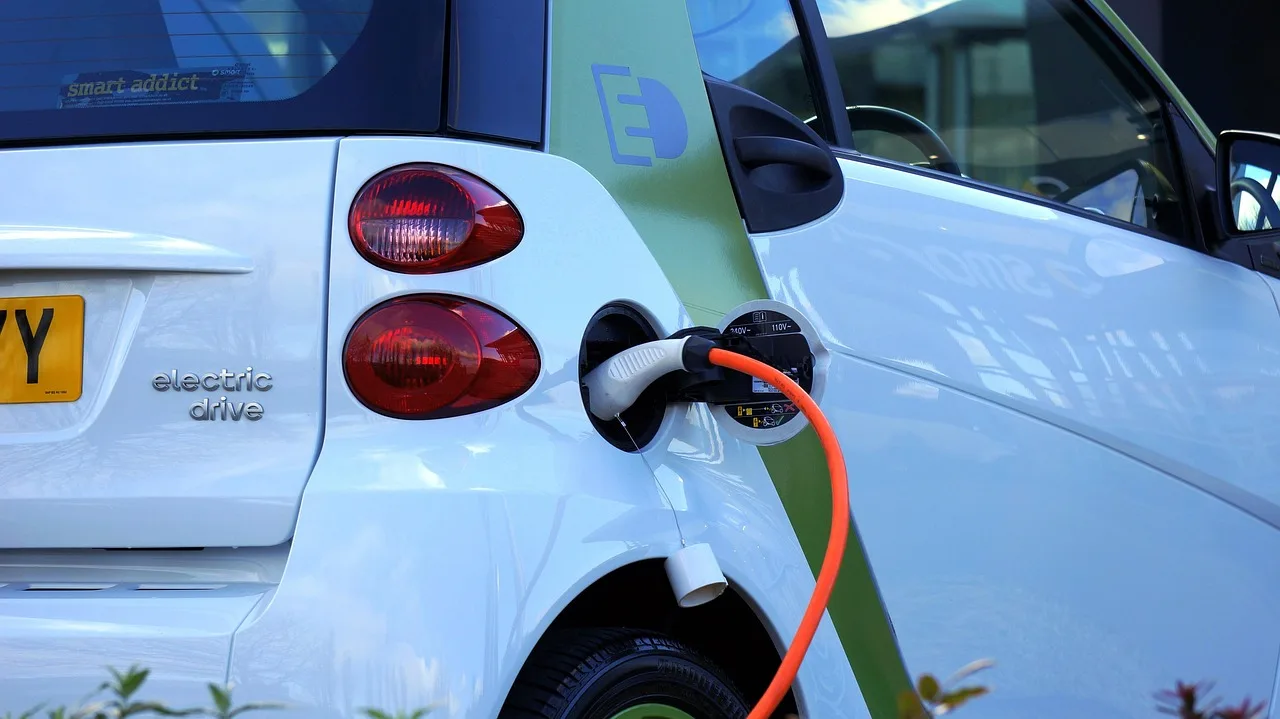
A battery electric vehicle, or EV, runs only on battery and electric motor(s). It needs charging to keep moving. Many models offer about 250-350 miles of U.S. range, and some go farther; the Lucid Air can travel more than 500 miles on a full charge. That range still depends on speed, weather, and driving style.
The one choice that matters most: charging access
Home charging access is the biggest divider. If you have off-street parking, enough electrical capacity, and a workable install, an EV becomes far easier to live with. A PHEV can often get by with slower Level 1 charging, while an EV usually works best with regular Level 2 charging at home or work.
Plug-in hybrid vs EV side-by-side
Electric-only range and total driving range
Plug-in hybrids usually give you limited electric driving, then gasoline takes over. Consumer Reports says most PHEVs can travel between 20 and 40 miles on electric power, and sourced examples land in that band: the 2025 Niro PHEV can travel up to 34 miles on electricity alone, while the 2025 Mazda CX-70 PHEV travels just 26 miles using electric power. The 2025 Niro PHEV has a total driving range of 510 miles.
EVs are the opposite. They usually offer far more electric range from the start, with many models in the 250-350 mile band and the 2025 Niro EV at up to 253 miles. That longer electric range matters most when your longest normal day still sits well inside the EV’s real-world window. (Motortrend)
Charging types: Level 1, Level 2, and DC fast charging
Level 1 charging uses a standard 120-volt outlet. It is the slowest charging method, but Consumer Reports says many PHEV owners can get by with it. The 2025 Niro PHEV can charge via a standard Level 1 wall outlet or a Level 2 charger. (Consumerreports)
Level 2 charging is the common overnight solution for EVs and PHEVs. It is much faster than Level 1 and is the home setup most EV shoppers should target. DC fast charging is public rapid charging for EVs. It is much faster than AC charging, but it is not the main home-charging method.
What happens after the battery is depleted
This is where the gasoline backup engine changes the decision. A PHEV with a depleted battery does not stop being useful. It becomes a gasoline-electric hybrid, which removes full dependence on charging for long trips or surprise detours. That backup matters if your schedule is irregular or your charging access is uncertain.
An EV has no gasoline fallback. If you cannot charge, you cannot keep driving. That sounds obvious, but many shoppers miss it when they focus only on sticker range.
Where regenerative braking fits
Regenerative braking appears in hybrids, PHEVs, and EVs. It recaptures kinetic energy during braking and helps recharge the battery while driving. It helps, but it does not replace plugging in. It also does not erase the difference between a short electric commute and a long highway day.
What if you cannot charge at home?
If you cannot charge at home, the choice tilts toward a PHEV unless your workplace charging is reliable enough to cover most days. Apartment dwellers, street-parking setups, and older homes without easy electrical upgrades should treat home charging access as a primary filter, not a nice extra. Public charging can work, but it is not the same as plugging in overnight.
Apartment dwellers and street parking
A common first-timer mistake is assuming nearby public chargers solve the same problem as a driveway outlet. They do not. If you need to move the car to charge, or if charger access is uncertain, an EV becomes harder to live with. A PHEV keeps gasoline available for those gaps.
Workplace charging and public charging fallback
Workplace charging can make an EV practical without home charging, but only if it is dependable and available often enough to match your mileage. Public charging alone works best when your driving is predictable and you are comfortable planning stops. If you need frequent, last-minute top-offs, a PHEV is the safer fit.
When a plug-in hybrid makes more sense than an EV
Choose the PHEV if you cannot install home charging, your office chargers are occupied most days, or your schedule changes enough that you may miss charging windows. The gasoline engine prevents the car from depending on charger access. That is the advantage the EV does not have.
Which is cheaper to run?
EVs are usually cheaper to run when you can charge at home, because electricity is generally less expensive than gasoline per mile and there is no engine fuel to buy. That advantage narrows if you rely on public charging, especially if station pricing is high. A PHEV can be cheap too, but only when it is plugged in often enough to use its electric miles.
Home electricity versus public charging
Home electricity is the low-friction path to lower operating cost. Level 2 charging overnight also keeps an EV ready without much effort. Public charging can still be practical, but its cost and inconvenience vary more, so it is harder to count on for low-cost daily use.
Gasoline fallback in a rarely charged plug-in hybrid
If a PHEV is rarely plugged in, the purchase premium can be wasted. You carry the battery and electric hardware, but you use the gasoline engine for most miles. That can mean a higher upfront price without much return, plus more fuel use than you expected. In that case, a regular hybrid or a conventional gasoline vehicle may make more sense than a PHEV.
Why annual mileage changes the answer
High annual mileage magnifies whatever energy source you use most. If most of your miles are electric and you have cheap home charging, an EV usually gains ground quickly. If your mileage is moderate and charging is inconsistent, the PHEV’s flexibility can matter more than its theoretical efficiency.
Drive profile matrix
This matrix uses the same five factors across four common profiles: daily miles, home or work charging access, winter exposure, road-trip frequency, and annual fuel or charging cost sensitivity. The recommendation assumes the longest normal day matters more than the average day.
| Driver profile | Plug-in hybrid | EV | Simple recommendation | Buy this if… |
|---|---|---|---|---|
| Profile 1: short commute, reliable home charging | Good, but the gas engine may go unused if the commute stays under electric range | Best fit for daily use and lower-fuss charging | EV | Your longest normal day stays within the car’s real range and you can charge overnight |
| Profile 2: mixed commute, no home charging | Strong fit because gas covers days you cannot recharge | Works only if workplace charging is dependable | Plug-in hybrid | You cannot install home charging and public charging would be your main backup |
| Profile 3: long highway days, frequent road trips | Useful because the engine removes charging dependence on the road | Good only if charging stops are easy to plan and accept | Plug-in hybrid | You take long trips often and do not want to plan around chargers |
| Profile 4: cold climate, variable winter use | More forgiving when range dips or heating use rises | Still workable, but winter loss matters more in the planning | Plug-in hybrid | Your winter days are long, cold, and hard to predict |
Say your weekday commute is 18 miles each way, you park in a garage, and you can plug in every night. An EV fits cleanly here because the daily distance stays inside a typical range and charging access is simple. A PHEV would work too, but it would carry an engine you may rarely use.
Suppose your apartment has street parking, your office charger is often occupied, and your Saturday drives can stretch beyond 80 miles. That pattern leans toward a PHEV because the backup engine covers missed charging days and weekend spikes without turning every public charger search into a trip requirement.
How does winter change the choice?
Cold weather can reduce EV range, and short trips with cabin heating make the drop feel bigger. That does not mean every EV becomes impractical in winter. It does mean you should size the car for your longest normal cold-day drive, not your mild-weather commute. PHEVs are less exposed to that planning pressure because gasoline can take over.
Winter range loss in EVs
Winter range loss matters because the battery has to do more work to warm the cabin and maintain output. A 250-350 mile EV can still be enough in winter, but the usable buffer shrinks. If your daily life already sits near the edge of the car’s range, cold weather can turn “fine on paper” into “too tight.”
Cabin heat, short trips, and energy use
Short trips are harder on EV range than many shoppers expect. The car spends a bigger share of each drive warming the cabin and the battery, so energy use rises. A longer, steady drive is easier to manage than several cold starts scattered through the day.
Why a plug-in hybrid can feel safer in cold weather
A PHEV gives you a gasoline backup engine when winter range falls short or roads and schedules change. That does not make it the better efficiency choice. It does make it the lower-stress choice for drivers who see hard freezes, long heating use, and irregular days in the same week.
Choose Plug-in hybrid if… / Choose EV if…
Choose a plug-in hybrid if your longest normal day often exceeds your car’s electric-only range, if you cannot charge at home or work, or if you want a gasoline backup for road trips and winter days. Choose an EV if you can charge regularly, most of your driving fits inside the real range, and you want the simplest daily electric routine.
Choose Plug-in hybrid if…
- Your longest normal day is beyond about 40 to 60 electric miles.
- You do not have reliable home charging.
- You drive long highway trips often and do not want to plan charging stops.
- You live in a cold climate and want a backup when winter range drops.
Choose EV if…
- You can charge at home overnight.
- Your daily and weekly miles fit within a real-world EV range.
- You want lower-fuss driving with no gasoline fallback to manage.
- You can accept planning for public charging on longer road trips.
Frequently asked questions
Is a plug-in hybrid or EV better for my daily commute?
If your commute fits comfortably inside an EV’s real range and you can charge at home, the EV is usually the cleaner fit. If your commute is longer than a PHEV’s electric-only range or charging is unreliable, the plug-in hybrid is safer because it can finish the trip on gasoline.
How many miles can a plug-in hybrid go on electricity alone?
Most PHEVs can travel between 20 and 40 miles on electric power, and many are described in the 25-50 mile band. Specific models vary: the 2025 Niro PHEV can travel up to 34 miles on electricity alone, while the 2025 Mazda CX-70 PHEV travels just 26 miles using electric power.
What if I can’t charge an EV at home?
You can still make an EV work if workplace charging is dependable or public charging is easy to access, but it is a harder ownership pattern. Without home charging, an EV depends on outside infrastructure every week. A plug-in hybrid is usually the lower-risk choice because gasoline covers missed charging opportunities.
Which is cheaper to run: a plug-in hybrid or an EV?
An EV is usually cheaper to run when you charge at home, because electricity often costs less per mile than gasoline. A PHEV can also be inexpensive if you plug it in often, but if you rarely charge it, the fuel savings shrink fast and the purchase premium may not pay back.
Is a plug-in hybrid worth it if I rarely plug in?
Usually not. If you rarely plug in, you are paying for a battery and electric system that you do not use much, while the gasoline engine does most of the work. In that case, a regular hybrid or conventional gasoline model may be the better value than a PHEV.
How does winter weather affect EV range compared with a plug-in hybrid?
Winter can cut EV range enough to matter, especially on short trips with heavy cabin heating use. A PHEV is less exposed because it can switch to gasoline once the battery is depleted. That makes it easier to live with in cold weather, though not necessarily cheaper or cleaner over time.
Can a plug-in hybrid handle road trips without charging?
Yes. That is one of its main advantages. Once the battery is used up, the gasoline engine keeps the car moving like a conventional hybrid. That removes the need to plan around chargers on long trips, which is useful when routes, weather, or schedules change.
Which is better for apartment dwellers: plug-in hybrid or EV?
For most apartment dwellers, a plug-in hybrid is the easier choice unless charging is available at work or in a nearby, dependable location. EVs can still work, but they ask more of your parking setup. If home charging is not realistic, the PHEV’s gasoline fallback matters a lot.