How to Charge an Electric Car at Home
For many UK drivers, a home charger is the simplest way to keep an EV ready overnight. A 7.4 kW wallbox on a dedicated circuit is the common domestic setup, while a 3-pin socket is usually a slow backup. The right choice depends on parking, daily miles, tariff, and how quickly you need range back by morning.
Home charging methods and what affects them
Most home charging means plugging in while the car is parked for several hours. In the UK, that is usually either a 3-pin domestic socket or a dedicated AC wallbox. The best option depends on whether you have safe off-street parking, how far you drive each day, and whether you want the cheapest overnight rate or the fastest practical refill.
The main home charging methods
A 3-pin domestic socket is the slowest common home option. It can be useful as a temporary fallback, but it typically adds only a few miles of range per hour in UK conditions because domestic sockets are limited to low power and are not designed for repeated high-load use. The Energy Saving Trust and UK charger guidance generally treat it as occasional-use charging rather than the default routine.
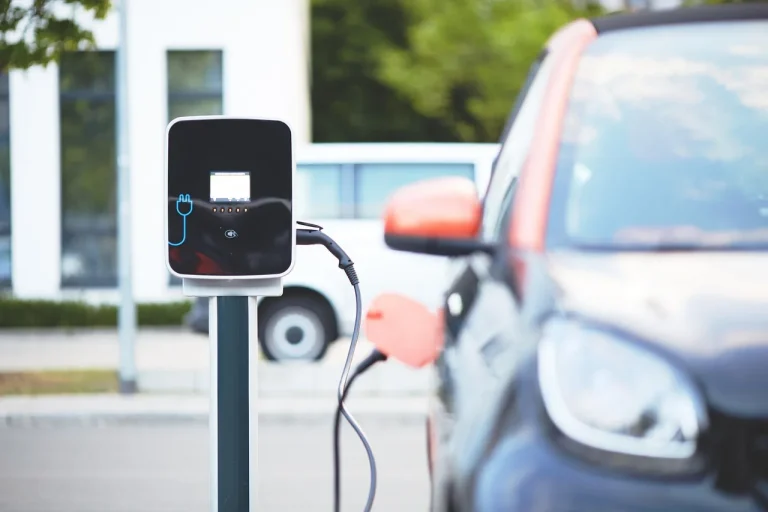
A 7.4 kW wallbox is the standard UK home solution on single-phase supplies. At that power, a typical EV with a suitable onboard charger can recover enough range overnight for normal commuting. BMW’s home charging guidance notes that many home setups reach up to 7.4 kW, while the actual charging rate is still capped by the car’s onboard charger and the home supply.
What makes home charging practical
Three things decide whether home charging works well: parking, daily mileage, and tariff. If you park on a driveway and drive modest distances, a wallbox usually gives the best balance of speed and convenience. If you only need an occasional top-up, a 3-pin plug may be enough, but it becomes less suitable as a daily charging plan.
Picture a driver covering about 20 miles a day and parking on a driveway. A wallbox can usually replenish that easily overnight. Now imagine the same driver has only a curbside space and no safe cable route. The charging answer changes, even though the car and battery are unchanged.
Which home charging option suits your setup?
The best choice depends more on parking than on the vehicle. A driveway gives you the simplest route to home charging, shared private parking needs more planning, and no dedicated bay often means you need landlord or management approval. If home charging is not safe or practical, public charging can be the better backup even though it usually costs more.
Driveway and dedicated parking
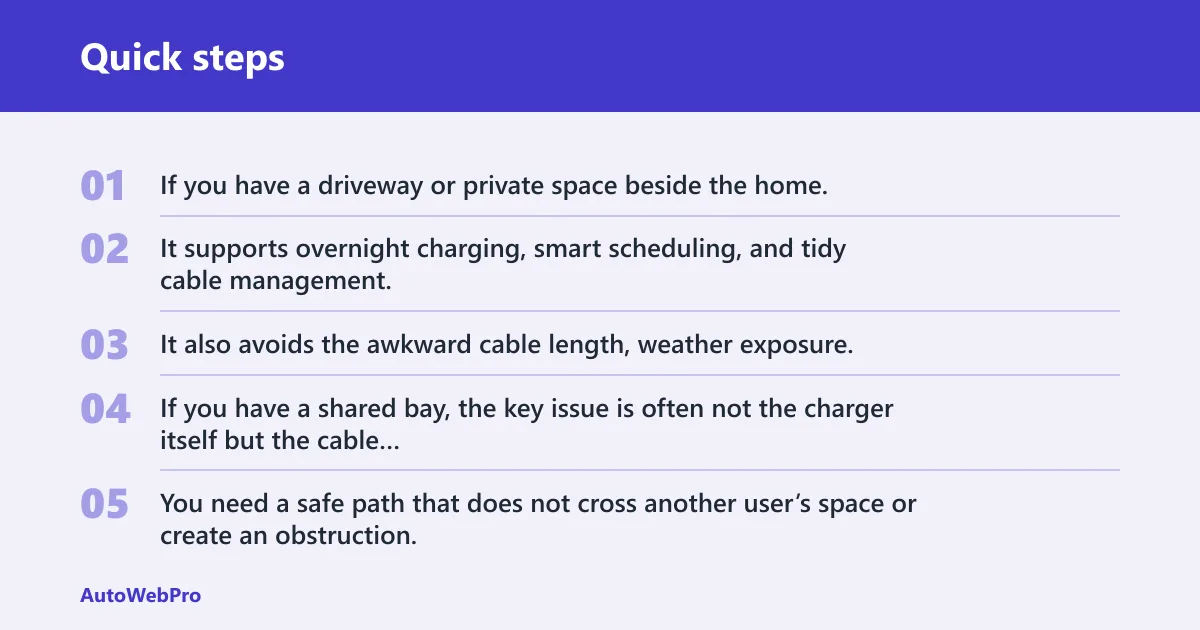
If you have a driveway or private space beside the home, a dedicated wallbox is usually the best fit. It supports overnight charging, smart scheduling, and tidy cable management. It also avoids the awkward cable length, weather exposure, and trip hazards that come with improvised charging arrangements.
Shared or private parking
If you have a shared bay, the key issue is often not the charger itself but the cable route. You need a safe path that does not cross another user’s space or create an obstruction. A wallbox may still work if the layout supports it and permissions are in place.
No driveway or no dedicated bay
If you do not have dedicated parking, home charging may still be possible only in limited cases. You may need approval from a landlord or management company, and the bay must be close enough for a safe cable run. If the cable would cross a pavement, road, or shared access route, that is not a proper routine charging plan.
| Scenario | Recommended setup | Typical charging speed | Likely cost driver | Safety note | When to upgrade |
|---|---|---|---|---|---|
| Driveway + wallbox | 7.4 kW Level 2 charger on a dedicated circuit | Often enough for roughly 20-30 miles of range per charging hour, depending on the car and efficiency | Off-peak electricity tariff is the biggest savings lever | Best fit for regular home charging when installed correctly | Upgrade if your daily mileage rises, you want app-based scheduling, or your current cable/set-up feels awkward |
| Driveway + 3-pin fallback | 3-pin domestic socket for temporary or occasional use | Usually only a few miles of range per hour in UK domestic-socket conditions | Standard electricity rate unless you can time charging off-peak | Fine for short-term use; not ideal as the normal long-term solution | Upgrade once you need regular overnight replenishment instead of occasional top-ups |
| Shared/private parking | Wallbox only if cable routing and permissions are workable | Usually similar to a home wallbox if installation is allowed | Installation complexity and tariff | Cable routing must not create a trip or access hazard | Upgrade if the bay layout changes or you need more dependable overnight charging |
| No dedicated parking | No routine home setup; rely on workplace charging, public charging, or a later parking solution | Not a practical home-charging case | Public charging rates and access fees | Do not run cables across footpaths or shared routes | Upgrade only after you secure a legal, safe parking space |
Can you charge an electric car at home without a charger?
Yes, but only in limited cases. A 3-pin domestic socket can charge an EV without a wallbox, yet it is much slower and needs more caution. It works best as a temporary or occasional backup, not as the normal answer for daily commuting or for larger batteries that need frequent replenishment.
3-pin socket as a temporary fallback
UK domestic sockets are typically limited to low-power charging, so the practical result is slow range recovery rather than fast refilling. In real terms, a 3-pin plug usually adds only a few miles per hour, which can be enough for short mileage but frustrating if you need a full battery every morning. Charger manufacturers and UK EV guidance generally recommend it only when a wallbox is not yet available.
Why extension cords are a bad idea
Extension cords add resistance, heat, and extra failure points. They also create a trip risk and are more vulnerable to rain, crushing, or damage from doors and gates. If the only way to charge is to stretch a cable across a path, the issue is the parking layout, not the charger itself.
When a wallbox becomes the better answer
Once you need dependable overnight charging, a wallbox is usually the better answer. It gives you more usable charging speed, safer cable management, and a purpose-built setup for repeated charging. Many UK homes are effectively capped at 7.4 kW single-phase supply for standard home charging, although some vehicles and some three-phase properties can differ.
How long does home charging take?
Charging time depends on battery size, charger power, and the vehicle’s onboard charger limit. A smaller battery fills faster than a larger one, but only if the car can accept the available AC power. Many EVs also slow as they get close to full, so the last part of the session takes longer than the middle.
Battery capacity and onboard charger limits
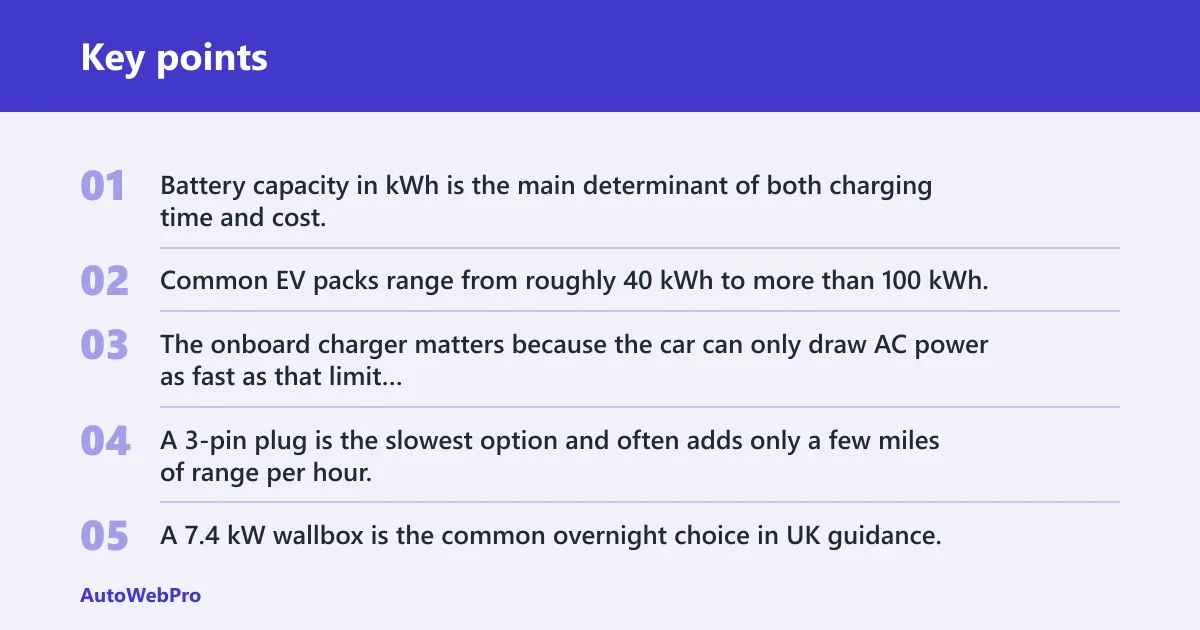
Battery capacity in kWh is the main determinant of both charging time and cost. Common EV packs range from roughly 40 kWh to more than 100 kWh. The onboard charger matters because the car can only draw AC power as fast as that limit allows, even if the wallbox is capable of more.
Typical 3-pin versus 7.4 kW timing
A 3-pin plug is the slowest option and often adds only a few miles of range per hour. A 7.4 kW wallbox is the common overnight choice in UK guidance. For a practical timing reference, UK charger manufacturer and fleet guidance commonly puts a 50 kWh battery at around 7 to 8 hours on a 7.4 kW charger, assuming the car can accept that full AC rate.
For a larger pack, the overnight window still depends on the vehicle’s AC limit. If the car’s onboard charger tops out below 7.4 kW, the wallbox cannot make it charge faster. If the car supports more, the home supply and charger design still determine the actual speed available at the property.
Why charging slows near full
Many EVs reduce charging speed after about 80% state of charge. That slowdown is normal for AC home charging and helps protect the battery. It means the last 20% can take a disproportionate amount of time, so many drivers aim for 80% to 90% overnight rather than insisting on 100% every session. This is separate from public DC rapid charging, which also tapers near the top for different technical reasons.
How much does home charging cost?
Cost is driven first by battery size and tariff. A larger battery costs more to fill, and the electricity rate matters even more than charger power. A full charge can be relatively cheap on an off-peak EV plan and much more expensive on a standard tariff, especially once charging losses are included.
Standard rate versus EV off-peak rate
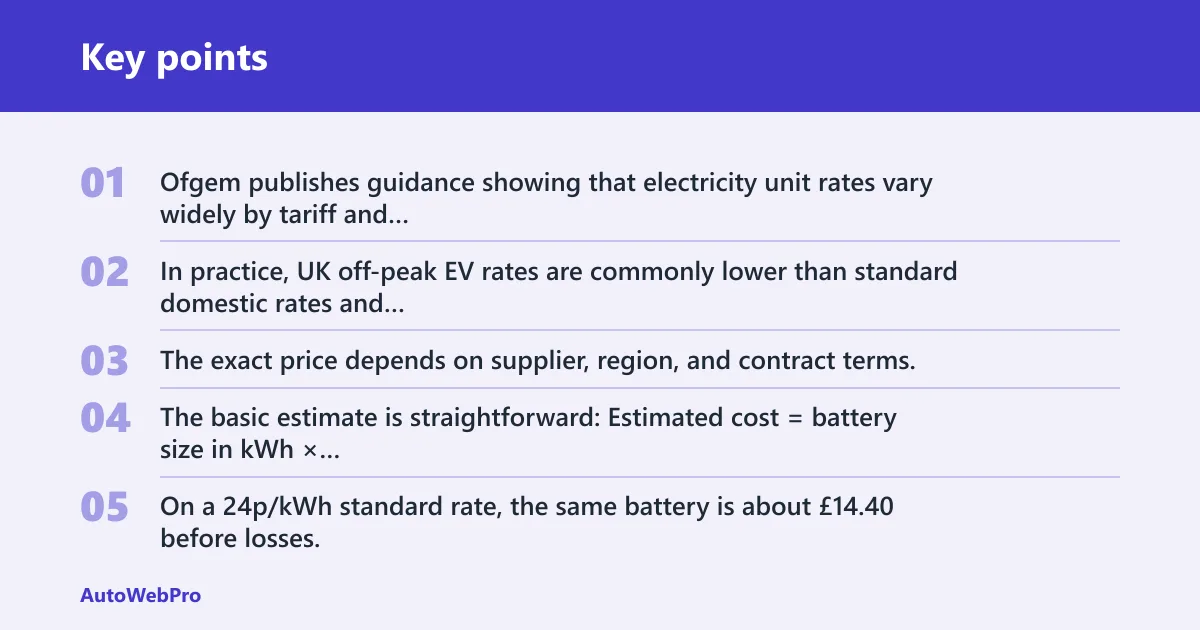
Ofgem publishes guidance showing that electricity unit rates vary widely by tariff and region, while EV-specific tariffs are often designed with a cheap overnight window. In practice, UK off-peak EV rates are commonly lower than standard domestic rates and can be substantially cheaper for drivers who can shift charging into the cheaper block. The exact price depends on supplier, region, and contract terms.
A simple cost formula
The basic estimate is straightforward:
Estimated cost = battery size in kWh × electricity rate per kWh ÷ 100
For example, a 60 kWh battery on a 10p/kWh off-peak rate is about £6 for a nominal full fill before losses. On a 24p/kWh standard rate, the same battery is about £14.40 before losses. The real bill will usually be a little higher because charging is not perfectly efficient.
Why you should allow for charging losses
Home charging is not 100% efficient. UK consumer guidance and charger manufacturers typically place AC charging losses in the rough range of 5% to 15%, depending on the car, charger, temperature, and charging speed. A practical planning assumption is to allow about 10% extra energy when estimating time and cost. That means a nominal full charge needs more electricity from the wall than the battery size alone suggests.
In simple terms, if the battery holds 60 kWh, the wall may need to supply more than 60 kWh to account for conversion and system losses. The exact figure varies, but the point is the same: tariff matters most, and losses should not be ignored.
Can you cut charging costs with smart charging or solar?
Yes. Smart charging can move charging into cheaper hours, and solar can reduce daytime grid use when the car is plugged in while panels are producing. These options do not change the battery size or the car’s charger limit, but they can change what each kilowatt-hour costs you and when you use it.
How smart charging targets off-peak windows
Smart charging schedules the session overnight and aims for the cheapest tariff window. That matters most if your supplier offers a long off-peak period or a short ultra-cheap block. The battery still fills at the same technical limit, but the electricity price drops because the car draws power when rates are lower.
When solar helps most
Solar helps most when the car is available in the daytime. If the vehicle is home while the panels are producing, excess solar can offset grid electricity. If you only plug in overnight, solar may help the house more than the car unless your system can store solar energy or intelligently manage charging around generation.
What changes and what does not
Smart charging changes timing. Solar changes the source of some of the power. Neither one changes the vehicle’s onboard charger limit or the battery’s capacity. If the car can only accept a certain AC rate, that remains the ceiling regardless of how clever the schedule is.
Before you install
Before fitting a home charger, check three things: parking permission, electrical capacity, and cable safety. The goal is not just to charge faster, but to charge legally and without creating a trip or fire hazard. A good installation should fit the way you park today and still make sense if your mileage changes later.
Electric car at home checklist
- Confirm you have a safe parking space with a legal cable route.
- Check whether your supply is single-phase or three-phase.
- Ask whether your car’s onboard charger can use 7.4 kW or less.
- Choose a tariff that rewards overnight charging if possible.
- Plan for cable storage so leads do not cross paths or sit in water.
3-pin, 7.4 kW wallbox, and public charging compared
| Option | Best for | Typical UK home or fallback use | Speed | Cost |
|---|---|---|---|---|
| 3-pin plug | Occasional top-ups and short-term backup | Temporary use only if no wallbox is available | Slowest; usually only a few miles per hour | Can be cheap on off-peak rates, but takes longer and is less convenient |
| 7.4 kW wallbox | Regular overnight home charging | Best fit for a driveway or approved private bay | Common overnight recovery option | Usually the best value at home when used with off-peak tariffs |
| Public charging | Back-up when home charging is not practical | Useful for drivers without safe off-street charging | Can be fast, but the result depends on the charger type and queue | Typically more expensive than home charging, but often the better backup when you need flexibility |
Frequently asked questions
How do you charge an electric car at home?
Most drivers plug in at home overnight using either a 3-pin socket or a wallbox. The wallbox is the better daily-use option for most UK homes with off-street parking. The car’s onboard charger, battery size, and tariff decide how fast and how cheaply it fills.
How long does it take to charge an electric car at home?
Time varies with battery size and charging power. A 3-pin socket is slow, while a 7.4 kW wallbox is the common overnight choice in UK guidance. If the car’s onboard charger is the limit, the session will not go faster just because the wallbox can supply more.
How much does it cost to charge an electric car at home overnight?
Use battery size and tariff to estimate the bill. Off-peak EV tariffs can be much cheaper than standard domestic rates, and you should also allow roughly 5% to 15% for charging losses. That makes overnight home charging the lowest-cost option for many drivers.
Can you charge an electric car at home with a 3 pin plug?
Yes, but only as a temporary or occasional solution. A 3-pin domestic socket is the slowest common home option and usually adds only a few miles per hour. It is useful in a pinch, but a wallbox is the better answer for regular charging.
Can you charge an electric car at home without a driveway?
Sometimes, but only if you have a safe, approved parking arrangement and a cable route that does not cross a public path or create a hazard. Shared or private parking may work. If you have no dedicated bay, home charging is often not practical.
Sources
- Ofgem — guidance on domestic electricity tariffs and bill calculation basics.
- Energy Saving Trust — EV charging advice for home sockets, wallboxes, and practical charging habits.
- UK charger manufacturer documentation — typical 7.4 kW home charging speeds and AC charging timing references.
- Vehicle manufacturer charging manuals — onboard charger limits, AC charging rates, and charging taper guidance.
- UK government and motoring guidance on safe EV charging installation and cable safety.