Lane Keeping Assist vs Lane Following Assist: What’s Different?
Lane keeping assist nudges the car back after a drift. Lane following assist holds the car closer to the lane center, often alongside adaptive cruise or highway assist. If you mix them up, you may expect steering help a system cannot provide. For most highway-focused drivers, lane following assist is the stronger choice; for drivers who want a lighter correction aid, lane keeping assist is enough.
| Feature name | Driver feel | Activation conditions | Failure modes |
|---|---|---|---|
| Lane Departure Warning | Alert-only; beeps, chimes, or steering-wheel vibration without steering the car | Detected lane markings, camera online, and a departure event without a turn signal in many systems | Faded paint, snow, glare, occlusion, sharp curves, and missing lane lines can reduce or stop alerts |
| Lane keeping assist | Brief steering correction after drift; feels like a light nudge back into the lane | Visible lane lines, functioning front camera, and model-specific speed limits or road-type limits | Sharp curves, poor markings, covered lines, camera occlusion, and cut-in traffic can reduce or stop correction |
| lane following assist | Continuous centering support; feels steadier and more active than a simple nudge | Visible lane lines, eligible speed range, and often a wider driver-assist package such as adaptive cruise control or highway assist | Sharp curves, poor markings, occluded cameras, hands-off monitoring limits, and model-specific speed thresholds can trigger warnings or disengagement |
| Lane centering / LFA | Closest to staying centered between the lines, often with the least steering effort on highways | Camera-based lane detection, sometimes radar support, and frequently hands-on steering-wheel monitoring | Loss of lane contrast, speed outside the usable range, steering-torque detection limits, or capacitive wheel checks not satisfied can cause nagging or shutoff |
The table looks simple because the split is simple. Lane keeping assist gives shorter, lighter intervention. Lane following assist stays in the lane more continuously, so it usually feels better on roads with clear markings and steady lane geometry. In official terms, these are driver-assistance features, not automated driving systems; the SAE J3016 taxonomy separates assistance from automation, and NHTSA’s guidance keeps the driver in the loop rather than handing over control.
How each system handles lane drift
Lane keeping assist gives a brief steering nudge after the car starts to drift. Lane following assist works more continuously and tries to keep the car centered in the lane, so it feels closer to constant steering support than a correction-only aid. That difference matters most on longer trips and clearer highways.
Lane keeping assist means correction, not constant centering
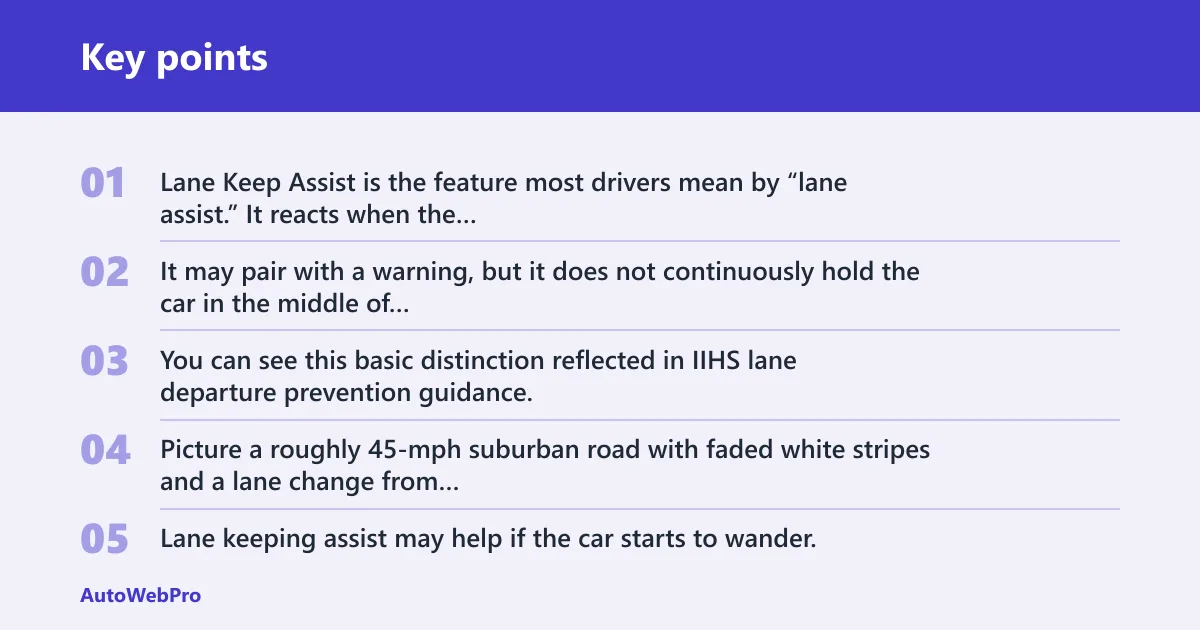
Lane Keep Assist is the feature most drivers mean by “lane assist.” It reacts when the vehicle drifts toward a lane line, then nudges the steering back toward center. It may pair with a warning, but it does not continuously hold the car in the middle of the lane. You can see this basic distinction reflected in IIHS lane departure prevention guidance, which separates alerting from active lane support.
Picture a roughly 45-mph suburban road with faded white stripes and a lane change from another driver ahead. Lane keeping assist may help if the car starts to wander, but it will not guide the vehicle through every turn the way a centering system tries to do. On many models, the owner manual also limits operation by road type or speed; for example, some OEM lane-assist pages explain that the system is designed for clearly marked lanes and can switch off if the camera loses the lane.
Lane following assist means continuous tracking
Lane following assist is the more active system. It usually works as a higher-level steering assist because it keeps trying to center the car as long as the lane markings and system checks stay valid. That is why it feels steadier on long, well-marked roads.
Lane Centering is the term many shoppers will see in spec sheets for that same continuous behavior. It often works with adaptive cruise control, and some systems require hands-on steering wheel pressure even while they are actively helping. Many owner-manual pages also show the same split: some brands list lane centering or LFA as part of highway driving assist, while lane departure warning remains a separate alert-only feature. A closely related system is lane keeping assist, which helps explain why shoppers often confuse the names.
Does lane keeping assist steer the car or just warn you?
Lane keeping assist does steer, but only in a limited way. It is not an alert-only system. It gives a momentary correction after drifting, while lane departure warning only beeps, buzzes, or flashes and never physically steers the car.
How lane departure warning fits beside it
Lane Departure Warning is the most basic level of lane safety tech. It watches for drifting without a turn signal and issues an alert, but it does not move the steering wheel at all. That makes it useful as a warning layer, not as a steering aid.
When lane keeping assist can stop correcting
Lane assist systems may disengage on sharp curves or poor road markings. If the camera cannot clearly detect lane lines, the correction may fade or stop. Cut-in traffic can also make the system feel less confident, because the lane picture it relies on changes quickly.
A common first-timer mistake is expecting the car to “hold on” through every bend. On a sharp on-ramp, the driver may feel the assist taper off, then return once the lane geometry becomes simpler and the markings are readable again. OEM owner-manual pages often describe this same behavior, warning that the feature is support for marked roads, not a guarantee of steering through every curve or lane merge.
Is lane following assist the same as lane centering?
In many brand lineups, yes in practice, but not always in name. Lane following assist is often the marketing term, while lane centering is the functional description: continuous steering support that keeps the car in the middle of the lane. You need to read the spec sheet carefully because names vary by automaker.
Why lane following assist is often tied to a wider driver-assist stack
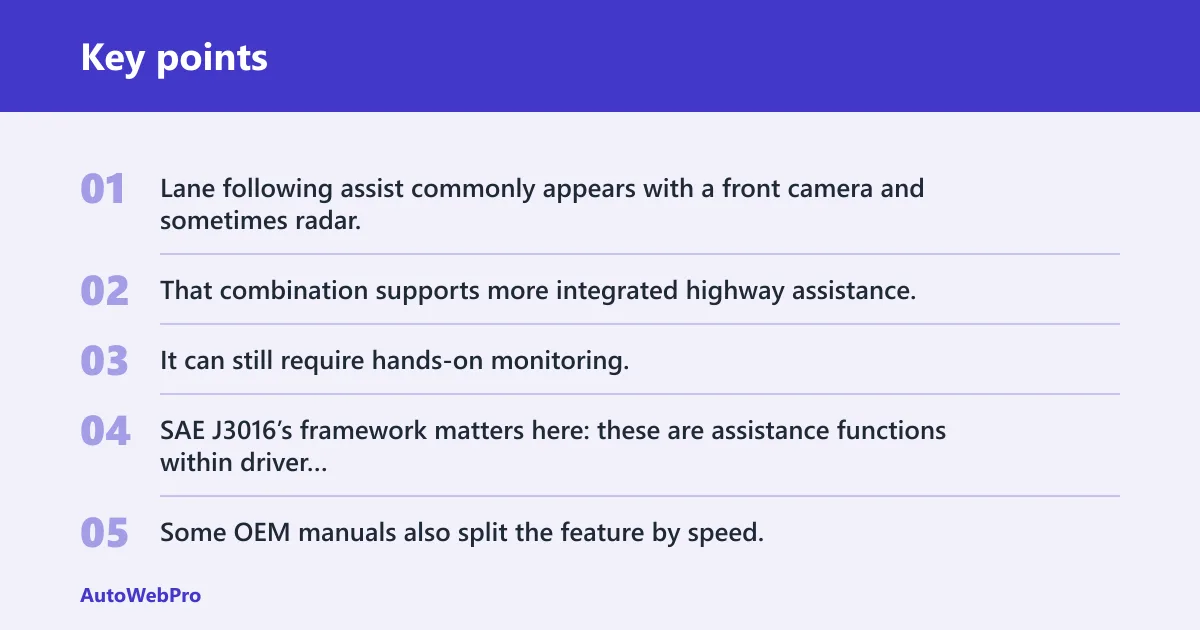
Lane following assist commonly appears with a front camera and sometimes radar, plus adaptive cruise control. That combination supports more integrated highway assistance. It can still require hands-on monitoring, because the system is not self-driving and may disengage if the road picture becomes unreliable. SAE J3016’s framework matters here: these are assistance functions within driver monitoring expectations, not a transition to full automation.
Some OEM manuals also split the feature by speed. On certain models, LFA or lane centering may engage only above a minimum speed; on others it may drop out below a set threshold, then resume later. That is why a feature can feel available on the freeway but absent in slow traffic or on local roads.
How adaptive cruise control fits into the package
Adaptive cruise control is often paired with lane centering, but it is not always required for lane keep assist. ACC manages speed and distance; lane centering manages lateral position. Together they can create a semi-automated highway feel, but the driver still has to supervise and keep hands ready.
That separation matters when shopping trims. Some models offer lane keeping assist as a standalone camera-based aid, while the more complete highway package adds ACC and centering in one bundle. If the package description is vague, the owner manual usually makes the difference clear, especially on pages describing lane departure warning, lane keeping assist, lane centering, and hands-on supervision.
How each system uses cameras and radar
Both features rely heavily on a front-facing camera that detects lane markings. That camera can read painted lines, lane reflectors, and road edges when conditions are good. When the lines fade, get covered, or disappear in snow, performance drops fast. NHTSA’s driver-assistance materials and OEM manuals consistently describe the camera as the core lane sensor, with radar used mainly to support gap and traffic functions in broader packages.
Front-facing camera lane detection
The camera is the core sensor for lane keep and lane centering systems. It scans for lane markings and compares the car’s path with the lane boundaries. If the camera cannot see enough contrast, the system has less to work with. That is why faded paint, glare, rain, and snow can have such an outsized effect on performance.
Where radar helps, and where it does not
Radar is sometimes used alongside cameras, especially in integrated driver-assist packages. It helps the car understand traffic and spacing better, which can support more advanced centering functions. Radar does not read paint lines by itself, so it generally cannot replace camera-based lane detection.
That is why weather and road surface matter so much. Snow, leaves, mud, worn paint, or glare can block the camera’s view even if radar still sees the car ahead. If the owner manual says the system depends on lane visibility, that is the practical boundary you should expect.
Where each system helps most
Lane following assist usually shines on highways, while lane keeping assist is fine for everyday roads where you mainly want drift correction. Neither system is a substitute for attention. Both work best on clearly marked roads, and both can lose confidence when the lane picture gets messy.
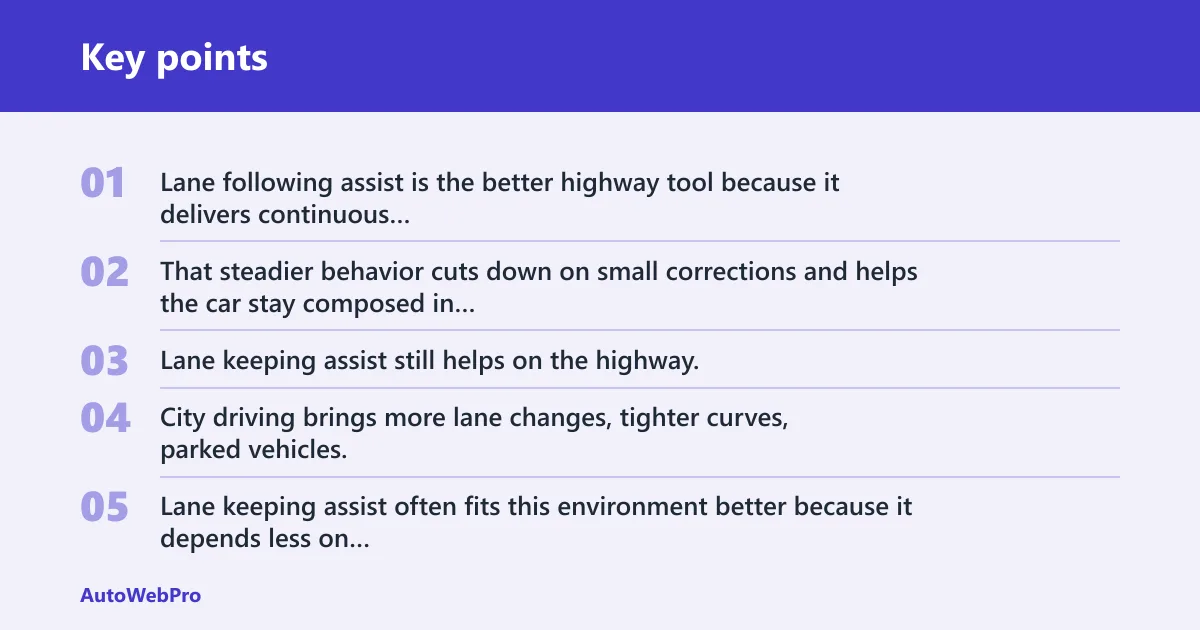
Highway driving
Lane following assist is the better highway tool because it delivers continuous centering support. That steadier behavior cuts down on small corrections and helps the car stay composed in long, marked lanes. Lane keeping assist still helps on the highway, but it feels more like a backstop than a guide.
City streets
City driving brings more lane changes, tighter curves, parked vehicles, and frequent cut-ins. Lane keeping assist often fits this environment better because it depends less on perfect lane continuity. Lane following assist can still work, but the system may feel busier and more likely to drop out in complex traffic.
Snow, faded lines, and covered markings
Snow and faded paint are commonly hard cases for both systems. If the front-facing camera cannot clearly detect the lane, either feature may disengage. Lane departure warning may also become less reliable, because it depends on the same lane picture.
Stop-and-go traffic
Stop-and-go traffic is where the rest of the stack matters. If lane following assist is paired with adaptive cruise control, it can reduce effort during slow highway congestion. Lane keeping assist alone does not manage speed, so it helps less in heavy traffic even if the lane lines are visible.
| Feature | City streets | Highways | Snow or faded lines | Stop-and-go traffic |
|---|---|---|---|---|
| Lane Departure Warning | Useful only when lane edges are clearly visible | Helpful as a fallback alert | Often reduced or unavailable | Limited benefit |
| Lane keeping assist | Useful for drift correction | Helpful, but limited | Often reduced or unavailable | Limited benefit without ACC |
| lane following assist | Works, but can feel overactive in tight traffic | Best fit | Can disengage when markings are poor | Best when paired with adaptive cruise control |
Why do automakers use different names?
Automakers use different names because the feature set is not identical from one model to the next. One brand may call a brief steering aid lane keeping assist, while another uses lane following assist or lane centering for a more active system. The wording changes even when the driver feel is similar.
What to check in the owner manual or spec sheet
Look for three clues: whether the car only warns, whether it nudges after drift, and whether it continuously centers the lane. Also check whether adaptive cruise control is required for the feature to work, and whether the system asks for hands-on steering wheel pressure.
If the brochure says “highway assist,” read the fine print. It may combine camera lane tracking, radar, and ACC into one package, while a lower trim only gets lane departure warning or basic lane keeping assist. OEM documentation is usually the best source for speed thresholds, driver monitoring language, and when the feature may disengage.
Choose Lane keeping assist if… / Choose lane following assist if…
Choose Lane keeping assist if you want a basic steering aid for mixed driving, smaller commutes, and roads where lane markings are decent but not perfect. Choose lane following assist if your routes are mostly highways, you want continuous centering support, or you are already shopping for a package that includes adaptive cruise control.
Choose Lane keeping assist if…
- You want a brief correction when the car drifts, not constant steering help.
- You drive a mix of city streets and secondary roads.
- You do not need ACC to make the feature useful.
- You want the simpler lane aid in a lower trim.
Choose lane following assist if…
- You spend a lot of time on highways with clear lane lines.
- You want the car to stay centered continuously, not just recover after drift.
- You are considering a package that includes adaptive cruise control.
- You value lower steering effort on long trips more than basic lane correction.
Frequently asked questions
What is the difference between lane keeping assist and lane following assist?
Lane keeping assist gives a short steering correction after drift, while lane following assist holds the car more continuously in the center of the lane. The first is a corrective aid. The second is a tracking aid, and it usually feels more active on well-marked highways.
Which system works better on highways?
Lane following assist usually works better on highways because it keeps the car centered continuously. That steady behavior fits long, marked lanes and pairs well with adaptive cruise control. Lane keeping assist still helps, but it is more of a correction backup than a highway centering tool.
Why do automakers use different names for lane assist?
Because the feature set changes across trims and brands. Some systems only warn, some nudge, and some center continuously with radar and adaptive cruise control. Automakers choose different names for similar behavior, so you should compare the actual functions rather than the label.
Can lane keeping assist work without adaptive cruise control?
Yes. Lane keeping assist does not always need adaptive cruise control. ACC is often paired with lane centering or lane following assist, but the simpler keep-assist function can operate on its own as long as the camera can see the lane lines clearly.
When does lane assist stop working on poor lane markings?
It may stop or disengage when markings fade, get covered by snow or leaves, or become hard to read in sharp curves. Camera occlusion can also interrupt the system. When that happens, the car may drop back to alert-only behavior or shut the assist off.
Is lane following assist safer than lane keeping assist?
It can reduce workload more effectively on highways, but “safer” depends on the road and the driver’s attention. Both systems require hands-on monitoring and neither makes the car self-driving. The safer choice is the one that matches your routes and keeps you alert, not the one with the fancier name.
Sources
- NHTSA: Automated Vehicles for Safety
- IIHS: Lane departure prevention
- SAE J3016: Taxonomy and Definitions for Terms Related to Driving Automation Systems
- Honda owner manual: Lane Keeping Assist System / Road Departure Mitigation
- Hyundai owner information: Lane Following Assist / Highway Driving Assist
- Kia owner manuals: Lane Keeping Assist / Lane Following Assist