Lane Keeping Assist vs Lane Departure Warning Explained?
Lane departure warning alerts you when the car drifts, lane keeping assist adds steering input to nudge you back, and lane centering continuously helps hold the car in the middle of the lane. Mixing them up can leave you expecting steering help that a system will not provide. This guide explains what each feature does at the wheel, how lane centering differs, and how to verify the system in your owner’s manual or dashboard settings. (Consumerreports)
How warning, assist, and centering differ
Lane departure warning is the alert-only step. Lane keeping assist adds steering support, so the car can resist a drift or guide itself back toward lane center. Lane centering goes further and keeps providing steering help as long as the required conditions stay met.
Warning only: what LDW does
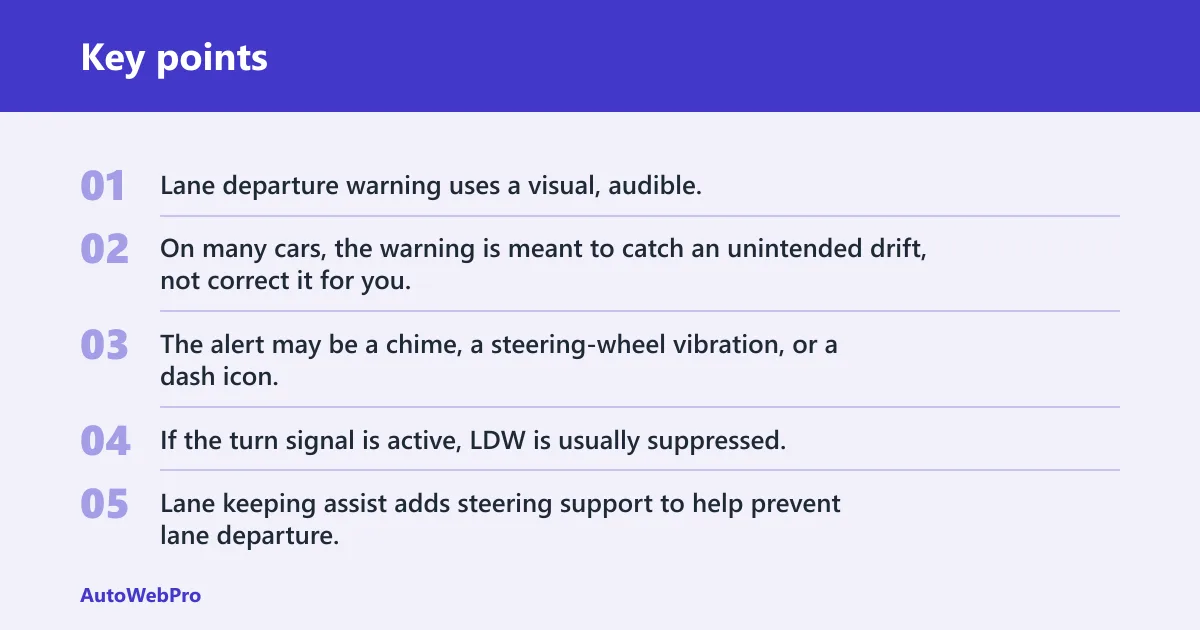
Lane departure warning uses a visual, audible, or tactile alert when the vehicle approaches or crosses lane markings. It does not steer the vehicle. On many cars, the warning is meant to catch an unintended drift, not correct it for you.
The alert may be a chime, a steering-wheel vibration, or a dash icon. If the turn signal is active, LDW is usually suppressed, because the car treats the move as intentional.
Steering support: what LKA adds
Lane keeping assist adds steering support to help prevent lane departure. In many vehicles, that support is a brief correction toward the lane interior when the car starts to drift. Some systems are linked with lane departure warning, so the warning and steering action happen in the same lane event.
Depending on the vehicle, lane keeping assist may also use selective braking. That is less common than steering input, but it is part of how some systems keep the car from crossing a line.
Where lane centering fits
Lane centering is the stronger steering feature in the group. It provides automatic steering to help keep the vehicle centered while the required conditions are met. That is different from lane keeping assist, which is usually a correction feature rather than a constant centering function.
Many drivers confuse the labels because brand names vary. The owner’s manual is the final source for whether your car has a warning, a correction feature, or a true centering function.
What your car actually does
The useful question is not the badge on the button. It is whether the car warns, nudges, or centers. Those are different driver experiences, and the dash icon often tells you which one is active.
Alert, nudge, or center
If the system only warns, you will feel or hear an alert and still need to steer back yourself. If it nudges, the wheel may move slightly or resist your drift. If it centers, the car keeps applying steering help across the lane, not just at the edge.
When braking enters the picture
Some lane keeping systems can correct with brief steering input, and some vehicles can add selective braking. That braking is part of the assist logic, not a sign that the car is stopping on its own. The driver still has to supervise the move.
Suppose your crossover gives a steering tug near the lane line, then a second later feels like it trims speed in a curve. That can still be lane assist behavior, but the manual should say whether your trim uses steering only or steering plus braking.
Why names vary by brand
Brands label these systems differently. One maker may use lane departure warning and lane keep assist. Another may fold centering into a highway package. A dash setting can also change the behavior, so the same car may feel different after a menu change.
Can lane departure warning steer the car?
No. Lane departure warning is usually alert-only. It gives a visual cue, sound, or vibration when the car drifts across a white line without indicating. The system is there to warn you, not to move the steering wheel for you.
Why LDW is usually alert-only
LDW is meant to tell you that the car is approaching or crossing lane markings. It can use sound, vibration, or a visual indication. That alert is the feature. Steering intervention is a lane keeping assist job, not an LDW job.
What the driver feels when it triggers
When LDW activates, the driver usually feels a chime, a vibration in the seat or wheel, or sees a lane icon change on the dash. If the turn signal is on, many systems stay quiet because the lane change looks intentional.
Why lane keeping assist can feel intrusive

Lane keeping assist can feel intrusive when it reacts to lane edges the driver did not mean to follow. It may push back during an intentional lane change without a signal, or it may read a rough road edge as a lane line. That can make the wheel feel like it is fighting you.
Intentional lane changes and turn signals
Turn-signal use usually tells the system that the move is deliberate. LDW does not intervene when the turn signal is active, and many lane assist systems reduce or stop intervention as well. If the signal is off, the car may treat the move as an unplanned drift.
A common mistake is drifting toward the shoulder on a curving highway without using the turn signal, then mistaking the brief steering correction for a malfunction. In that case, the assist is doing what it was programmed to do: it thinks the lane change is accidental.
Road edges, curves, and lane markings
Lane markings are not always the only thing a camera sees. Road-edge paint, worn striping, merge zones, and patched pavement can confuse the camera. Potholes and roadside shifts can also pull the car toward a line the driver never meant to follow.
Picture a two-lane road with faded white paint and a fresh roadwork taper. The system may keep searching for the original lane and then correct hard when it finds a line segment again. That can feel abrupt, especially if the road bends at the same time.
When the system pushes back
When lane keeping assist feels pushy, it is often because the camera thinks the vehicle is leaving the lane. The correction can be brief and mild, or it can be strong enough to notice in the steering wheel. That is still assist, not self-driving.
Lane assist comparison matrix
This comparison table separates the three behaviors most drivers are trying to identify. Use it to match what the car does with what the manual and dash icons say.
| Row | Lane departure warning | Lane keeping assist | Lane centering |
|---|---|---|---|
| Trigger | Approaches or crosses lane markings | Drift toward a lane edge | Lane position drifts off center while conditions stay met |
| Driver alert type | Visual, audible, or tactile warning | May warn, then add steering support | Usually a status icon plus steering activity |
| Steering intervention | No | Yes, often a brief steering correction | Yes, ongoing steering assistance |
| Braking intervention | No | Possible in some vehicles | May be paired with a larger driver-assist package, but the lane function itself is steering-based |
| Turn-signal behavior | Usually suppressed when the turn signal is active | Often reduced or stopped during an indicated lane change | Often reduced during a signaled lane change |
| Typical speed range | Some systems activate once the vehicle is traveling over 40mph | Some systems activate once the vehicle is traveling over 40mph | Often paired with higher-speed driving and adaptive cruise control |
| Common failure cases | Faded lines, glare, rain, fog, dirt, missing markings | Roadworks, potholes, road-edge shifts, cyclists, faded paint | Missing lines, glare, rain, fog, dirt, and lane construction patterns |
| What to check in the owner’s manual | Exact alert type, turn-signal suppression, and speed threshold | Whether it nudges, centers, or uses braking; how to adjust sensitivity | Whether it needs adaptive cruise control, and which conditions must stay active |
How cameras and road conditions affect both systems
All three lane features use forward-facing cameras. That camera reads lane lines around the vehicle and decides when to warn, nudge, or center. If the camera cannot see clean markings, the system may become less helpful or switch off.
Forward-facing camera limits
The camera needs clear contrast and a readable lane pattern. Glare can wash out paint. Dirt can block the lens. Fog and rain can soften the lane lines. Faded markings can leave the system unsure where the lane actually is.
Rain, fog, glare, dirt, and faded paint
Lane assistance can be reduced by faded or missing lines, roadworks, glare, rain, or fog. That does not always mean the car is faulty. It often means the camera has less to read, so the logic becomes cautious or unavailable.
Missing lines and roadwork
Roadwork can create temporary lane patterns, cones, and short paint runs that confuse lane logic. Missing markings are worse. If the camera cannot see both sides of the lane, the feature may drop out or give a warning that it is unavailable.
Is lane centering the same as lane keeping assist?
No. Lane centering is a continuous steering function that keeps helping hold the car in the middle of the lane. Lane keeping assist is usually a correction feature that reacts when the vehicle starts to drift. The two can live in the same package, but they do not behave the same.
Continuous centering vs brief correction
Lane keeping assist may give a brief steering correction toward the lane interior. Lane centering keeps applying steering assistance while required conditions are met. That is why centering feels steadier on a highway and lane keeping feels more like a guardrail against drift.
Why adaptive cruise control often appears with centering
Lane centering is often paired with adaptive cruise control or a highway assist package. The cruise system handles speed and spacing, while the steering aid keeps the car centered. That pairing is common, but the manual should spell it out for your exact trim.
Driver supervision still matters
Lane centering does not make the car self-driving. Keep your hands on the wheel and your eyes on the road. The driver remains responsible for lane changes, curves, construction zones, and traffic. The system is there to assist, not replace attention.
What to check in the owner’s manual
The owner’s manual settles the naming differences. It also explains the exact conditions, icons, and menu items for your vehicle. If a feature seems weak or unavailable, the manual and settings menu should come before any conclusion that the system is broken.
- Find the feature name used for your trim and market.
- Check whether the system is warning-only, steering support, or centering.
- Look for the speed threshold and any camera or road-condition limits.
- Confirm whether turn-signal use reduces or stops intervention.
- Review the dash icons for active, standby, and unavailable states.
- Open the settings menu for sensitivity, lane-assist strength, or steering feel options.
Feature names in your trim
One brand may say LDW. Another may say LKA, LKAS, lane centering, highway assist, or lane trace. Those names are not interchangeable across brands. The manual should tell you whether the button controls warning, steering support, or both.
Dash icons and availability messages
Watch the cluster for the active and unavailable states. A green icon may mean the system is ready or active, while a gray or crossed-out symbol can mean the camera cannot read the road. That status message is often more useful than the badge on the switch.
Settings, sensitivity, and turn-signal behavior
Many cars let you change lane-assist sensitivity or steering strength. Some also let you adjust warning timing. If the system feels too eager, a settings change may solve it without turning the feature off entirely.
Frequently asked questions
What is the difference between lane keeping assist and lane departure warning?
Lane departure warning alerts you when the car approaches or crosses a lane line. Lane keeping assist goes a step further and adds steering support to help keep the vehicle in lane. The first warns. The second can intervene with the wheel.
Does lane departure warning steer the car?
No. Lane departure warning is alert-only. It can use a visual, audible, or tactile warning when the vehicle approaches or crosses lane markings, but it does not steer. If you feel steering input, that is lane keeping assist or a related centering feature.
Does lane keeping assist only work when I drift out of the lane?
Usually, yes in practical terms. Lane keeping assist is designed to react when the vehicle starts drifting toward a lane edge. Some systems also respond to light wandering or lane position changes, so the intervention can begin before a full departure happens.
How do lane keeping assist and lane departure warning work together?
Many cars link them. LDW gives the warning, and LKA adds steering support when the drift continues. That pairing lets the driver hear or feel the lane event first, then get a steering correction if the car keeps moving toward the line.
Will lane keeping assist turn off if I use my turn signal?
Often it reduces or stops intervention during an intentional lane change. LDW does not intervene when the turn signal is active, and many lane assist systems treat the signal as a sign that the move is deliberate. The exact behavior still depends on the manual.
Why does lane keeping assist feel like it is fighting me?
It often feels that way when the system thinks the car is leaving the lane. Unsignaled lane changes, faded markings, road-edge shifts, potholes, cyclists near the lane, or roadwork patterns can all trigger corrections. The wheel tug is usually the camera reacting to what it sees.
What conditions make lane keeping assist unavailable?
Faded or missing lines, roadworks, glare, rain, fog, and dirt can reduce lane assistance or make it unavailable. A blocked or dirty forward-facing camera can do the same. The dash often shows a standby or unavailable message when the system cannot read the road.
Can lane keeping assist correct the car by braking?
Yes, on some vehicles. Lane keeping assist usually works through steering correction, but some systems can also use selective braking. That braking is part of the lane-assist response, and it still depends on the driver staying alert and supervising the car.
Do lane assist systems work without visible lane markings?
Not well, and often not at all. These systems rely on a forward-facing camera that reads lane lines. If the markings are faded, missing, covered by rain, or hidden by roadworks, the system may reduce intervention or turn unavailable until it can read the lane again.