How Do Plug-In Hybrids Work?
A plug-in hybrid runs on battery power first, then brings in the gas engine when charge drops, demand rises, or speed and temperature make electric-only driving less efficient. If you ignore that behavior, you can misread fuel use, charging needs, and the vehicle’s real value. This guide explains electric drive, hybrid mode, charging, and engine takeover in plain English.
What a plug-in hybrid
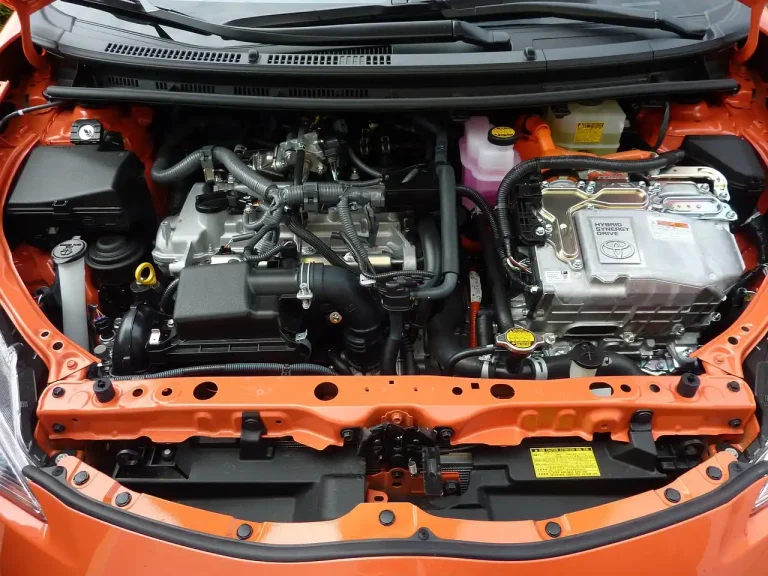
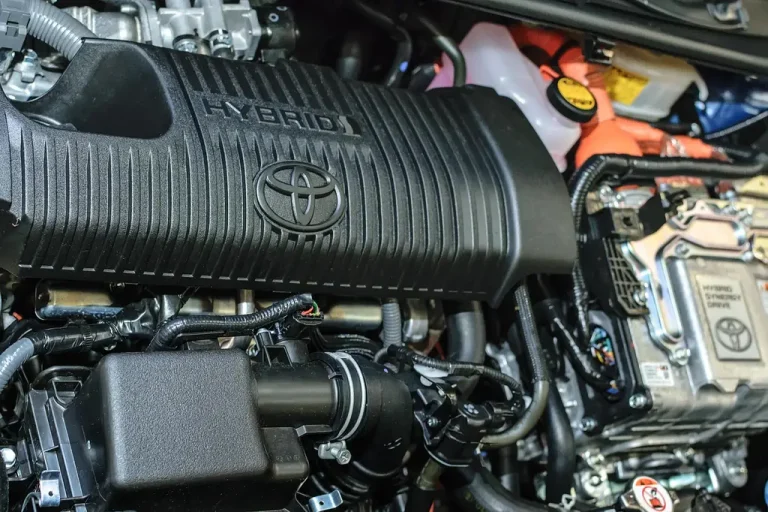
A plug-in hybrid electric vehicle, or PHEV, combines a gasoline or diesel engine, an electric motor, and a large rechargeable battery. You can plug it in to recharge from outside power, and it can also recover energy while slowing down. That gives you short-range electric driving with gas backup for longer trips.
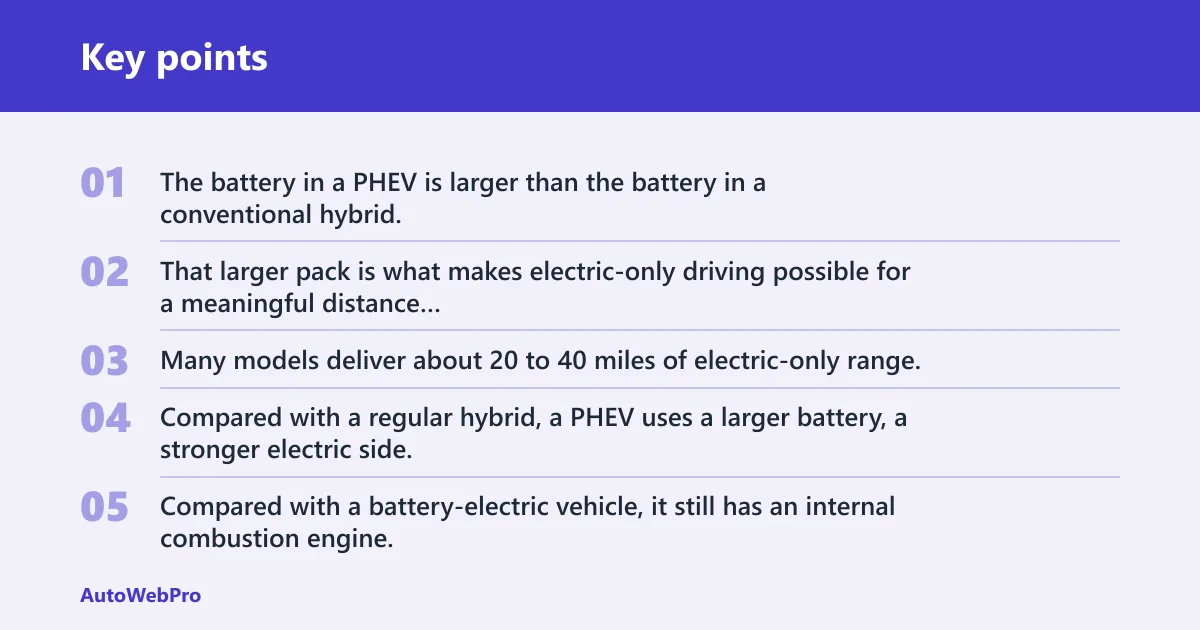
The battery in a PHEV is larger than the battery in a conventional hybrid. That larger pack is what makes electric-only driving possible for a meaningful distance before the engine takes over. Many models deliver about 20 to 40 miles of electric-only range, although the exact number depends on the vehicle and conditions.
Compared with a regular hybrid, a PHEV uses a larger battery, a stronger electric side, and a charge port for home or public charging equipment. Compared with a battery-electric vehicle, it still has an internal combustion engine, so it can keep going after the battery is depleted. That fallback is the whole point of the power-management system.
Gas engine, electric motor, and traction battery
The electric traction motor is the part that moves the wheels on battery power. It can also assist the engine during acceleration, which helps the car feel smoother and quieter than gas-only driving. The internal combustion engine, or ICE, provides propulsion when battery charge runs low or when the control system decides more total output is needed.
The traction battery pack stores electricity for electric driving. It can be charged from a wall outlet, charging equipment, the engine, or regenerative braking. In other words, the battery is not just a storage box. It is the central buffer that decides how much driving comes from electricity and how much comes from fuel.
Why a PHEV is different from a regular hybrid
A regular hybrid charges mainly through the engine and regenerative braking. A PHEV can do that too, but it can also be plugged in, which gives it a much bigger electric window before the engine needs to help. That usually means more short trips can be done without using fuel.
That does not mean the engine stays off until the battery is empty. Some PHEVs start the engine with charge left if the driver asks for hard acceleration, climbs a steep grade, drives at higher speed, or demands cabin heat in cold weather. The control system is always balancing battery state, power demand, and efficiency.
How does a plug-in hybrid drive?
A plug-in hybrid usually starts in electric mode if the battery has enough charge and conditions allow it. At low and moderate speeds, the electric traction motor often moves the wheels by itself. When charge falls, speed rises, or the driver demands more power, the vehicle shifts into hybrid mode and blends the engine with the motor.
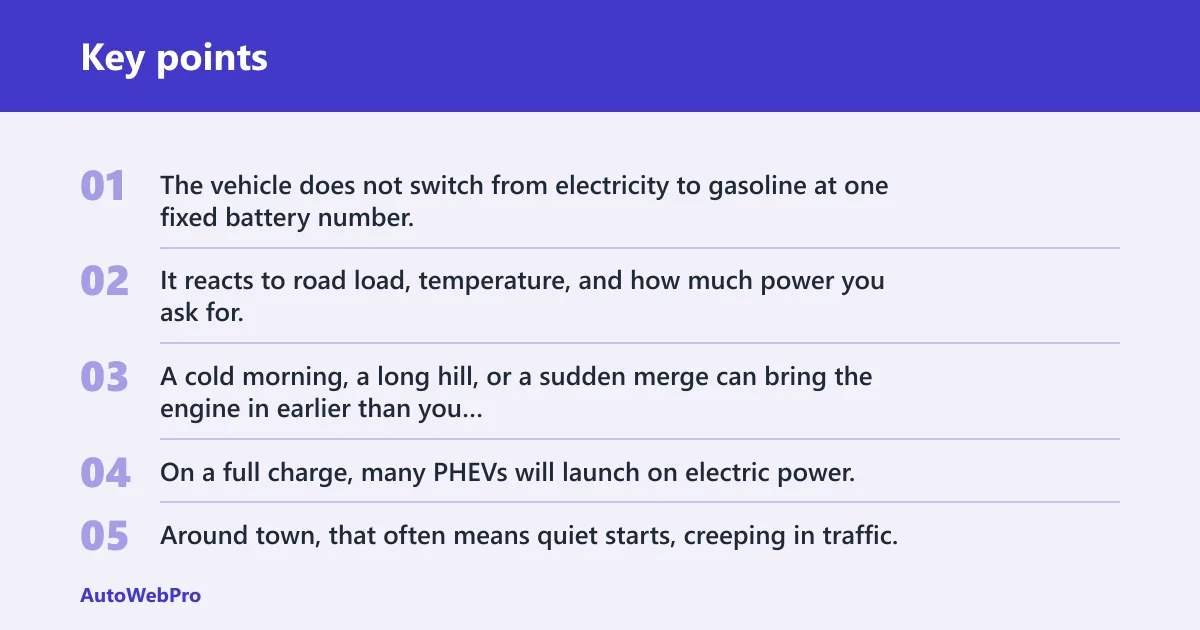
That sequence matters. The vehicle does not switch from electricity to gasoline at one fixed battery number. It reacts to road load, temperature, and how much power you ask for. A cold morning, a long hill, or a sudden merge can bring the engine in earlier than you expect.
Electric-only launch and low-speed driving
On a full charge, many PHEVs will launch on electric power. Around town, that often means quiet starts, creeping in traffic, and short errands with no fuel use at all. Consumer Reports says PHEVs usually add electric-only range between 20 and 40 miles, and AFDC says the vehicle typically runs on electric power until the battery is nearly depleted.
That range can be enough for many daily commutes. It is still a limited range, not an unlimited one. Speed, temperature, hills, heating and cooling loads, and aggressive acceleration all shorten it.
When the engine starts
The engine can start for several reasons before the battery is empty. High speed is one. Strong acceleration is another. Cold weather can do it too, because battery output and cabin heating both place extra demands on the system. Some PHEVs also start the engine to protect drivability or maintain battery reserve.
Picture a 30-mile commute with a steep freeway on-ramp near the end. Even if the battery still shows charge, the car may bring in the engine during the merge because the power request is high. That is normal. The control system is choosing the source that can meet the moment best.
How hybrid mode shares the load
In hybrid mode, the engine and motor work together. The engine may provide the main propulsion, while the motor fills in during acceleration, smooths shifts, or helps at lower speeds. That sharing extends total range and keeps the car usable long after the electric-only portion is spent.
If you never plug in a PHEV, it can still operate as a hybrid. You lose much of the electric-only benefit, but the car remains drivable because the engine and regenerative braking still support motion and battery recovery.
How do plug-in hybrids charge at home?
PHEVs charge through a charge port connected to external power. Inside the car, an onboard charger converts AC power to DC so the traction battery can store it. For most owners, home charging is the simplest way to keep the battery ready.
A regular 120V outlet is usually enough for plug-in hybrids. The same source says a PHEV can charge overnight from a standard household outlet, and it tested PHEVs at an average 14 hours to charge at a 120V outlet. A Level 2 charger uses 240V equipment and can top up the battery in just a few hours. (Consumerreports)
Charge port and onboard charger
The charge port is the plug-in connection point. It does not feed the battery directly in the same form that comes from the wall. The onboard charger does the conversion from AC to DC. That is why charging speed depends on both the outlet or charger and the vehicle’s own hardware.
Level 1 charging from a 120V outlet
Level 1 charging uses a standard 120V household outlet. For many PHEVs, that is enough if the car sits parked overnight. It is slower than Level 2 charging, but it can still restore a daily commute’s worth of electricity for many owners.
Level 2 charging from 240V equipment
Level 2 charging uses 240V equipment and usually cuts charge time sharply. The same source says a Level 2 charger can top up the battery in just a few hours. You do not always need it for home ownership, but it is useful if you want quicker turnarounds or have longer daily driving.
Most PHEVs do not work with public DC fast chargers in the same way many EVs do. That is an important difference. A PHEV is built around slower AC charging, not rapid top-offs at high-power public chargers.
How plug-in hybrids work checklist
This checklist shows what is moving the wheels in four common situations. It keeps the power flow plain: electricity first, hybrid support when needed, and engine takeover as charge falls or demand rises.
| Scenario | What powers the wheels | What triggers engine start | What you should feel |
|---|---|---|---|
| Home departure with full battery | Electric traction motor alone | Heavy throttle, steep grade, or cold start load | Quiet pull-away and smooth low-speed driving |
| City commute | Mainly battery power, with the motor doing most of the work | Battery state drops, stop-and-go load changes, or cabin heat demand | Frequent electric driving, with a possible engine start in traffic |
| Highway merge | Motor and engine together in hybrid mode | Fast acceleration or sustained high speed | Stronger response and a more noticeable engine note |
| Empty battery | Engine carries most propulsion, motor still assists | Battery nearly depleted and system enters hybrid mode | Feels more like a regular hybrid, with less electric-only running |
- Plug in at home when the car is parked for several hours.
- Drive on electricity first while the battery has enough charge.
- Expect the engine to start sooner under high speed, hard acceleration, hills, or cold weather.
- Let regenerative braking recover energy whenever you slow down.
- Accept that once the battery is low, the vehicle behaves more like a hybrid.
How does regenerative braking work?
Regenerative braking turns slowing into battery charging. When you lift off the accelerator or press the brake, the motor can act like a generator. That recovered energy goes back into the traction battery instead of being wasted as heat in the brakes.
This helps stretch electric range and can reduce fuel use in stop-and-go driving. It does not make the car self-charging in any complete sense, but it does reclaim energy that would otherwise disappear during deceleration.
What happens when you slow down
During deceleration, the motor resists wheel motion and captures energy. The control system blends regen with the friction brakes as needed. In gentle slowing, regen can do a larger share. In harder stops, the friction brakes handle more of the work.
How recovered energy returns to the battery
AFDC says PHEV batteries can be charged by regenerative braking. That matters in city driving, where repeated slowing gives the vehicle many small chances to recover energy. Those little gains can add up over a day of short trips.
Why regen helps stretch range
Regeneration lowers wasted braking energy, which helps preserve the battery charge you already have. That can delay engine start and improve the usefulness of the electric-only portion. It is one reason PHEVs often perform best in stop-and-go driving rather than long, steady highway runs.
What happens when the battery runs out?
When the battery runs low, a PHEV shifts into hybrid mode and the engine takes a larger role. The car does not stop being useful. It simply stops behaving like an electric-first vehicle and starts behaving more like a regular hybrid with a smaller electric assist.
The same source says the vehicle typically runs on electric power until the battery is nearly depleted. After that point, the engine supplies most of the propulsion, while the motor may still help during acceleration and low-speed movement. The battery is not gone. It is just operating in a narrower support role.
How the car behaves in hybrid mode
In hybrid mode, you may notice more engine sound, less electric glide, and shorter periods of electric-only operation. That is normal. The system is preserving drivability and range by using fuel when battery power is no longer the best option.
Why the engine may start before zero
The battery meter is not a promise that the engine will stay off until the last bar disappears. Some PHEVs hold a reserve, and others start the engine under load even with charge remaining. Cold weather, cabin heat, and steep climbs can all change the point at which that happens.
What you feel behind the wheel
A common first-timer mistake is expecting every mile of the battery gauge to feel identical. Suppose the battery shows half full on a winter morning, but the cabin heater is running hard. The engine may start much sooner than it would on a mild day, and the shift in sound is the first sign that the system has changed strategy.
How do plug-in hybrids work versus regular hybrids?
A plug-in hybrid and a regular hybrid both blend an engine with electric drive, but the PHEV has a much larger battery and an external charging port. That gives it a real electric-only driving window. A regular hybrid depends mainly on the engine, regenerative braking, and a smaller battery.
The practical difference is simple. If your driving is mostly short trips and you can plug in, a PHEV can spend a lot of time in electric mode. If you never charge it, it still works, but you lose most of what makes it a plug-in hybrid in the first place.
How does a plug-in hybrid work in the UK?
The operating logic is the same in the UK as elsewhere: plug in, charge the battery, drive on electricity first, then let the engine join in when demand or battery state requires it. What changes is mainly the charging setup at home and the model lineup sold in that market.
For UK shoppers, the key questions are still the same: how far the car goes on electricity, whether home charging is practical, and whether your daily driving fits the electric-only range. The vehicle still uses the same basic power-management approach.
Frequently asked questions
How do plug-in hybrids work?
A plug-in hybrid uses a battery and electric motor first, then brings in the engine when charge drops, speed rises, or demand gets higher. It can be plugged in at a wall outlet or Level 2 equipment, and regenerative braking helps refill the battery during slowing.
Do you plug in a hybrid?
You plug in a plug-in hybrid, yes. That is what separates it from a regular hybrid. You can charge it from a standard 120V outlet or faster 240V equipment, though many owners rely on overnight charging at home because the battery is usually smaller than an EV’s.
What happens when a plug-in hybrid battery runs out?
When the battery gets low, the car shifts into hybrid mode. The engine takes a larger role, and the motor still helps when needed. The vehicle keeps moving normally, but it behaves more like a regular hybrid and less like an electric-first car.
How long does a plug-in hybrid take to charge?
Charge time depends on the outlet and the car. The same source says a PHEV can charge overnight from a standard household outlet and found an average 14 hours at a 120V outlet. A Level 2 charger can top up the battery in just a few hours.
Can a plug-in hybrid use gas and electricity at the same time?
Yes. In hybrid mode, the engine and motor can work together. That can happen during hard acceleration, highway merging, hill climbs, or when the battery is low. The system blends both sources to meet power demand and keep the car moving efficiently.
What is the difference between a plug-in hybrid and an EV?
An EV runs only on electricity and needs charging to keep moving. A plug-in hybrid can do the same for a limited range, but it also has a gasoline or diesel engine for backup. That makes a PHEV less dependent on charging, but also less electric than a full EV.