Level 1 vs Level 2 Charging: What’s the Real Difference?
Level 1 charging adds about 3–5 miles of range per hour from a 120V outlet; level 2 adds about 12–60 miles per hour from 208–240V power. EPA and DOE consumer guidance, plus automaker charging examples, place those figures in the right range. The best choice depends on overnight time, daily miles, and home electrical capacity. Pick the wrong setup and you may wake up short on range, lean on public DC fast charging, or find that your panel needs work before the upgrade fits.
| Decision factor | Level 1 | level 2 | Winner |
|---|---|---|---|
| Power source | Standard 120V outlet | 208–240V AC supply | level 2 |
| Typical charging speed | About 3–5 miles of range per hour | About 12–60 miles of range per hour | level 2 |
| Install burden | Usually no professional installation | Dedicated circuit and professional installation | Level 1 |
| Best fit | Low-mileage drivers and many PHEVs | Daily home charging for full EVs | Depends on use case |
| Equipment and install cost | Lower equipment cost | Higher equipment and installation cost | Level 1 |
| Home electrical flexibility | Works with an existing outlet | May need panel-capacity checks and circuit sizing | Level 1 |
How charging speed changes your routine
The real difference is speed and how that changes your routine. Level 1 is the low-cost, low-commitment option that fits a light driving pattern. level 2 buys back time and convenience when your daily miles outgrow what an overnight 120V charge can replace. DOE and automaker charging guides consistently frame the trade-off this way.
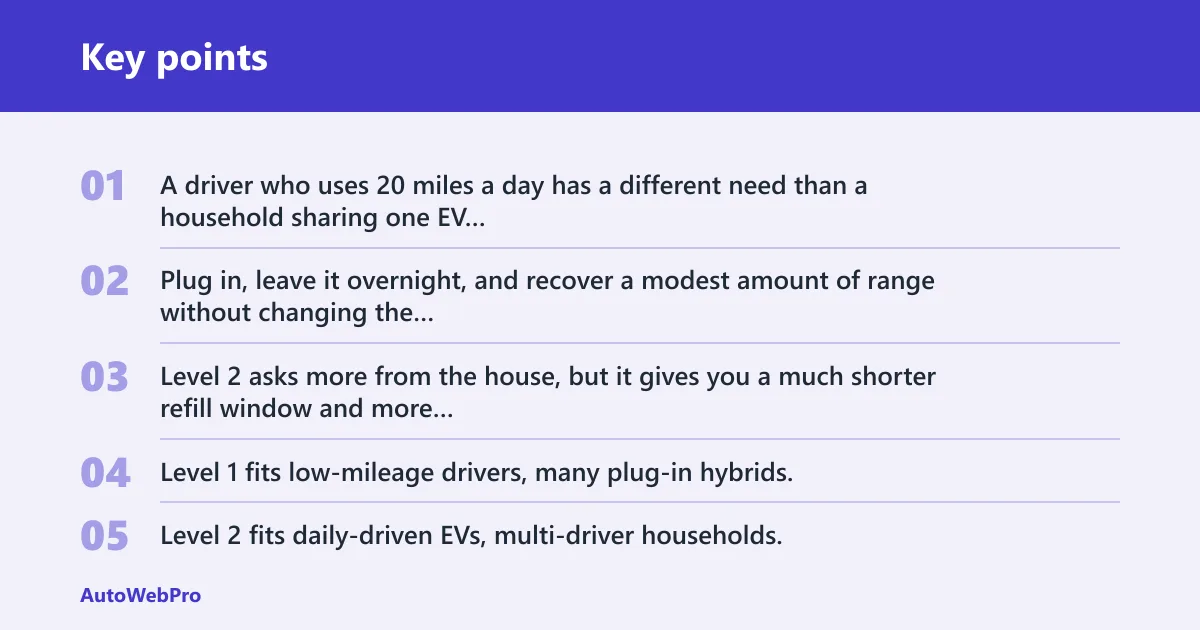
That matters more than paper specs. A driver who uses 20 miles a day has a different need than a household sharing one EV across two schedules, or a commuter refilling a larger battery after a long winter drive.
What changes in home use
Level 1 is simple. Plug in, leave it overnight, and recover a modest amount of range without changing the electrical setup in most homes. Level 2 asks more from the house, but it gives you a much shorter refill window and more reliable overnight recovery for higher-mileage drivers.
Where each level fits
Level 1 fits low-mileage drivers, many plug-in hybrids, and people who can leave the vehicle plugged in for long stretches. Level 2 fits daily-driven EVs, multi-driver households, and any routine where the car must recover a large share of its range every night.
How fast does each charging level add range?
Level 1 typically adds about 3–5 miles of range per hour, while level 2 typically adds about 12–60 miles per hour. DOE consumer pages and automaker examples show the spread: charging time changes with vehicle efficiency, charger output, battery size, state of charge, and cold weather.
Why battery size changes the answer
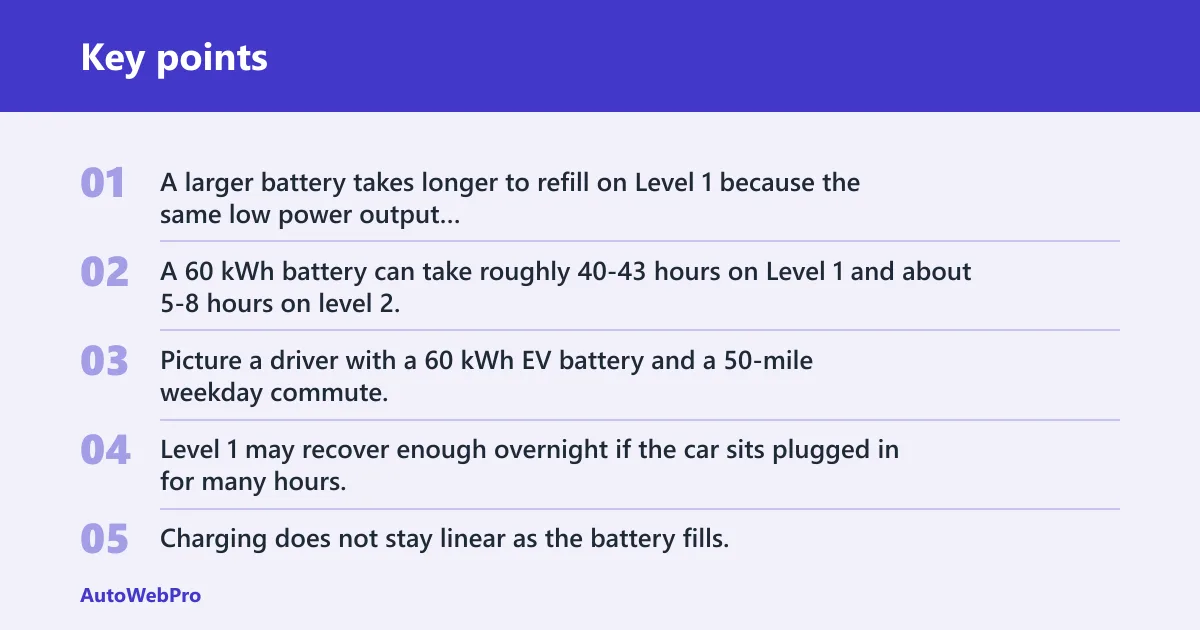
A larger battery takes longer to refill on Level 1 because the same low power output must cover more stored energy. A 60 kWh battery can take roughly 40-43 hours on Level 1 and about 5-8 hours on level 2, depending on efficiency and charger output, which is why battery size matters as much as charging level.
Picture a driver with a 60 kWh EV battery and a 50-mile weekday commute. Level 1 may recover enough overnight if the car sits plugged in for many hours, but level 2 leaves more margin for errands, detours, and a late return home.
Why the last 20 percent takes longer
Charging does not stay linear as the battery fills. The last 20 percent usually charges slower, so a car that looks fine from 20 to 80 percent may spend much longer pushing from 80 to 100 percent, especially on a lower-power setup.
That is why “full overnight” can mean different things in practice. A driver who only needs 60 to 80 percent each morning may be satisfied with level 1, while a driver who wants a near-full battery every day may find level 2 much easier to live with.
What outlet and circuit does each need?
Level 1 uses a standard 120V outlet. Level 2 uses a dedicated 208V or 240V circuit, and NEC-based continuous-load sizing matters because the branch circuit, breaker, and EV supply equipment all have to be sized for sustained use rather than short bursts. The common rule is to size continuous loads at no more than 80% of breaker rating.
When a professional install matters
Level 2 usually needs an electrician because the job can involve a new circuit, load calculation, and possible panel-capacity checks. If the panel is already near its limit, the upgrade may require an adjustment before the charger can be added safely.
Common first-timer mistake: assuming any 240V outlet is enough. A clothes-dryer receptacle is not the same thing as a properly planned EV charging circuit, and the circuit rating must match the charger and the vehicle’s charging draw.
What outlet type is involved
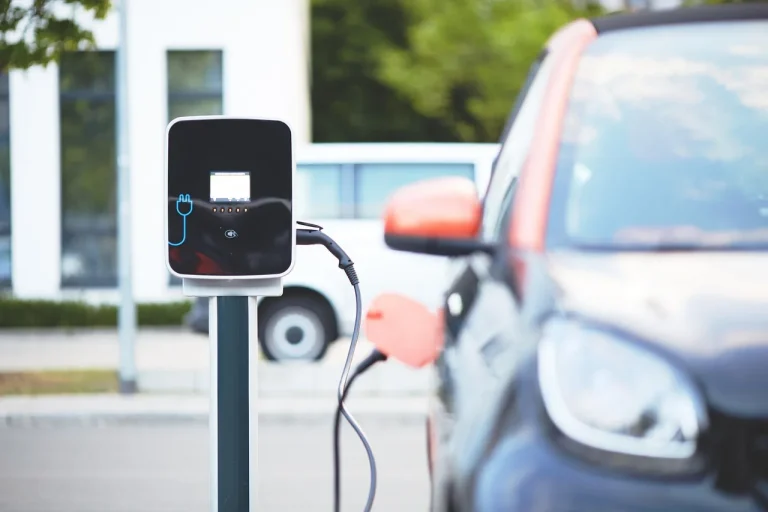
For many non-Tesla EVs, the connector on the charging cord is J1772 for Level 1 and Level 2 at home. That is a connector standard, not a charging level. The level comes from the power supply; the connector just has to match the vehicle and charger.
Charging levels decision matrix
This matrix turns the choice into routine, not theory. Start with your daily miles, overnight hours, and whether your home can support a 240V circuit without a major electrical project. The estimated overnight recovery ranges below are intentionally practical, not perfect: they show what many drivers can expect when the vehicle sits plugged in for a full night.
| Scenario | Recommended level | Expected overnight recovery | Red flags |
|---|---|---|---|
| PHEV | Level 1 | Usually enough to refill a typical plug-in hybrid overnight; roughly 30% to 100% of a small PHEV battery, depending on model | Long daily drives or frequent back-to-back trips |
| Under-30-mile commute | Level 1 | Often recovers the day’s use with margin left over; roughly 25% to 60% of a mainstream EV battery overnight | Very cold weather, extra errands, or limited plug-in hours |
| 40-70-mile commute | level 2 | Can recover a large share of the battery in one night; roughly 35% to 90% for many EVs, depending on battery size and charger output | Shared outlet use, short overnight window, or a large battery |
| Multi-driver household | level 2 | Better odds of refilling between overlapping schedules; often 40% to 100% for one car if the charging window is long enough | Only one charger, two EVs, or a car that returns late |
| Winter range loss | level 2 | Gives more recovery room when efficiency drops; often the difference between an incomplete refill and a comfortable overnight reset | Heating load, snow tires, and longer charging sessions |
| New home install | Level 1 if the panel is tight; level 2 if capacity is available | Level 1 works immediately; level 2 depends on circuit planning | Limited panel space, planned future EVs, or long daily drives |
Why the matrix points this way
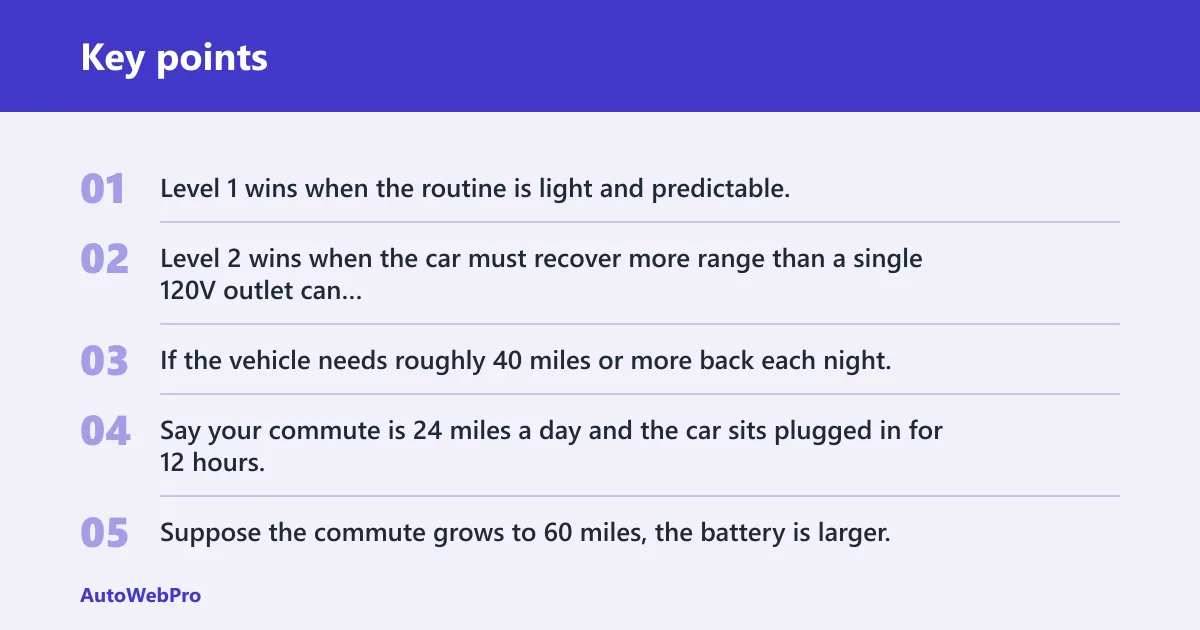
Level 1 wins when the routine is light and predictable. Level 2 wins when the car must recover more range than a single 120V outlet can comfortably supply in the time available. If the vehicle needs roughly 40 miles or more back each night, Level 1 starts to lose margin quickly.
Say your commute is 24 miles a day and the car sits plugged in for 12 hours. Level 1 may be enough. Suppose the commute grows to 60 miles, the battery is larger, and winter temperatures reduce efficiency; level 2 becomes the safer fit.
Level 1 will likely fail here
If you routinely need to replace more than about 5 miles of range per hour of plug-in time, or you need roughly 50 miles back in under eight to ten hours most nights, Level 1 will likely fail to keep up.
Choose Level 1 if… / Choose level 2 if…
Choose Level 1 if your daily driving stays under 50 miles, your car is a plug-in hybrid, or you can plug in for a long overnight stretch and do not want electrical work at home. Choose level 2 if you drive 50 miles or more most days, share the vehicle, or need a larger battery ready on a tighter schedule.
Choose Level 1 if…
- You drive less than 50 miles per day.
- You own a plug-in hybrid and can rely on the gas engine when needed.
- You already have a good place to plug in and do not want a dedicated circuit yet.
- Your charging window is long enough to let a slower refill finish overnight.
Choose level 2 if…
- You use the EV as a primary daily driver.
- Your commute often runs above 50 miles.
- You live in a cold climate where winter losses stretch charging time.
- You want more flexibility for multiple drivers, errands, and a larger battery.
Can one charger work across both standards?
Yes, some portable chargers are dual-voltage and can work on Level 1 or level 2 if the right power source is available. That does not mean every adapter solves every problem, and it does not turn DC fast charging into a home solution.
Where adapters help and where they do not
J1772 is the common North American connector for many non-Tesla EVs on Level 1 and Level 2. NACS is Tesla’s connector and is now being adopted more broadly by other automakers through native support and approved adapters. Connector type is separate from charging level; the level is set by the power supply and the onboard charging hardware.
Adapters help with plug compatibility. They do not change the fact that a charger still needs the correct power supply, and they do not make level 3 charging practical for home installation.
Level 1 vs level 2 vs level 3 charging
Level 3 is DC fast charging for road trips and quick top-ups. It belongs in public infrastructure, not a normal garage setup. If your only goal is home charging, the useful choice is usually between Level 1 and level 2.
Level 1 is the cheaper, simpler option and often works well for PHEVs and low-mileage drivers. level 2 costs more up front, but it is the better daily answer when you need more overnight recovery, have a bigger battery, or do not want charging time to shape your schedule.
Frequently asked questions
What is the real difference between Level 1 and Level 2 charging?
The real difference is power delivery and how that changes daily use. Level 1 uses a 120V outlet and is slower but simpler.
How fast is Level 1 charging compared with Level 2?
Level 1 typically adds about 3–5 miles of range per hour, while level 2 typically adds about 12–60 miles per hour. The exact result depends on the vehicle, battery size, temperature, and how full the battery already is when you start.
Can I use Level 1 charging at home every day?
Yes, if your daily driving is light and you can leave the vehicle plugged in long enough. Level 1 is often fine for low-mileage drivers and many plug-in hybrids, but it can become short on margin when commutes grow longer or winter reduces efficiency.
Do I need a dedicated circuit for Level 2 charging?
Yes. Level 2 requires a dedicated circuit, and the circuit must be sized for continuous load. That is why panel capacity matters, especially in older homes or in houses that already run several large appliances from the same electrical service.
Which charging level is best for a plug-in hybrid?
Level 1 is often enough for a plug-in hybrid because the battery is usually smaller and the daily electric range is shorter. If the PHEV is driven hard every day or only gets a short parking window, level 2 may still be worth it.
Is Level 2 worth the installation cost?
It is worth it when your routine needs the extra speed. If you drive a full EV every day, have a long commute, or need more flexibility for a shared household, the higher equipment and installation cost can buy far less charging hassle than Level 1 can provide.
Sources: EPA consumer charging guidance, DOE FuelEconomy.gov charging pages, automaker owner manuals and charging guides, NEC Article 625 and the 80% continuous-load rule, SAE J1772 connector standard, and SAE J3400/NACS connector standard.