What Is Level 3 Charging and When Should You Use It?
Level 3 charging is DC fast charging, typically around 50 kW or higher. Use it when saving 30 minutes or more matters more than paying extra and charging only to about 80%. Using it too often, or pushing the battery too close to full, can cost more, slow down near full, and add avoidable battery wear. This guide explains what Level 3 means, when it makes sense, and when Level 1 or Level 2 is the better choice.
How DC fast charging works and compares
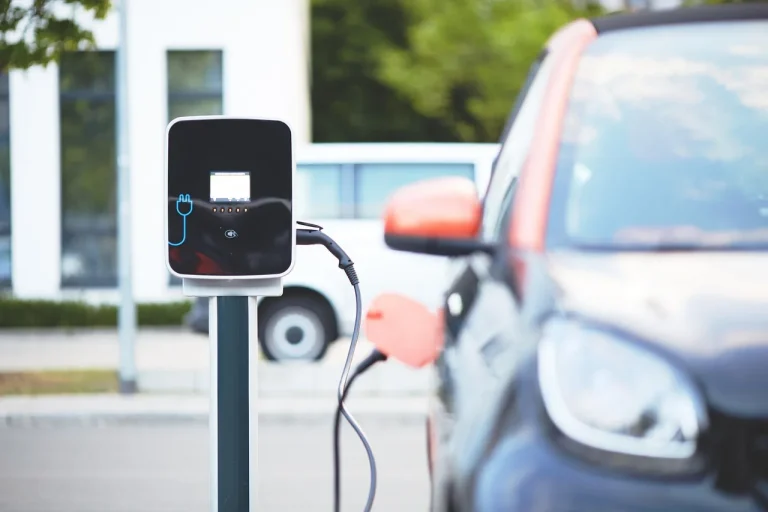
Level 3 charging is the fastest common EV charging option. It is also called DC fast charging, and it delivers DC power directly to the battery at public charging stations and highway stops. That direct-feed setup is why it can recharge some EV batteries in minutes, and why it fits long trips better than everyday charging.
How it fits with the other levels
Level 1 uses a 120V household outlet and adds limited range per hour. Level 2 uses 208-240V AC and is commonly used as the everyday benchmark for home and regular public charging. Level 3 sits above both: it is built for speed, not for overnight convenience or low-cost daily fills.
Level 3 matters because it saves time. Engadget says these chargers typically deliver anywhere from 50kW to 500kW, and MotorTrend says DC fast chargers can add roughly 3 to 20 miles of range per minute. In practical terms, some EVs can go from 20-80% in under an hour, and some can do it much faster. (Motortrend)
Level 3 charging vs level 2
Level 2 charging sends AC power through the vehicle’s onboard charger, while Level 3 bypasses that onboard charger and sends DC straight to the battery. That difference changes everything: speed, station type, hardware cost, and where each one fits in daily driving. Level 2 is the normal home and workplace choice; Level 3 is the quick-stop choice.
Onboard charger versus direct DC
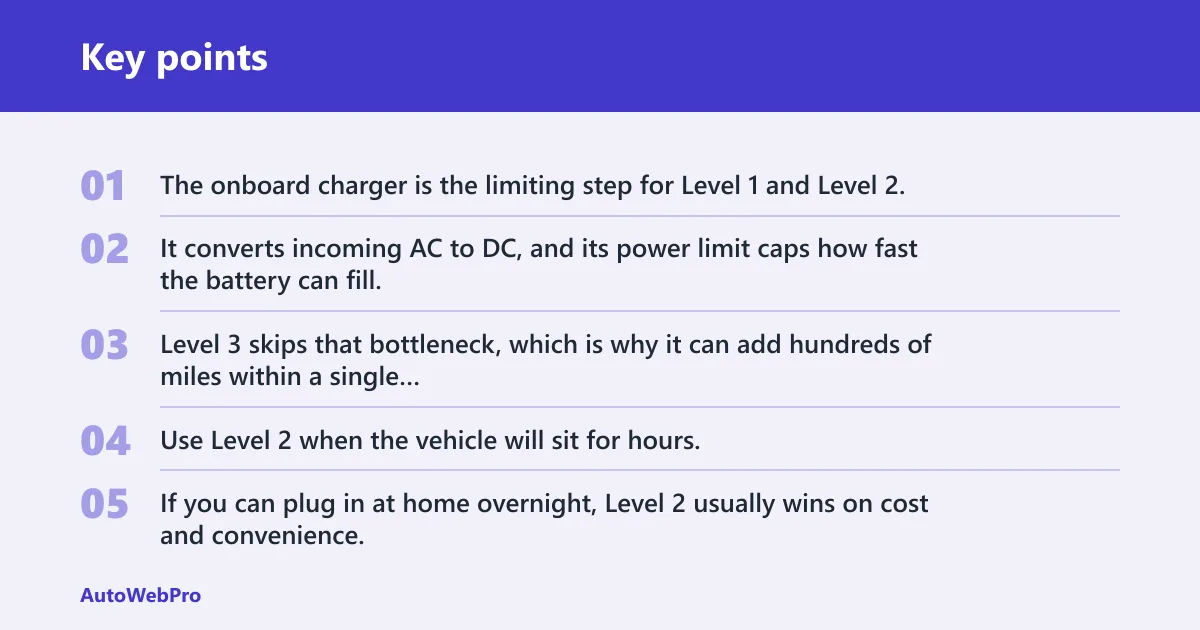
The onboard charger is the limiting step for Level 1 and Level 2. It converts incoming AC to DC, and its power limit caps how fast the battery can fill. Level 3 skips that bottleneck, which is why it can add hundreds of miles within a single hour and why the charging curve looks much steeper at the start.
What that means in practice
Use Level 2 when the vehicle will sit for hours. Use Level 3 when the vehicle will not. If you can plug in at home overnight, Level 2 usually wins on cost and convenience. If you need 150 miles before the next hotel or worksite, Level 3 may be worth it even with the higher price.
When should you use level 3 charging?
Use Level 3 when the time saved is worth the extra cost and the charger matches your vehicle. It fits road trips, highway stops, and quick top-ups between long drives. It also makes sense when home or workplace charging is unavailable and you need a fast refill to keep the day moving.
Best use cases
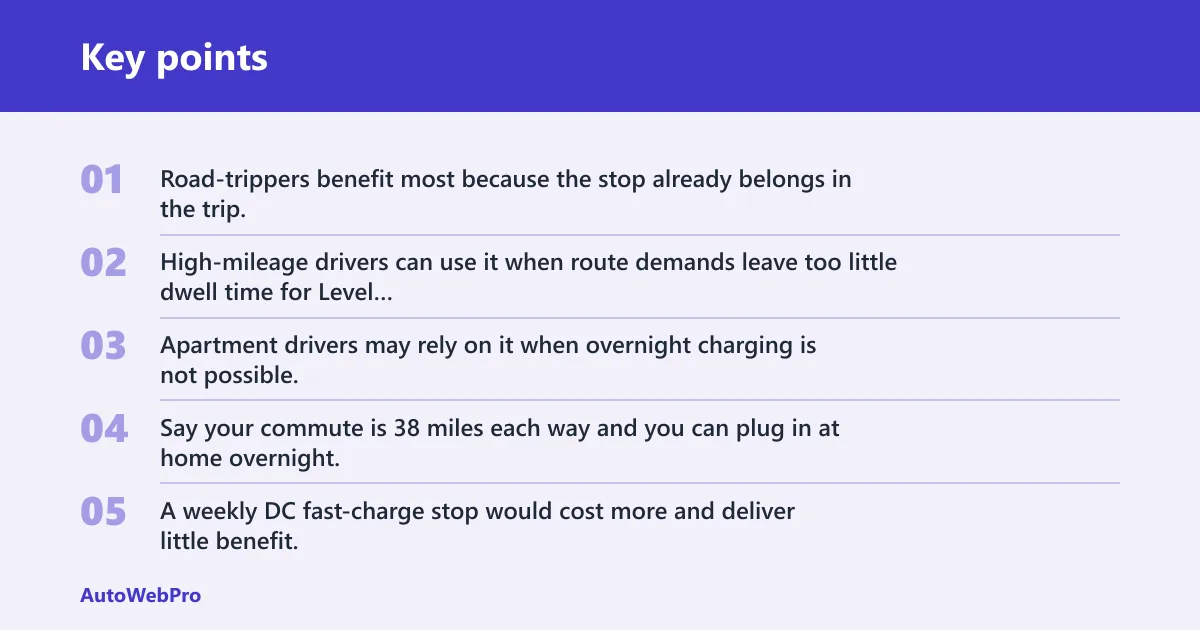
Road-trippers benefit most because the stop already belongs in the trip. High-mileage drivers can use it when route demands leave too little dwell time for Level 2. Apartment drivers may rely on it when overnight charging is not possible, but it is still better as a backup than as a daily habit.
Say your commute is 38 miles each way and you can plug in at home overnight. Level 2 is the better fit. A weekly DC fast-charge stop would cost more and deliver little benefit, because the car already has hours to refill while parked.
Suppose you pull into a highway site with 14% battery and need enough range for the next 180 miles. That is the right moment for Level 3. The quick jump to 80% can save a long dinner stop from turning into an overnight wait.
Charging speed and taper
Charging speed is best read three ways: power in kW, miles of range per hour, and minutes added during a stop. Level 3 is fast at low and mid battery states, but the rate tapers as the battery fills. The most useful window is often about 20-80%.
Why 20-80% matters
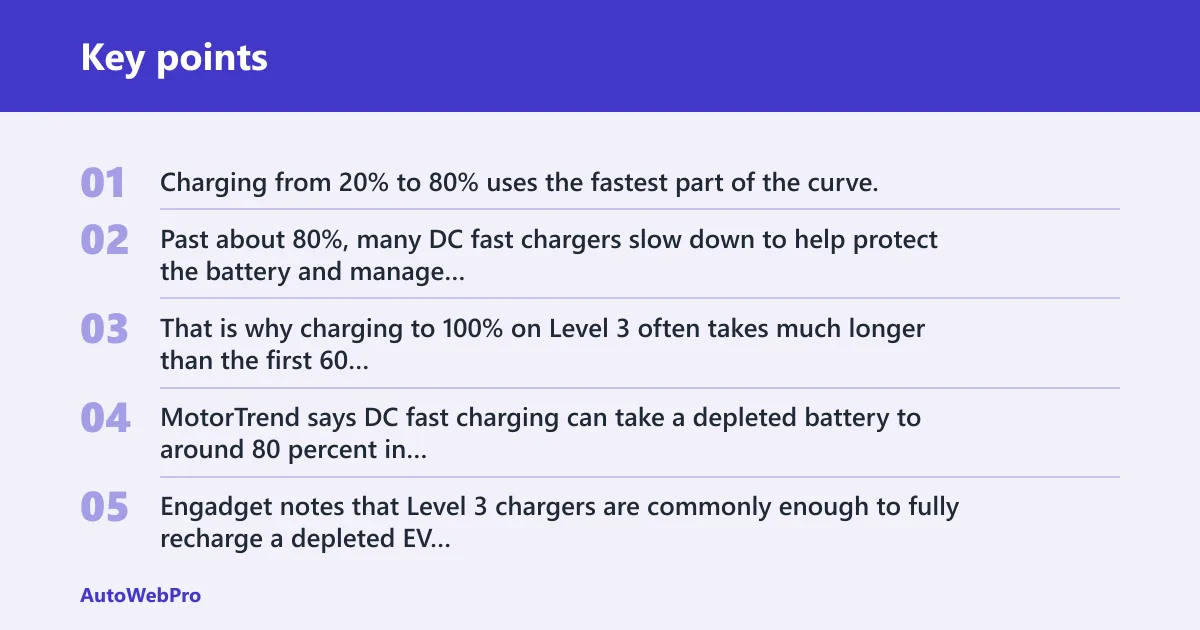
Charging from 20% to 80% uses the fastest part of the curve. Past about 80%, many DC fast chargers slow down to help protect the battery and manage heat. That is why charging to 100% on Level 3 often takes much longer than the first 60 percentage points.
MotorTrend says DC fast charging can take a depleted battery to around 80 percent in under an hour. The same source notes that Level 3 chargers are commonly enough to fully recharge a depleted EV battery in an hour or two, but “fully” often means the last stretch is slow. For routine travel, that final stretch is usually the least efficient use of time.
| Driver type | Recommended charging level | Typical session frequency | Cost sensitivity | Battery-health caution |
|---|---|---|---|---|
| Commuter | Level 2 | Most days or overnight | High | Low if DC fast charging is rare |
| Apartment driver | Level 2 when available, Level 3 as backup | Weekly or as needed | Medium to high | Watch repeated fast charging in cold weather |
| Road-tripper | Level 3 on the route | Per travel day | Medium | Best kept near 20-80% on each stop |
| High-mileage driver | Level 2 for base charging, Level 3 for gaps | Several times per week if routes demand it | High | Limit unnecessary charging to 100% on DC fast chargers |
What plugs and chargers work
Compatibility matters as much as speed. EnergySage says Level 3 charging uses CCS plugs in North America, and it also includes Tesla Superchargers among Level 3 chargers. North American Level 1 and Level 2 charging typically uses J1772. Because the NACS transition is still underway, adapters and vehicle support need a check before you plug in.
How to confirm compatibility
- Check the vehicle inlet and owner manual for the DC fast-charge standard it accepts.
- Check the station label for CCS, NACS, or another connector type.
- Confirm whether your car needs an adapter and whether that adapter supports DC fast charging.
- Check the station power and your vehicle’s maximum DC charging rate.
- Look for app or network notes about access rules, payment, and plug availability.
A charger can be fast and still be wrong for your vehicle. The right question is not only “Is this a DC fast charger?” but also “Can this specific car use this specific plug at this specific station?” That check prevents wasted time at a highway stop with no compatible session.
Level 3 charging matrix
This matrix turns the decision into a simple filter. If the row matches your driving pattern, Level 3 may be useful. If it does not, Level 2 is usually the cleaner choice and Level 1 remains a low-speed fallback for limited driving.
Use-case guide
| Driver type | Recommended charging level | Typical session frequency | Cost sensitivity | Battery-health caution |
|---|---|---|---|---|
| Commuter | Level 2 | Overnight or near-daily | High | Prefer AC charging for routine use |
| Apartment driver | Level 2 when available, Level 3 when needed | Several times a week | Medium | Repeated DC fast charging can be less friendly than home AC |
| Road-tripper | Level 3 | During travel stops | Medium | Stay near the 20-80% window when possible |
| High-mileage driver | Level 2 first, Level 3 for schedule gaps | As route demands | High | Do not rely on DC fast charging for every refill |
Can you install level 3 charging at home?
Residential Level 3 installs are generally uncommon. They need far more electrical capacity than a typical home setup, and the equipment cost is much higher than Level 2. For most homes, the service size and infrastructure demands make DC fast charging a poor fit, even if the driveway has space for it.
Why Level 2 is the usual home solution
It is faster than Level 1, much cheaper and simpler than Level 3, and enough for the daily needs of most drivers. If home charging is an option, Level 2 is usually the practical answer.
Level 1 still has a place. It is the slowest level and works for emergency use or low-mileage drivers who can leave the car plugged in for a long time. But for most EV owners, Level 2 is the daily benchmark and Level 3 is the travel tool.
Frequently asked questions
What is a level 3 charger?
A Level 3 charger is a DC fast charger. It sends DC power directly to the battery, usually at public charging stations, and it is the fastest common EV charging option. Most drivers use it for road trips, highway stops, and other times when speed matters more than price.
How fast does level 3 charging work?
Speed varies by vehicle and charger power, but Level 3 can be extremely fast. The same source says these chargers commonly deliver 50kW to 500kW, and MotorTrend says DC fast chargers can add roughly 3 to 20 miles of range per minute. The rate usually slows as the battery fills.
What plug does level 3 charging use?
In North America, Level 3 charging commonly uses CCS, and EnergySage includes Tesla Superchargers among Level 3 chargers as well. Because connector standards are shifting, you should confirm whether the vehicle supports the station’s plug directly or needs an adapter that works for DC fast charging.
How much does level 3 charging cost?
Level 3 charging usually costs more than home AC charging. The exact price depends on the network, location, and whether the station charges by the minute or by the kilowatt-hour. Public DC fast charging is a time-saving tool, but that speed usually comes with a higher bill.
Does level 3 charging hurt EV battery life?
Frequent DC fast charging can add more battery stress than Level 2, especially when you charge near 100% or do it in hot or cold conditions. The practical rule is simple: use Level 3 when you need the time savings, and keep routine charging in the 20-80% window when you can.