Charging Levels Explained for EV Shoppers
EV charging has three levels: Level 1 on 120 volts adds about 3 to 5 miles per hour, Level 2 on 240 volts adds about 12 to 45 miles per hour, and DC fast charging can add roughly 100 or more miles in about 20 to 30 minutes. Pick the lowest level that replaces your daily driving during your usual parking time, or you can spend too much, charge too slowly, or rule out EVs that would actually fit. This guide ties charging levels to home type, commute miles, parking windows, public-charging access, and your vehicle’s onboard-charger limit.
What do EV charging levels actually mean?
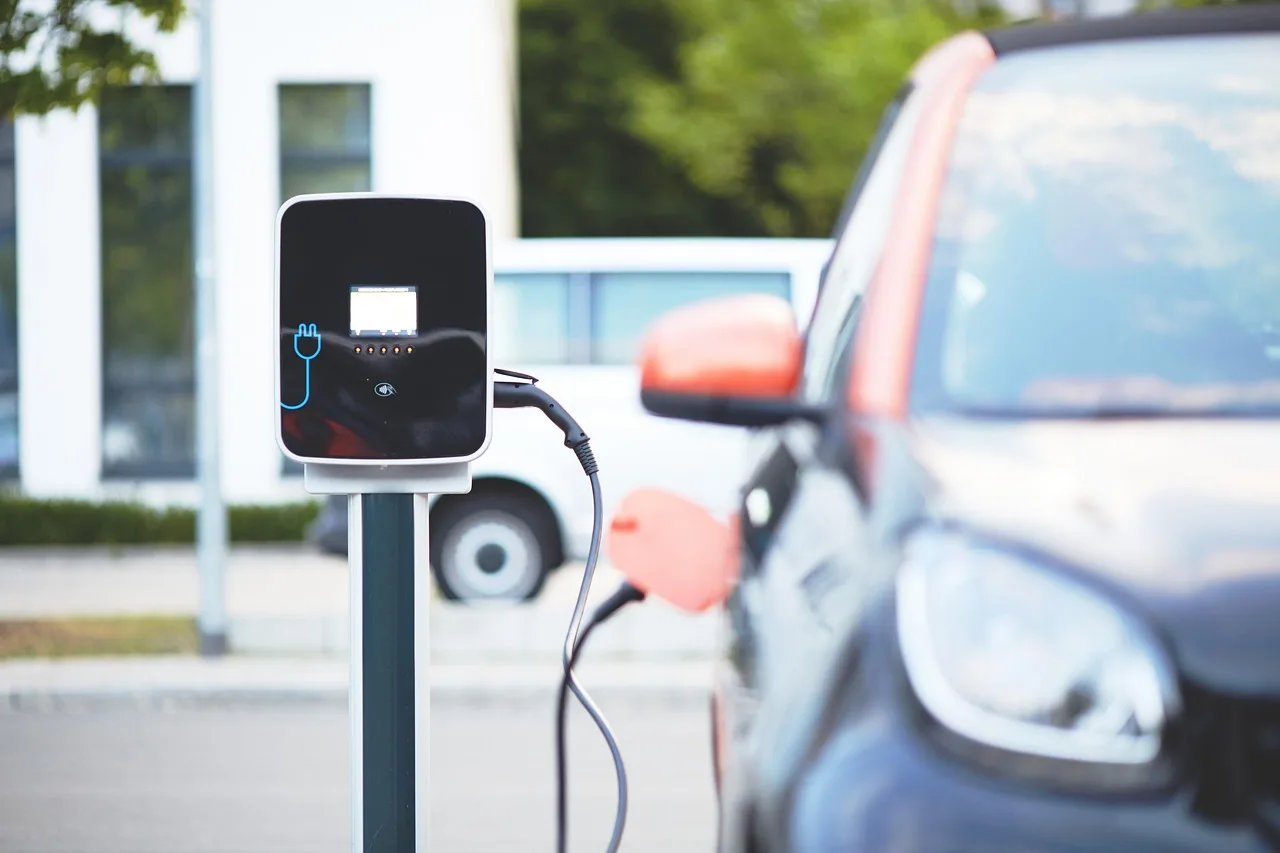
In North America, EV charging is commonly grouped into three SAE levels: Level 1, Level 2, and Level 3. In practice, Level 1 and Level 2 are AC charging, while Level 3 is DC fast charging. Outside North America, IEC Mode 2, Mode 3, and Mode 4 terms appear more often, but the mapping is loose rather than exact.
SAE levels in North America
The level terminology comes from North America. That shorthand helps, but it does not tell the full charging story, because vehicle hardware can cut the actual speed.
For most shoppers, the split is straightforward. Level 1 and Level 2 send AC power to the car, and the car’s onboard charger converts that AC to DC for the battery. Level 3 sends DC power from the station straight to the battery system, bypassing the onboard charger to charge faster.
How IEC modes fit
Outside North America, formal terminology under IEC 61851 often uses Mode 2, Mode 3, and Mode 4. A rough translation is that portable AC charging with in-cable controls often aligns with Mode 2, dedicated AC charging stations with communication align with Mode 3, and DC fast charging aligns with Mode 4.
That translation helps, but it is not a perfect one-to-one chart. A shopper comparing a North American spec sheet and an international charging document should treat SAE levels and IEC modes as related labels, not identical categories.
The two parts that control charging speed
The speed you actually get depends on two separate pieces: the EVSE outside the car and the onboard charger inside it. Read both the charger label and the vehicle spec sheet before assuming any AC charging rate. If those numbers do not match, the lower limit wins.
EVSE is the cable, box, and safety handshake
EVSE means electric vehicle supply equipment. That is the cable, wallbox or pedestal, control electronics, and safety hardware that communicate with the vehicle before charging starts. It is not the onboard charger. The EVSE tells the car how much current is available and confirms that conditions are safe.
This matters in a garage and at a public station. A wallbox marked for a higher power level does not make the car take that rate. It only offers that rate if the circuit, connector, and vehicle all agree.
The onboard charger inside the vehicle sets AC limits
The onboard charger is built into the vehicle. Its job is to convert AC power to DC power for the battery, and it sets the maximum AC charging speed the vehicle can accept. That is why two cars can plug into the same Level 2 station and charge at different rates.
Say your apartment garage has an AC station labeled 11 kW. One EV with an 11 kW onboard charger can use the full listed rate in ideal conditions. Another EV with a 7.4 kW onboard charger will stop there, even though the station itself is capable of more.
How to read the label, the spec sheet, and the plug together
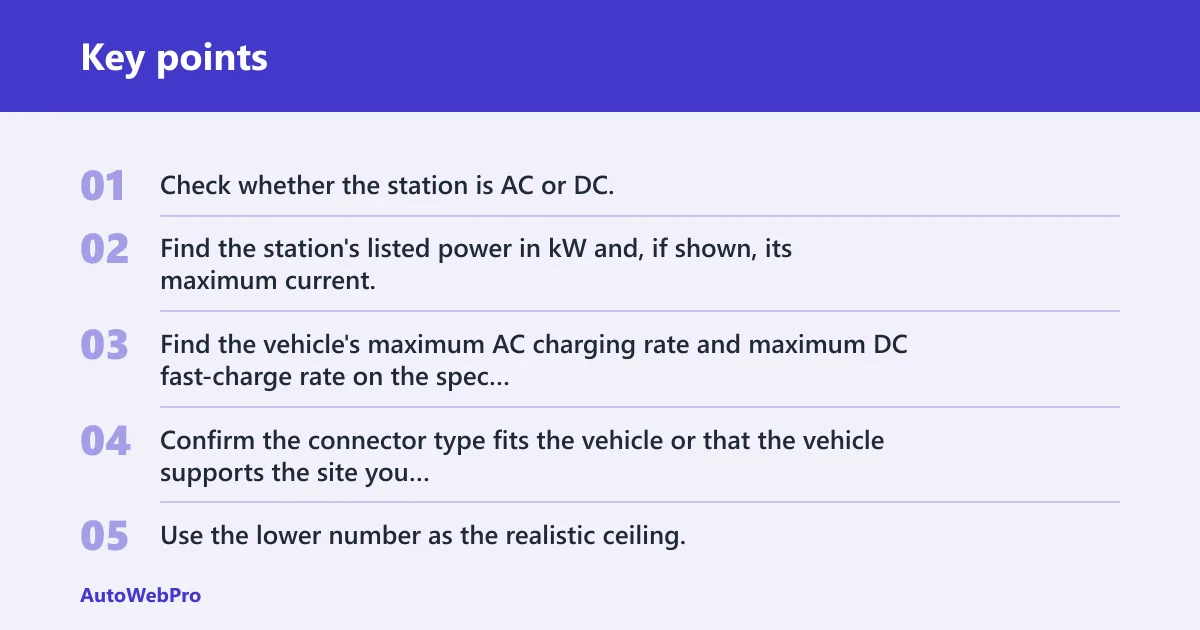
- Check whether the station is AC or DC. If it is AC, the onboard charger matters. If it is DC fast charging, the vehicle’s DC charge acceptance matters instead.
- Find the station’s listed power in kW and, if shown, its maximum current.
- Find the vehicle’s maximum AC charging rate and maximum DC fast-charge rate on the spec sheet.
- Confirm the connector type fits the vehicle or that the vehicle supports the site you plan to use.
- Use the lower number as the realistic ceiling, then expect less near a high state of charge or at an unfavorable battery temperature.
How fast is Level 1 charging?
Level 1 uses 120V AC in North America and is usually the slowest common option, listed at about 1.4 kW to 2.4 kW. It works best when the car sits for long stretches and daily energy needs are small. For many battery EV drivers, it is a backup or low-mileage solution rather than the main plan.
Where Level 1 fits
Level 1 charging usually means a standard household outlet in North America. It can make sense for plug-in hybrids, emergency charging, drivers with very short daily trips, and owners who park overnight for long windows every day.
A common first-timer mistake is assuming Level 1 is useless because it is slow. If a driver covers a modest daily distance and parks for a full night, Level 1 may replace that energy well enough. The decision turns on miles driven versus hours parked, not on the mere existence of a faster option.
Where Level 1 falls short
Level 1 often struggles with larger battery EVs, cold-weather losses, back-to-back long commutes, and homes where the parking outlet is inconvenient or shared. It also leaves little margin if one missed night of charging would disrupt the next day.
Suppose a battery EV is parked at home for 12 hours, but the driver regularly burns through a sizable chunk of the pack each weekday. Level 1 may recover some of that usage, yet still leave the battery lower each morning. That is where Level 2 starts to matter.
How fast is Level 2 charging?
Level 2 uses 240V AC in North America and spans a wide power range, listed at about 3.7 kW to 22 kW. It is the everyday standard for home wallboxes and many workplace chargers. Real speed depends on the circuit, the EVSE rating, and the vehicle’s onboard charger limit.
Why Level 2 is the everyday standard
Level 2 is called the everyday standard because it matches typical parking patterns. A car parked overnight at home, for several hours at work, or through a long errand stop can add meaningful energy without making you wait at a DC fast charger.
For shoppers, this is usually the first path to check. If the vehicle can recover normal daily use during regular parking windows, Level 2 is usually the simplest long-term answer.
Why one Level 2 setup differs from another
The label “Level 2” covers a broad range. A lower-power Level 2 circuit, a mid-power home wallbox, and a higher-capacity commercial AC station all sit in the same category. The actual result depends on the lowest limit among the electrical circuit, the EVSE, and the car’s onboard charger.
That is why “11 kW charger” can mislead shoppers. The station may be rated for 11 kW, but the car may only accept 7.4 kW on AC. Or the station may share power across multiple ports, reducing output when neighboring stalls are occupied.
Using battery size to estimate time
kW measures charging power. kWh measures battery capacity, or energy added over time. A simple planning framework is battery energy divided by charging power, then adjusted upward for losses and battery management.
Using a 65 kWh battery and an 11 kW charger as an example, the idealized math is 65 divided by 11, or about 5.9 hours from empty to full. Real charging time is longer because charging is not perfectly efficient and the rate can taper as the battery fills. That is still a useful shopping comparison, because it shows the scale of the difference between AC levels.
What is Level 3 charging and when should you use it?
Level 3 is DC fast charging, commonly listed at about 50 kW to 350+ kW, and it is mainly for road trips and quick top-ups. It uses different hardware and connector ecosystems than AC charging. It is powerful, but it is not the normal home solution and it will not always hit the number printed on the station.
Where Level 3 fits
Level 3 is the marketing-friendly name for DC fast charging. Because the station sends DC power directly to the battery system, it bypasses the onboard charger. That is a main reason it can charge much faster than AC charging.
Its best use cases are travel days, mid-route charging, and short dwell stops when time matters more than cost or convenience. It can also work for drivers who cannot charge at home, but routine dependence on public DC charging needs a careful look at access, queue risk, and pricing.
Why the label number is not a promise
DC fast charging speed depends on the station’s output, the vehicle’s maximum DC acceptance, battery temperature, and state of charge. Most EVs slow down as the battery gets fuller. That taper is normal, and it is one reason quick top-ups are often more time-efficient than charging all the way to full on a road trip.
Picture a fast charger labeled 150 kW. A vehicle may only reach that range briefly, or not at all, if the battery is cold, nearly full, or limited by the car’s own charging curve. Station derating and shared site power can lower it further.
Connector and hardware differences that matter
For shoppers, the main point is compatibility. AC home charging and DC fast charging can involve different connector ecosystems and different access networks. Verify that the vehicle supports the public charging hardware in the areas where it will be used, especially if road trips are part of the buying decision.
Charging fit decision matrix
Decision matrix
| Daily miles | Usual parking time | Dwelling type | Vehicle onboard charger limit | Most suitable level | Reason to choose it |
|---|---|---|---|---|---|
| Very low | Long overnight window | Single-family home with outlet access | Any AC limit | Level 1 | Lowest-cost starting point when daily energy use is small and the car sits long enough. |
| Very low | Long overnight window | Apartment or rental with only a household outlet | Any AC limit | Level 1 | Workable for a modest commute if outlet access is reliable and public charging exists as backup. |
| Moderate | Overnight at home | Single-family home or townhouse | 7.4 kW AC max | Level 2 | A 240V setup restores daily use with margin, and paying for more station power than the car can accept adds little. |
| Moderate to high | Overnight at home | Homeowner with dedicated parking | 11 kW AC max | Level 2 | Useful when the vehicle can use higher AC power and the daily drain is too large for Level 1 recovery. |
| Low at home, moderate total | Several hours at work | Apartment resident with workplace access | Any AC limit | Level 2 | Workplace charging can replace the missing home wallbox and reduce dependence on public fast charging. |
| High or irregular | Short stops only | No home charging, limited workplace access | Strong DC capability matters more than AC limit | Level 3 with backup AC when possible | Public DC fast charging becomes the practical option when parking windows are short and home charging is unavailable. |
| Road-trip days | Brief en-route stops | Any dwelling type | Vehicle DC acceptance is the key spec | Level 3 | Fast top-ups are the right tool when distance exceeds what overnight or workplace charging can cover. |
Charging levels table
| Station label | Vehicle AC onboard charger limit | Battery example | Idealized full-charge math | Why results differ |
|---|---|---|---|---|
| 11 kW Level 2 | 11 kW | 65 kWh | 65 ÷ 11 = about 5.9 hours | The car can use the station’s full AC rating, before normal losses and taper effects. |
| 11 kW Level 2 | 7.4 kW | 65 kWh | 65 ÷ 7.4 = about 8.8 hours | The same station charges slower because the vehicle caps AC intake below the station label. |
Quick decision rules
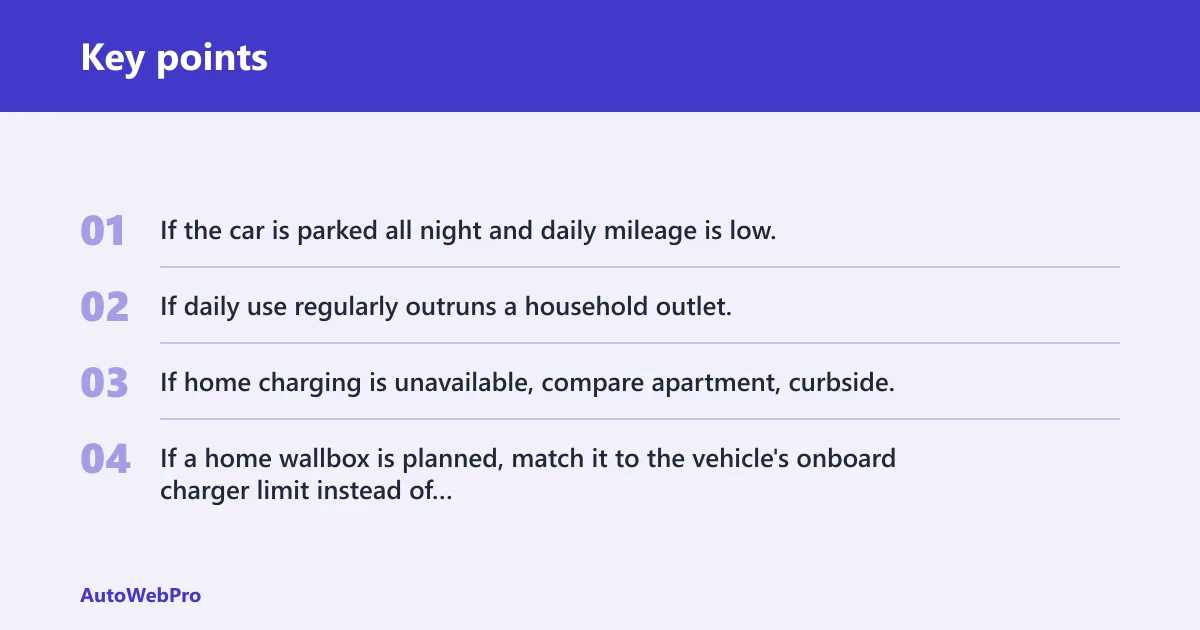
- If the car is parked all night and daily mileage is low, start by checking whether Level 1 covers the routine.
- If daily use regularly outruns a household outlet, Level 2 is usually the practical home or workplace target.
- If home charging is unavailable, compare apartment, curbside, and workplace AC access before assuming daily DC fast charging is the only path.
- If a home wallbox is planned, match it to the vehicle’s onboard charger limit instead of buying for the highest number on the shelf.
Why is my EV charging so slow?
Most slow charging complaints come from one of seven causes: the car’s onboard charger ceiling, normal battery taper, battery temperature, high state of charge, shared power, station derating, or vehicle scheduling and authentication issues. Start by checking whether the limit comes from the car, the station, or site conditions before blaming the cable or wallbox.
Use kW and kWh to spot the bottleneck
If the station says 11 kW but the car is adding energy at a lower rate on AC, the onboard charger limit is a prime suspect. If the battery is large in kWh, even a healthy charging rate can still take many hours. Big battery plus modest power equals long sessions.
Normal taper and temperature effects
As state of charge rises, many EVs reduce charging power to protect the battery and manage heat. Battery temperature also matters. Very hot or very cold conditions can reduce charging speed while the battery management system conditions the pack.
That slowdown is often most visible at DC fast chargers, but it can show up on AC too if thermal management is active. A slow session is not always a fault.
Site limits and settings that catch shoppers off guard
Shared-power stations may cut output when another vehicle plugs in nearby. Some stations derate because of heat. At home, electrical service limits or installation choices can cap a wallbox below its headline capability. In the car, charge schedules, target charge limits, or departure timers can also make charging appear inconsistent.
Why a car may refuse to charge
If charging does not start at all, common causes include a failed handshake between the EVSE and the car, connector faults, incompatible hardware, payment or app authentication problems at public sites, and vehicle settings that delay charging until a scheduled time.
Read the dashboard message first. Then check connector seating, station status lights, app authorization, and any scheduled charging setting in the vehicle. If the issue appears only at one site, suspect the station before the car.
What is the best charge level for daily driving?
The best daily charge level is the lowest one that reliably replaces your normal driving during the time the car is already parked. For many owners that is Level 2, but not always. Level 1 can be enough for low-mileage use, while regular DC fast charging is mainly a workaround when home or workplace AC charging is missing.
Match overnight parking to daily energy use
This is the core buying rule. Start with daily miles, then look at how many hours the car usually sits. A slow charger with a long parking window can beat a fast charger that is rarely available when the car is idle.
That is why shoppers should judge charging around routine parking behavior, not peak charging speed alone. A car that can quietly refill overnight often fits better than one chosen for occasional fast-charge bragging rights.
When Level 1 is enough
Level 1 makes sense when daily driving is light, parking time is long, and the driver has a fallback plan for occasional heavier-use days. Plug-in hybrids are a particularly strong fit because their battery packs are smaller and their daily refill need is lower.
When Level 2 is worth it
Level 2 is worth prioritizing when daily mileage is moderate or high, when weather increases energy use, when multiple EVs share one home, or when a missed charging night would create a problem. It is also the cleaner choice for many renters if the building offers assigned AC charging or if workplace charging is dependable.
When regular DC fast charging makes sense
Regular DC fast charging can make sense for drivers without home charging who have reliable nearby fast-charging access and a routine that supports it. Still, that lifestyle needs more planning. Queue times, pricing, weather, and station uptime matter much more than they do for a driver with overnight AC access.
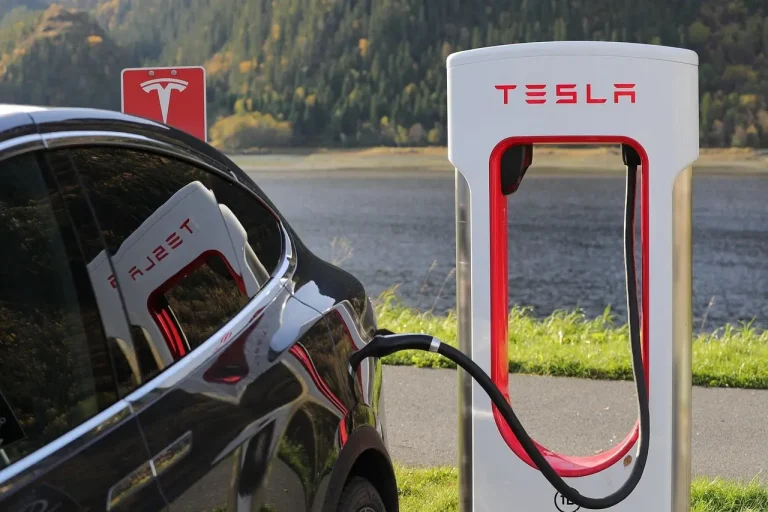
Do Teslas use the same charging levels as other EVs?
Yes. The charging levels are the same even when the connector situation differs. A Tesla and a non-Tesla can both use Level 1, Level 2, and DC fast charging in the broad sense. What changes is compatibility with specific connectors, networks, and each vehicle’s own AC and DC charging limits.
The level is separate from the plug
Level names describe the charging category, not the badge on the hood. A Tesla on AC charging is still using Level 1 or Level 2. A Tesla at a fast charger is still using DC fast charging, even if the connector ecosystem differs from another brand in a given market.
What to verify before buying home equipment
Check the vehicle’s maximum AC charging rate, the connector or adapter situation for the home setup, and whether the planned EVSE output exceeds what the car can actually accept. Also check whether the home’s electrical capacity supports the installation you want.
Frequently asked questions
What are the different EV charging levels?
In North America, the main charging levels are Level 1, Level 2, and Level 3.
How many levels of EV charging exist?
Most shoppers only need to think about three levels. SAE Level 1, Level 2, and Level 3 are the common North American labels. Outside North America, IEC Mode terms appear more often, but the practical shopping question stays the same: how much energy the car needs and how long it is parked.
What is the difference between Level 1, Level 2, and Level 3 charging?
Level 1 and Level 2 are AC charging, so the car’s onboard charger converts power and limits speed. Level 3 is DC fast charging, which bypasses the onboard charger and is used mainly for short, high-power charging stops.
What is the best charge level for daily EV driving?
The best daily level is the lowest one that replaces your usual driving during your normal parking window. For many households that means Level 2, because it fits overnight parking with margin. Level 1 can still work for low-mileage use, while regular DC fast charging is usually the fallback plan.