Regenerative Braking Explained for Hybrids and EVs
Regenerative braking uses the drive motor as a generator to slow the car and send energy back to the battery, but it commonly weakens or shuts off when the battery is near full charge, when temperatures are outside the preferred range, or when traction is limited. If you misread those limits, a normal change in stopping can look like a brake or battery problem, or cover up a real fault. This guide explains brake blending, one-pedal behavior, common regen limits, and the dash clues that separate normal operation from trouble.
The key point is that regen is a managed system, not one switch. The traction motor, inverter, high-voltage battery, brake controller, ABS, stability control, and software calibration all shape what you feel at the pedal and on lift-off.
What regenerative braking actually does
From wheel torque to electrical energy
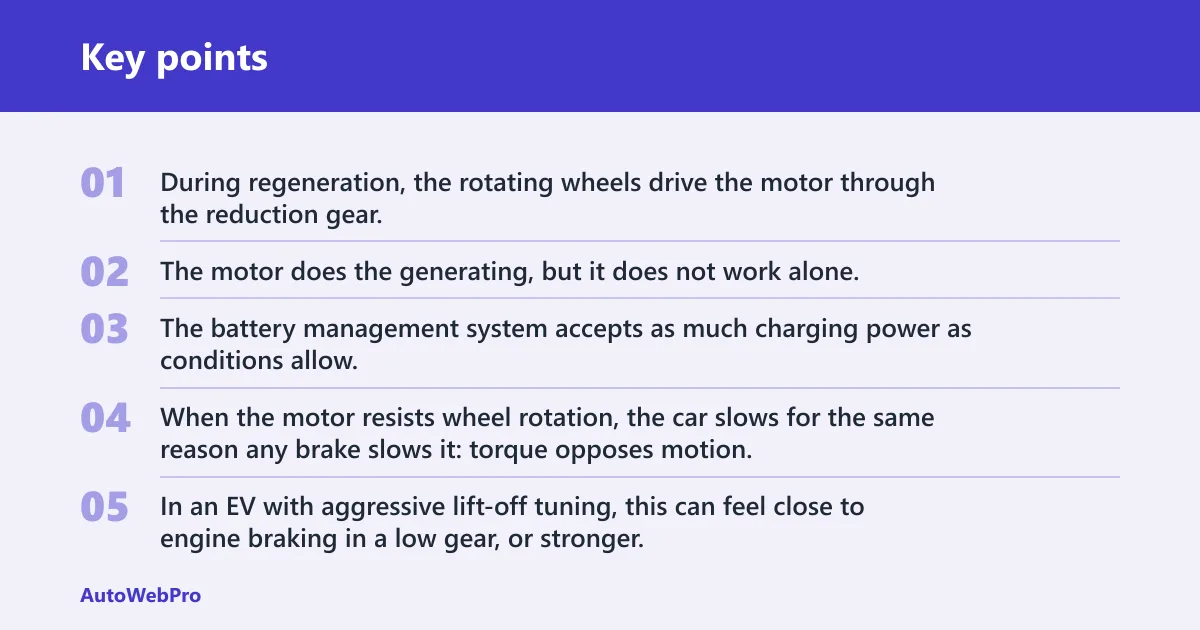
Regenerative braking slows the car by using the drive motor as a generator, then sending that recovered power back to the high-voltage battery. During regeneration, the rotating wheels drive the motor through the reduction gear. Instead of drawing battery power to move the car forward, the traction motor switches into generator mode and applies negative torque against wheel rotation.
That negative torque is what slows the vehicle. The energy recovered during deceleration goes back toward the high-voltage system instead of turning almost entirely into heat at the rotors and pads.
Motor, inverter, and battery roles
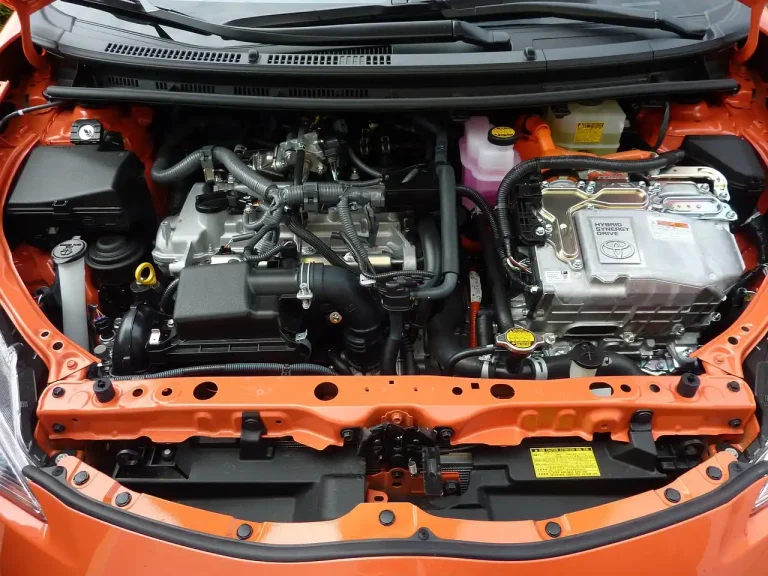
The motor does the generating, but it does not work alone. The inverter controls electrical output during regeneration, feeds power back into the high-voltage system, and coordinates the torque request with the motor so deceleration stays within battery and traction limits.
The battery management system accepts as much charging power as conditions allow. That explains many real-world symptoms. If battery temperature, battery state of charge, cell protection, or system heat limits say “no more,” the car cuts regen even if you expect the usual deceleration.
Why regen slows the vehicle
When the motor resists wheel rotation, the car slows for the same reason any brake slows it: torque opposes motion. In an EV with aggressive lift-off tuning, this can feel close to engine braking in a low gear, or stronger. In a full hybrid, it may feel lighter and blend in earlier with friction braking.
Driver displays often make this visible. A power meter or regen gauge may swing into a charge zone under lift-off or braking, helping you learn the timing and see whether the car is actually recovering energy.
Why service brakes still matter
Regen cuts how often the pads and rotors do the work, but the service brakes still handle hard stops, emergency braking, the last few mph before zero, and low-grip events. Regeneration itself fades near zero speed, so the final part of the stop usually does not recover energy.
How regen and friction brakes share stopping duties
Regenerative braking usually does the first part of slowing down, but it does not handle every stop on its own. The supporting article explains regenerative braking split between regen and the regular brakes: regen does most light deceleration and energy recovery, while friction brakes take over for harder stops, very low speeds, and emergency braking. That division matters because it affects how the pedal feels, how much energy gets recaptured, and why the car may still use the brake pads even in an EV or hybrid.
Understanding that handoff helps you judge what is normal versus what may point to a blending issue, weak regen, or unusual stopping behavior. It also makes brake wear and range estimates easier to interpret.
How does regenerative braking work in hybrids and EVs?
In every hybrid or EV, regen works by switching the drive motor into generator mode during lift-off or braking, then routing the recovered power back to the high-voltage system. The main differences are the negative wheel torque the motor can produce, the charging power the battery can take at that moment, and how the system hands off to friction brakes near a stop.
Battery EVs and strong lift-off regen
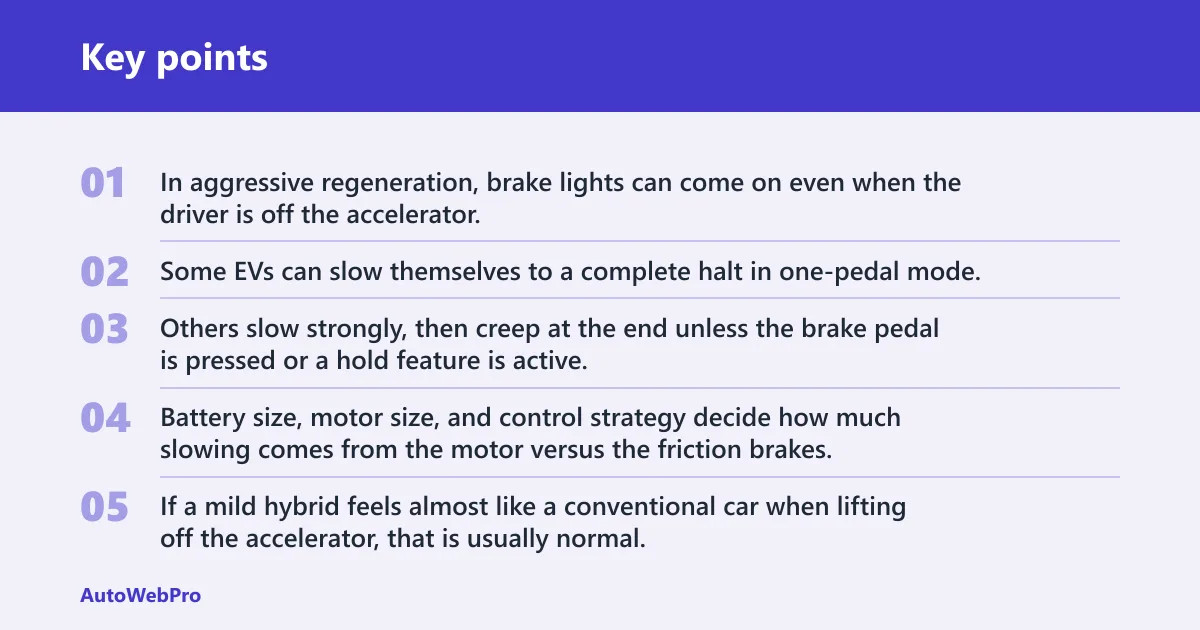
Battery EVs usually offer the widest regen range because the traction motor and battery are sized for electric driving all the time. Many can provide strong lift-off deceleration, and some let drivers choose Auto, High, Low, or Off for one-pedal behavior. In aggressive regeneration, brake lights can come on even when the driver is off the accelerator.
Some EVs can slow themselves to a complete halt in one-pedal mode. Others slow strongly, then creep at the end unless the brake pedal is pressed or a hold feature is active.
Full hybrids and plug-in hybrids
Full hybrids recover energy through their electric drive components, but the feel is usually softer than in a dedicated EV. Brake blending is more obvious because the vehicle often transitions between engine operation, electric propulsion, and friction braking as speed and battery state change.
Plug-in hybrids sit between the two. They often have more electric-only deceleration than a regular hybrid, but less sustained strong regen than a battery EV. Battery size, motor size, and control strategy decide how much slowing comes from the motor versus the friction brakes.
Mild hybrids and lower capture limits
Mild hybrids generally recover less energy because their motor-generator systems are smaller and often cannot provide strong independent vehicle deceleration. They may smooth stop-start operation and recover some energy during braking, but they rarely deliver the pronounced one-pedal feel common in EVs.
If a mild hybrid feels almost like a conventional car when lifting off the accelerator, that is usually normal. The system may still be charging modestly without producing strong negative torque at the wheels.
Coasting, braking, and downhill deceleration
Under gentle lift-off, some vehicles prioritize coasting and call for only light regeneration. Press the brake pedal, and the brake controller may request more regen first, then add friction braking as needed. On long descents, the system may hold a set level of deceleration, but available regen can taper if the battery fills or system temperatures rise.
Picture a compact EV set to high regen on a six-mile descent. The charge gauge may show strong recovery for the first section, then shrink later as the battery warms or state of charge climbs, even though road grade has not changed.
Why does regen feel different from one vehicle to another?
Regen feel varies because manufacturers tune deceleration, pedal mapping, brake blending, and one-pedal behavior differently, and because the hardware differs. Vehicle mass, motor output, tire grip, battery charge acceptance, and software all change how strong the slowing feels and how smooth the handoff is from regeneration to friction braking.
Calibration, weight, and motor power
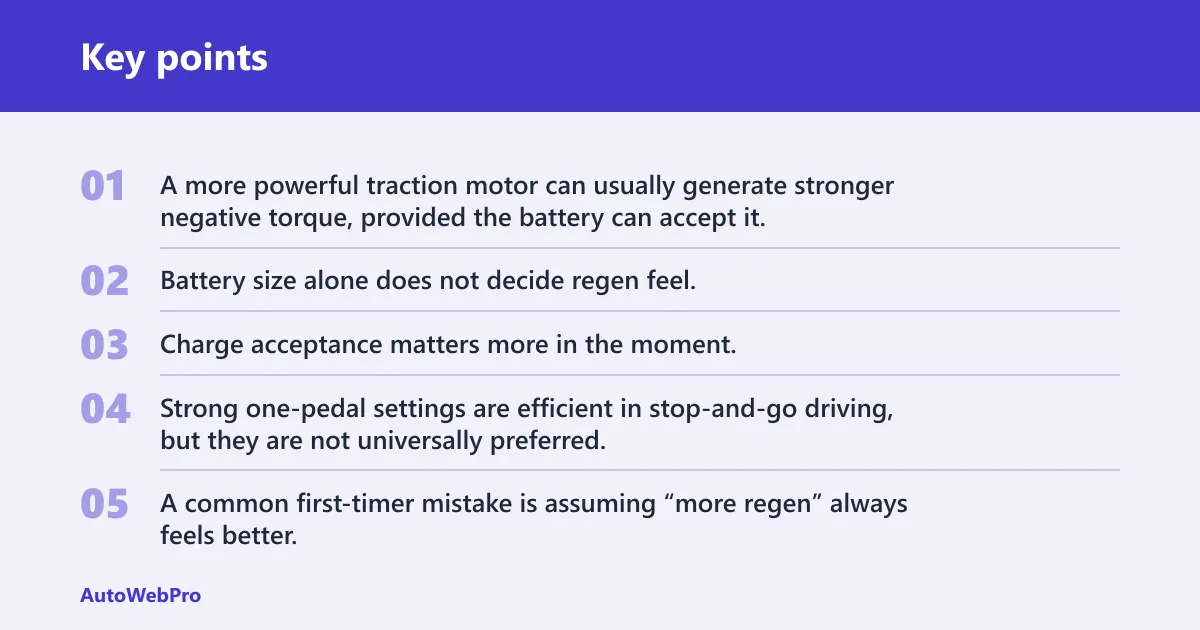
A heavier crossover with conservative lift-off tuning can feel much gentler than a lighter hatchback with aggressive one-pedal calibration, even if both recover energy. Motor power matters too. A more powerful traction motor can usually generate stronger negative torque, provided the battery can accept it.
Segment tuning matters. Family-oriented vehicles often use smoother coast behavior to reduce head toss in stop-and-go traffic, while some sporty EVs use stronger lift-off deceleration to make single-pedal modulation feel more direct.
Battery size and charge acceptance
Battery size alone does not decide regen feel. Charge acceptance matters more in the moment. A large pack that is very cold or nearly full may accept less regenerative power than a warmer, partly depleted pack, so the car can feel as if regen has weakened.
Suppose the same plug-in hybrid feels eager on a 45-degree morning after twenty minutes of driving, but lazy right after an overnight cold soak. That change can come from battery temperature alone, with no fault in the brakes or motor.
Aggressive one-pedal tuning versus smooth coasting
Strong one-pedal settings are efficient in stop-and-go driving, but they are not universally preferred. Some drivers like the immediate slowdown; others want a longer coast to make highway merging and passenger comfort easier. That is why some manufacturers let drivers set regen strength with paddles or a touchscreen menu.
A common first-timer mistake is assuming “more regen” always feels better. In dense traffic, abrupt lift-off deceleration can make passengers nod forward repeatedly, even when the energy recovery is working exactly as intended.
When does regenerative braking get reduced or stop working?
Regen is often reduced or turned off when the battery cannot accept more charge, when traction control needs wheel stability, when temperatures move outside the preferred window, or when software limits the system for protection. Those changes are often temporary and normal, but they can feel sudden from the driver seat.
Full battery and high state of charge
If the battery is full, regenerative braking may not work. That is why a car can feel different right after charging to 100% or starting a descent immediately after a full charge. The system has little or no room to store recovered energy, so friction braking must do more of the work.
This is one of the most common “something is wrong” complaints that is actually normal. Most cars do not actively show range going up unless descending a huge hill, so drivers may notice the missing deceleration before they notice the battery state explanation.
Cold battery, heat, and protection limits
Cold cells usually accept less charging power. Very hot cells may also trigger protective limits. In both cases, the car may show a reduced regen icon, a dashed portion on the charge meter, or a smaller section of available regeneration on the power display.
Battery protection mode can also cut available regen even when ambient temperature seems mild. Fast charging, repeated mountain descents, towing, or sustained high load can all leave the battery or power electronics outside the preferred operating band.
Wet pavement, ABS events, and low-grip cutback
Regen depends on tire grip because the same contact patch that accelerates the vehicle also has to handle deceleration torque. If ABS or stability control detects slip, software may cut back regenerative torque quickly and increase friction-brake contribution to help keep the wheels rotating predictably.
That can feel like the car suddenly “lets go” of strong lift-off braking on a slick patch. It is usually a stability decision, not a broken regen system.
Steep downhill and software-limited modes
Long descents can stack several limits at once: rising state of charge, higher battery temperature, and brake-system heat management. The software may trim regeneration to protect the battery, then use friction brakes more often to maintain speed control.
Some vehicles also reduce regen in valet, tow, snow, or other software-limited modes. One-pedal turned off is another simple cause. If the driver selected a low-regen or coast-heavy drive mode, the weak deceleration is expected behavior, not a fault.
Why does the brake pedal feel different with brake blending?
Brake blending can change pedal feel because the controller is deciding, in real time, how much slowing comes from the motor and how much comes from the friction brakes. The transition is usually most noticeable at low speed, during stronger stops, or when regen becomes limited by battery or traction conditions.
How blended braking works
In many hybrids and EVs, pressing the brake pedal does not mean “pads first.” The brake controller reads pedal demand, vehicle speed, wheel slip, battery limits, and available motor torque, then mixes regenerative and hydraulic braking to hit the requested deceleration.
Done well, the car feels natural. Done conservatively, you may notice a change in pedal response as the system moves from mostly regen to more friction braking.
The low-speed cutoff near a stop
The low-speed handoff matters because regeneration itself fades near zero speed, so the last part of the stop usually does not recover energy. Friction brakes or a hold function finish the stop. The exact cutoff differs by model and calibration, which is why two EVs can feel very different in the final few feet.
Say your EV glides smoothly from 30 mph to walking pace on lift-off, then the last car length feels more like a regular brake stop. That is typical low-speed cutoff behavior, not evidence that regen “failed” at the end.
What feels normal versus what suggests a problem
Normal signs include a mild change in pedal firmness near a stop, weaker lift-off regen with a full or cold battery, and brief cutback over bumps or slick patches if stability systems intervene. Less normal signs include warning lights, repeated surging under steady pedal pressure on dry pavement, or missing friction braking.
If the brake pedal suddenly gets long, the vehicle pulls sharply while braking, or the friction brakes seem unavailable, that moves past regen feel and into immediate brake-system diagnosis.
Can one-pedal driving stop the car completely?
Some one-pedal systems can stop the car completely, while others slow to a crawl and require the brake pedal or an auto-hold function to finish the job. The difference depends on model, software version, and calibration, and the final stop still relies on friction braking because regen fades near zero speed.
Stop-and-hold versus creep
A car can slow itself to a complete halt in one-pedal mode. Whether it stays stopped is another matter. Some vehicles apply hold logic and remain stationary until the accelerator is pressed. Others creep forward like a conventional automatic once speed falls low enough.
Where one-pedal ends and friction brakes take over
Even in a very strong one-pedal mode, the stop is not pure regeneration from start to finish. The last part typically uses friction brakes, often without the driver noticing. The better the blend, the less obvious this handoff feels.
That is also why one-pedal mode does not make the hydraulic brake system optional. Emergency stops still need full friction-brake authority.
Brand and software differences
Names vary by brand and software version, and behavior can change after updates. Some systems prioritize maximum lift-off deceleration, some favor smoothness, and some adapt based on traffic or navigation data. Market differences can matter too, especially where local rules influence deceleration behavior and signaling.
China’s GB 21670—2025 applies from 1 January 2027 to new type approvals. Rules like that can shape how aggressively systems are tuned and when brake lamps illuminate under off-accelerator deceleration.
Can you lower regen or turn it off?
Many hybrids and EVs let the driver reduce or change regen, though the exact options vary widely by brand, trim, market, and software version. Common choices include paddles, a B mode, drive-mode menus, or touchscreen controls for low, standard, high, adaptive, or one-pedal settings.
Common control methods
Some manufacturers let drivers set regen strength with paddles or a touchscreen menu. Other vehicles tie it to drive modes such as Eco, Normal, Snow, or Sport. A B mode often requests more deceleration on lift-off, but the label does not guarantee the same behavior across brands.
How to read the dash first
- Check the drive mode. Look for Eco, Normal, Snow, B, one-pedal, or custom modes before judging the brakes. A low-regen setting can feel like a fault if the mode changed after charging, a software update, or another driver used the car.
- Watch the power meter. Lift off the accelerator at a steady speed on dry pavement and see whether the display moves into a charge zone. If the meter shows little or no recovery, compare that with battery state of charge and any cold-battery or reduced-regen icon.
- Confirm battery conditions. Note whether the pack is near full, freshly fast-charged, very cold, or heat-soaked after a long climb or descent. The battery management system accepts as much charging power as conditions allow, so those states can cut regen without any hardware fault.
- Test brake blending gently. On a clear road, apply light brake pressure from a moderate speed and watch for regen indication before stronger friction braking joins in. Smooth response with some low-speed fade is normal; warning lights, abrupt surging, or no friction braking is not.
Why settings vary so much
Regeneration settings can change by market, model year, trim, and software version. A base trim may have fixed lift-off tuning where an upper trim offers paddles and adaptive modes. Some systems even reset to a default mode at every restart, which can confuse drivers who expect the previous setting to stay active.
How much range can regenerative braking actually add?
Regen can increase the number of miles you get from a battery, but the gain is route- and condition-dependent rather than fixed. It helps most in repeated deceleration, stop-and-go traffic, and long descents, while steady highway cruising offers fewer chances to recover energy in the first place.
City traffic versus steady highway driving
Urban driving creates more recoverable deceleration events. Highway driving at a stable speed does not, so regen contributes less there. Even in town, energy recovery is never complete because conversion losses, battery limits, and low-speed cutoff all trim the amount that actually returns to the pack.
Downhill descents versus flat commutes
Long descents can produce the most obvious regeneration, provided the battery has room and temperature margins. Flat commuting usually spreads the benefit into many smaller events, so the effect may show up more in overall efficiency than in an obvious jump on the range display.
Most cars do not actively show range going up unless descending a huge hill. That is why chasing a visible range increase on the dashboard is a poor way to judge whether regen is working.
How to read the gauge without overstating the benefit
The best quick check is whether the charge or regen section appears when expected during lift-off and light braking. A strong regen bar does not mean all lost speed becomes usable battery energy. It means the system is recovering some of it, within battery and traction limits, for later driving.
Regenerative braking matrix
| Scenario | Likely cause | What the driver feels | Normal? | What to check next |
|---|---|---|---|---|
| Battery near 100% charge | High state of charge leaves little room for recovered energy | Weak or missing lift-off deceleration; more friction-brake use right after charging | Usually yes | Confirm state of charge and drive a few miles; if regen returns after charge drops, behavior is expected |
| Cold battery after overnight park | Cells accept less charging power when cold | Reduced regen bar, softer one-pedal feel, stronger return after the pack warms | Usually yes | Check for reduced-regen icon or dashed gauge section; compare behavior after 15 to 30 minutes of driving |
| Steep downhill with long descent | Rising state of charge or temperature protection trims charging power | Strong regen at first, then tapering; more friction-brake contribution later | Usually yes | Watch the charge meter and battery temperature indicators if available; avoid assuming the system failed mid-descent |
| Wet road or ABS event | Traction control cuts negative motor torque to keep wheel slip in check | Sudden reduction in slowing over a slick patch or rough painted line | Usually yes | Note road surface and any traction or ABS indicator; retest on dry pavement before suspecting a fault |
| Battery protection mode | Battery or inverter limiting charge power because of temperature or system stress | Regen available, but capped lower than usual; dash may show reduced availability | Usually yes | Check for recent fast charging, repeated hard climbs, towing, or heat soak; verify whether the limit clears after temperatures normalize |
| One-pedal off or low regen selected | Driver setting changed by paddle, menu, or drive mode | Longer coasting, weaker lift-off slowdown, normal braking when pedal is pressed | Yes | Review drive mode, paddle setting, B mode, or one-pedal menu before booking service |
| Software-limited mode | Snow, tow, valet, or similar calibration reduces regen demand | Predictable but gentler deceleration than usual | Yes | Check active mode on the cluster; return to standard mode and compare |
How to tell normal regen limits from a fault
Normal temporary reductions and matching dash clues
Normal limits tend to match a visible condition: full battery after charging, cold-soak startup, slippery pavement, or a selected low-regen mode. The dash often backs that up with a reduced regen icon, a smaller available charge band, a different drive-mode label, or traction-control activity.
Signs of a calibration or sensor issue
Possible faults look less tied to conditions. Examples include regen disappearing at random battery states on dry pavement, inconsistent pedal response without traction events, or a charge gauge that never shows recovery even after the battery is partly depleted and warm. Warning messages move the issue higher on the list.
What to check before service
- Record the conditions. Note battery state of charge, outside temperature, road surface, drive mode, and whether charging or a long descent happened just before the symptom. Those details separate normal limits from intermittent faults faster than a vague complaint of “weak regen.”
- Compare with the display. Match the symptom to any reduced-regen icon, traction-control flash, or absent charge bar. If the display explains the behavior, the system is usually doing what the software asked it to do.
- Retest in a controlled situation. Try the same road at a moderate speed, on dry pavement, with the battery below full and the normal drive mode selected. If regen still seems absent or the pedal feel is erratic, service diagnosis makes more sense.
- Escalate brake warnings. Seek prompt service if brake warning lights appear, the pedal becomes abnormally long or hard, or the vehicle does not provide expected friction braking. Those are brake-system concerns first, regen questions second.
Frequently asked questions
Does regenerative braking charge the battery every time I slow down?
No. The battery only accepts recovered energy when conditions allow, and the battery management system accepts as much charging power as conditions allow. A full battery, cold or hot cells, low-grip conditions, software-limited modes, and low-speed cutoff can all reduce or prevent charging during deceleration.
Does regenerative braking replace the regular brakes?
No. Regen reduces friction-brake use, but it does not replace service brakes for emergency stops, strong deceleration, low-grip control, or the final phase near a complete stop. Regeneration itself fades near zero speed, so friction brakes or a hold function still finish the stop.
What happens if the battery is already full?
If the battery is full, regenerative braking may not work. The car then relies more heavily on friction brakes, and lift-off deceleration may feel weaker than usual right after charging. That change is commonly normal and often disappears after some charge is used.
Why does regenerative braking feel stronger in some cars than others?
Feel depends on motor size, vehicle tuning, battery charge acceptance, brake blending, and whether one-pedal mode is active. Some models are calibrated for strong lift-off deceleration, while others are tuned to coast more smoothly for comfort, especially in heavier vehicles or family-oriented segments.
Can I turn regenerative braking off or lower it?
Often, yes. Some EVs let drivers choose Auto, High, Low, or Off for one-pedal behavior, and some manufacturers let drivers set regen strength with paddles or a touchscreen menu. Exact choices vary by model year, trim, market, and software version.
Why does the brake pedal feel different when regen blends with friction brakes?
Because the brake controller is mixing two braking sources with different limits and responses. Pedal feel can change as regen reaches battery or traction limits, and again near a stop when regenerative braking fades and friction brakes take over the remaining deceleration.