Does Regenerative Braking Use the Regular Brakes?
Regenerative braking usually handles the slowdown, while the regular brakes finish the stop, cover emergency stops, and take over at very low speed. Miss that split, and you can read pedal feel, stopping distance, and battery charging behavior wrong. Here’s how regen and friction brakes divide the work in real driving, from light deceleration to a full stop.
When regular brakes join regenerative braking
Usually, no. On a light lift-off or a gentle stop, regenerative braking handles most of the slowdown by using the electric motor as a generator. The regular brakes step in when you ask for more stopping force, when speed gets very low, when the battery cannot accept more energy, or when you need an emergency stop.
Why the answer changes by stop type
The key is how the work is split. Regen captures kinetic energy while the vehicle slows, turns that motion into electrical energy, and sends it back to the battery in EVs, hybrids, and plug-in hybrids. Friction brakes still use pads and discs or rotors, and they still handle the final stop and hard braking when demand rises.
All hybrids and EVs still use traditional brakes along with regen. The mix changes by vehicle, speed, pedal pressure, and drive mode. That is why a light deceleration may feel like regen only, while a firmer press brings in the regular brakes without a clear step-change at the pedal.
Regenerative braking basics
Regenerative braking turns the drive motor into a generator during deceleration. When you slow the vehicle, wheel motion spins the motor. That motion becomes electrical current, and the vehicle sends the current back to the battery instead of wasting it as heat in the brakes.
How the motor becomes a generator
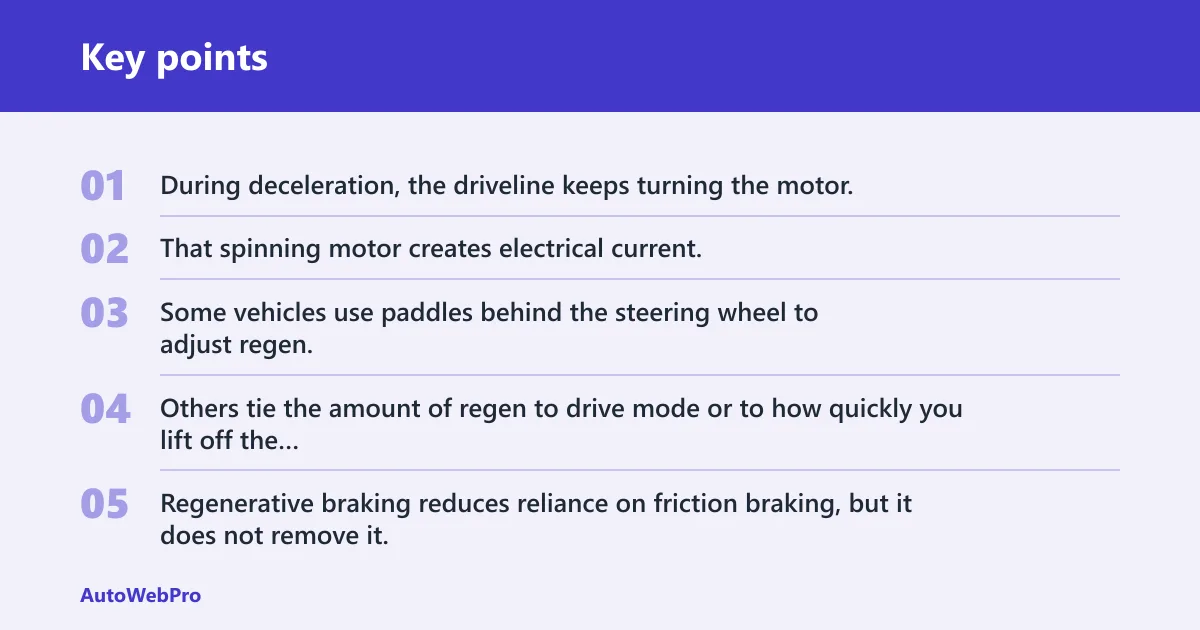
During deceleration, the driveline keeps turning the motor. That spinning motor creates electrical current, which the vehicle routes to the battery if conditions allow. Some vehicles use paddles behind the steering wheel to adjust regen. Others tie the amount of regen to drive mode or to how quickly you lift off the accelerator.
How slowed motion turns into battery charge
Regenerative braking reduces reliance on friction braking, but it does not remove it. Brake pads are still used when regenerative capacity is exceeded. Battery state of charge matters too. A nearly full battery can reduce regenerative braking effectiveness because there is less room to store more recovered energy.
Where regen appears in EVs, hybrids, and plug-in hybrids
Regenerative braking works in EVs, hybrids, and plug-in hybrids. Kia says all Kia electric, hybrid and plug-in hybrid models feature regenerative braking. That model-level detail varies by brand, but the operating idea is the same: slow the vehicle first with energy recovery, then finish the stop with friction braking when needed.
Regular brakes still matter
Friction brakes are still required in hybrid and EV braking systems. They use brake pads clamping onto discs or rotors to create stopping force. That hardware provides the final stop and the emergency stop, where regen alone cannot deliver sudden, high-demand braking quickly enough.
Pads, rotors, and the final stop
Brake pads and discs or rotors still do real work in regen-equipped vehicles. They may see less use than in traditional cars, but they do not disappear. Repeated low-load use can be reduced, and that changes wear patterns. Less use can also mean more rust or sticking risk on some components.
Why friction brakes are still required for emergencies
Regen alone cannot bring a car to a complete stop quickly. Safety systems still rely on friction braking for maximum stopping force. In a hard panic stop, the vehicle may add regen where it can, but the regular brakes do the heavy lifting.
What changes when regen is limited
Regen can be limited by battery state of charge, speed, temperature, and pedal demand. When that happens, the vehicle blends in friction braking earlier. The driver may feel a firmer or more conventional stop. That does not mean the system failed. It means the car shifted the load to the brakes that can finish the job.
Brake split checklist
This checklist shows the usual split between regen and friction braking. The exact handoff varies by vehicle, but the pattern below is the one most drivers will notice in day-to-day use.
| Scenario | What likely does most of the work | What the driver feels | What to expect from the brakes |
|---|---|---|---|
| Lift off the accelerator | Regen | Noticeable slowing without touching the pedal | The motor generates electricity and sends it to the battery |
| Gentle stop | Mostly regen, then a little friction near the end | Smooth deceleration, then a softer finish | Brake pedal blending adds the regular brakes as speed falls |
| Hard stop | Both, with friction brakes taking the lead | Strong pedal pressure and a faster stop | Regular brakes provide the main stopping force |
| Downhill driving | Regen first, friction if needed | Steady speed control, often with less pedal use | Blend can shift if the battery nears full or speed changes |
| Cold or near-full battery | Friction more often, regen reduced | Less slowing from lift-off, more conventional pedal feel | Battery state of charge can limit energy capture |
| Emergency stop | Friction brakes | Immediate, heavy stopping force | Regen is secondary; safety systems depend on traditional brakes |
Two common real-world situations
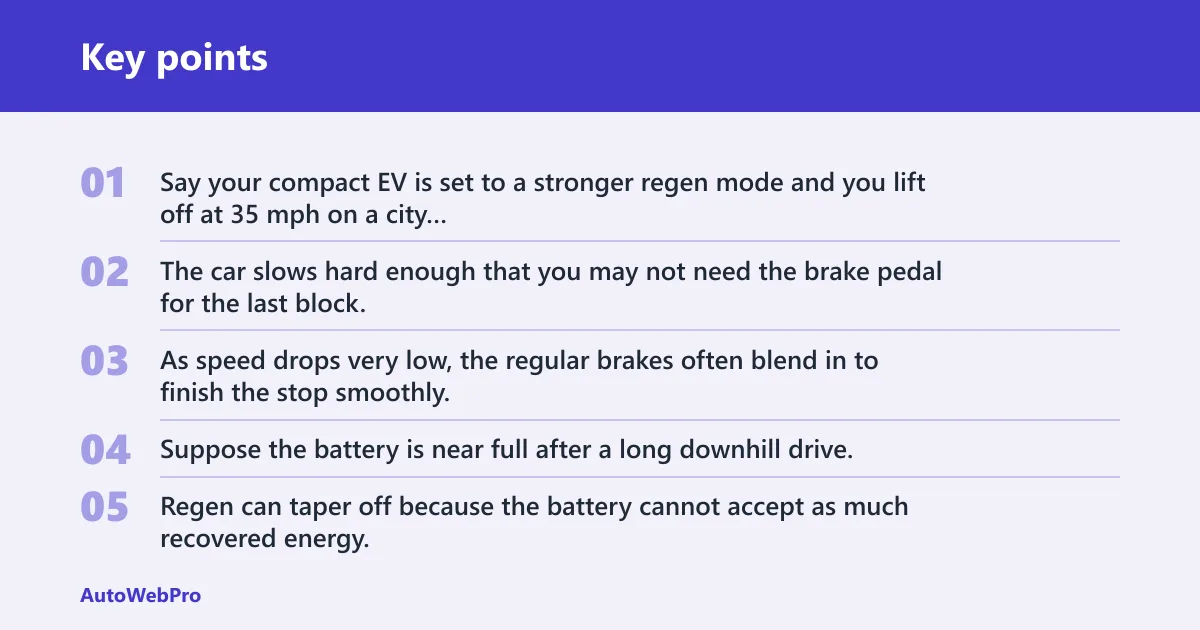
Say your compact EV is set to a stronger regen mode and you lift off at 35 mph on a city street. The car slows hard enough that you may not need the brake pedal for the last block. As speed drops very low, the regular brakes often blend in to finish the stop smoothly.
Suppose the battery is near full after a long downhill drive. Regen can taper off because the battery cannot accept as much recovered energy. The car then leans on the friction brakes sooner, and the pedal may feel more familiar than it did earlier in the trip.
Why the pedal feel changes
Brake pedal blending combines regen and friction braking automatically. The split is not fixed. It changes with vehicle software, speed, pedal pressure, drive mode, and battery state. That is why two similar EVs can feel very different even when both are using the same basic braking logic.
Low-speed blend-in and the handoff to friction brakes
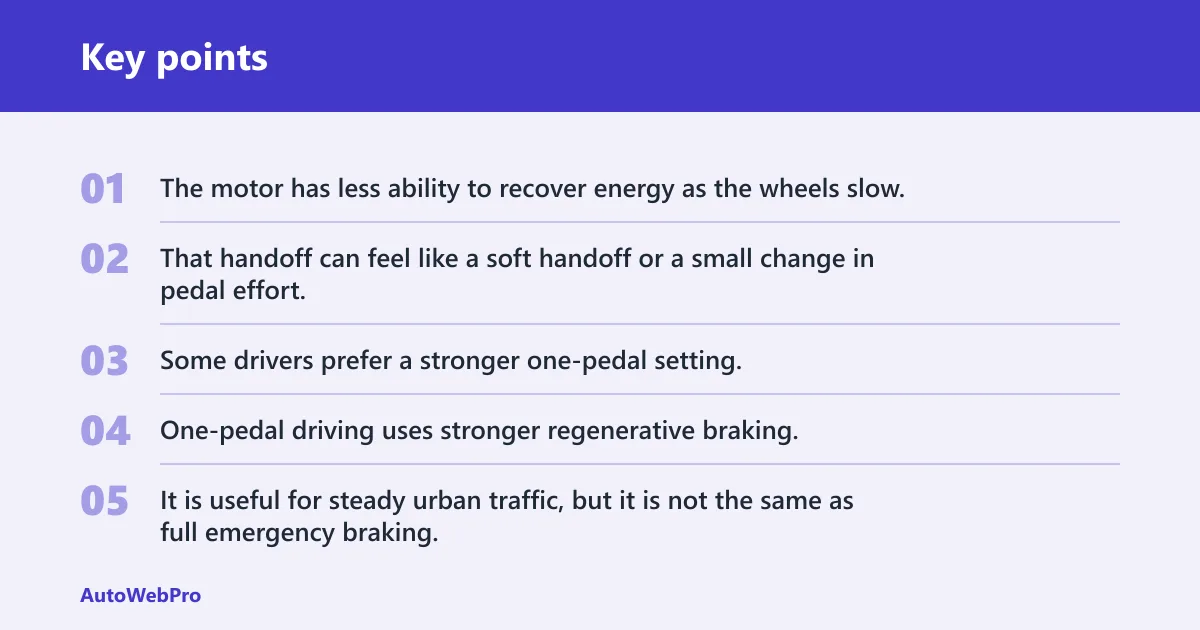
At low speed, regen usually gets weaker. The motor has less ability to recover energy as the wheels slow, so the system adds friction braking to finish the stop. That handoff can feel like a soft handoff or a small change in pedal effort, depending on how the vehicle is tuned.
Why different modes feel different
Some drivers prefer a stronger one-pedal setting. One-pedal driving uses stronger regenerative braking, so lifting off the accelerator can slow the car significantly. It is useful for steady urban traffic, but it is not the same as full emergency braking. You still need the brake pedal for abrupt stops and for maximum force.
Does regenerative braking wear out brake pads?
Yes, usually more slowly. Because regen handles more of the deceleration, brake pads often see less use and may last longer than in a comparable gasoline car. That said, they still need periodic inspection and replacement. Less use can also create its own maintenance issues if parts sit too long without being loaded.
Why pads can last longer
When regen does more of the slowing, the pads are not clamped against the rotors as often. That lowers wear. Brake pads and discs won’t need replacement nearly as often in traditional cars, and the same logic helps explain why regen-equipped vehicles can reduce brake wear over time.
Why rotors still need attention
Brake discs or rotors still work with the friction brakes to create stopping force. They can wear, and they may need replacement. In vehicles that use regen heavily, the rotors may see less frequent loading, which can leave surface rust that is harmless at first but may become noticeable.
Why underused brakes can rust or stick
If a vehicle leans on regen most of the time, the hardware behind the wheels can sit unused for longer stretches. That can lead to light corrosion, sticky slide pins, or uneven pad contact. Regular inspection matters because a brake system that sees less use can still need cleanup or service.
Frequently asked questions
Does regenerative braking use the actual brakes?
Usually, no for the main slowdown. Regenerative braking uses the electric motor as a generator, not the pad-and-rotor hardware, to recover energy. The actual brakes come in for harder stops, the last part of a gentle stop, and any situation where regen cannot provide enough stopping force.
Does regenerative braking use the brake pads?
Yes, but less often. Brake pads still matter because the car blends in friction braking when regen is limited or when the stop demand is higher. The pads may wear more slowly overall, but they still need inspection, and underused pads can develop rust or sticking issues.
Can regenerative braking stop the car completely?
Not quickly enough on its own in normal driving. Regen can slow the car a lot, especially in stronger lift-off settings, but the regular brakes are still required to bring the vehicle to a complete stop, especially at very low speed or in any emergency stop.
Is regenerative braking worth it?
For most EV and hybrid drivers, yes. It can recover some energy, reduce reliance on friction braking, and cut brake pad use. The tradeoff is that the feel changes by vehicle and situation, and a nearly full battery can reduce how much energy the car can take back.
What is the best way to use regenerative braking?
Use the setting that matches your driving and local traffic. A stronger regen mode can help in stop-and-go traffic, while a milder setting may feel more natural on open roads. Treat one-pedal driving as a convenience feature, not a replacement for the brake pedal or for emergency braking.
Does Tesla regenerative braking use the brakes?
Tesla braking follows the same basic split used by other EVs: regen handles much of the slowdown, and the regular brakes finish the stop or cover emergencies. The exact blend depends on speed, pedal input, battery state, and settings. The same task split still applies.