Should You Buy a Discounted Honda CR-V or Order New?
Buy the prior-year CR-V only if the verified out-the-door discount is larger than the value of the newer model’s added features, later warranty start, and stronger resale. A common target is at least about $2,000 to $3,000 off. Otherwise, you can save little now and pay more later through weaker trade-in value or a shorter remaining warranty window. This guide shows how to compare discount, equipment, warranty timing, and resale so you can choose with a clean break-even check.
CR-V model-year trade-off
The decision is usually not “old versus new.” It is sticker versus real price, plus what the later model year gives you in warranty timing, equipment, and resale. If the outgoing CR-V is a carryover with no major changes, the math favors the leftover only when the discount is large enough to beat those benefits.
Out-the-door price versus sticker price
MSRP is only the starting point. Destination charge, documentation fee, title, tax, registration, and any dealer-installed add-ons can push the final number far above window sticker. A leftover with a big advertised discount can still cost more than a current-model CR-V if the dealer pads the deal with fees or accessories.
| Comparison item | Prior-year CR-V leftover | Newest CR-V |
|---|---|---|
| Purchase price | Usually lower if aged inventory is discounted | Usually closer to MSRP |
| Warranty start | Starts on in-service date, so stock sitting on the lot can shorten remaining coverage | Starts when you buy or take delivery |
| Feature set | Can be equal on carryover trims, or older on refresh years | May add equipment, software, or safety changes |
| Resale outlook | Older model year from day one | Better age position in future trade-in math |
Warranty start date and ownership horizon
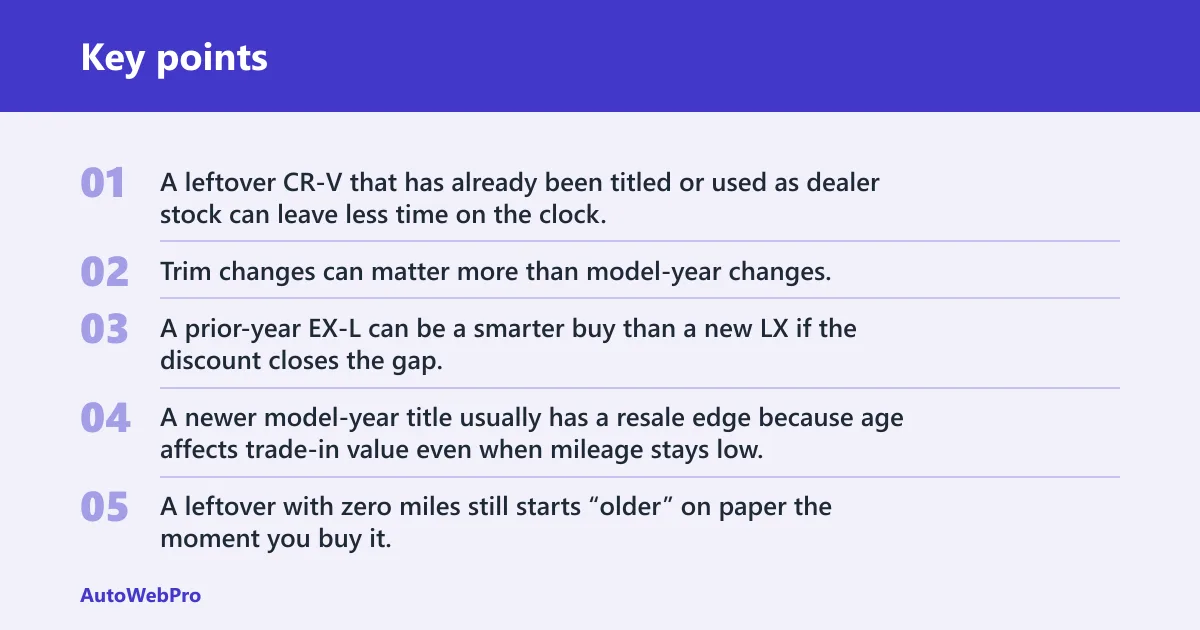
Honda’s new-vehicle warranty is commonly understood to start when the vehicle is first put into service, not when the buyer signs the final papers. A leftover CR-V that has already been titled or used as dealer stock can leave less time on the clock. That matters most if you plan to keep the vehicle only three to five years.
Feature content by trim and model year
Trim changes can matter more than model-year changes. On the CR-V, LX is the base step, EX adds more convenience, EX-L brings leather and a larger feature load, and Sport, Sport-L, and Sport Touring move farther into appearance, hybrid, and tech territory. A prior-year EX-L can be a smarter buy than a new LX if the discount closes the gap.
Resale value after five years
A newer model-year title usually has a resale edge because age affects trade-in value even when mileage stays low. A leftover with zero miles still starts “older” on paper the moment you buy it. The mileage-free advantage helps, but it rarely erases the model-year penalty unless the discount is meaningful.
Discounted prior-year honda cr-v worksheet
The break-even test is simple: compare the leftover’s real out-the-door discount against the dollar value of the newer model’s extra features, later warranty start, and better resale. If the discount is smaller than that combined value, the newer CR-V is the cleaner buy. If it is larger, the leftover wins on total value.
Inputs you need before you shop
- Write down both OTD quotes. Ask for a line-item quote on the prior-year CR-V and the current-year CR-V with destination, dealer fee, and add-ons listed separately. That is the only number that matters for comparison.
- Match the trim and drivetrain. Compare like with like whenever possible: gas to gas, hybrid to hybrid, front-drive to front-drive, or all-wheel drive to all-wheel drive. Cross-shopping a leftover Sport-L hybrid against a new LX gas model hides the real price gap.
- Count the warranty days left. Check the in-service date on the leftover inventory. A unit that has sat for months can reduce the remaining bumper-to-bumper and powertrain time you actually get.
- Estimate your ownership length. The longer you keep it, the more a newer model’s later resale date matters. A short hold makes the upfront discount more important.
Discount threshold for leftover inventory
A practical target is about $2,000 to $3,000 off the verified out-the-door number before the leftover starts to compete well with the newest model. That range is not a rule from Honda; it is a break-even guide that fits a normal carryover year with no major redesign. If the current-year CR-V has a fresh feature set or a cleaner warranty start, the needed discount can be even higher.
Suppose a leftover EX-L is $2,400 cheaper out the door than a new EX-L, but the leftover already has eight months of warranty clocked and the new model adds wireless phone projection. If you plan to keep the SUV for five years, that discount may feel thin once resale and warranty timing are counted.
When the newer model wins on value
The new CR-V usually wins when the leftover discount is small, when the outgoing model year misses a feature you want, or when you plan to keep the vehicle long enough that stronger resale matters. It also wins when the dealer’s “discount” is mostly offset by fees, accessories, or a trade-in number that is easier to pad than to verify.
Picture a shopper comparing a leftover Sport Touring hybrid with a current-year Sport Touring hybrid. If the current model adds a useful tech change and the leftover savings are only a few hundred dollars after fees, ordering new is the better call.
What changed on the current CR-V?
The biggest model-year changes are the ones that affect daily use: safety content, infotainment, hybrid availability, and any trim reshuffle. If the outgoing and current CR-V are close in structure, a leftover can be attractive. If Honda moved content upward or changed trim packaging, the newest model may justify its price more easily.
Safety content and Honda Sensing
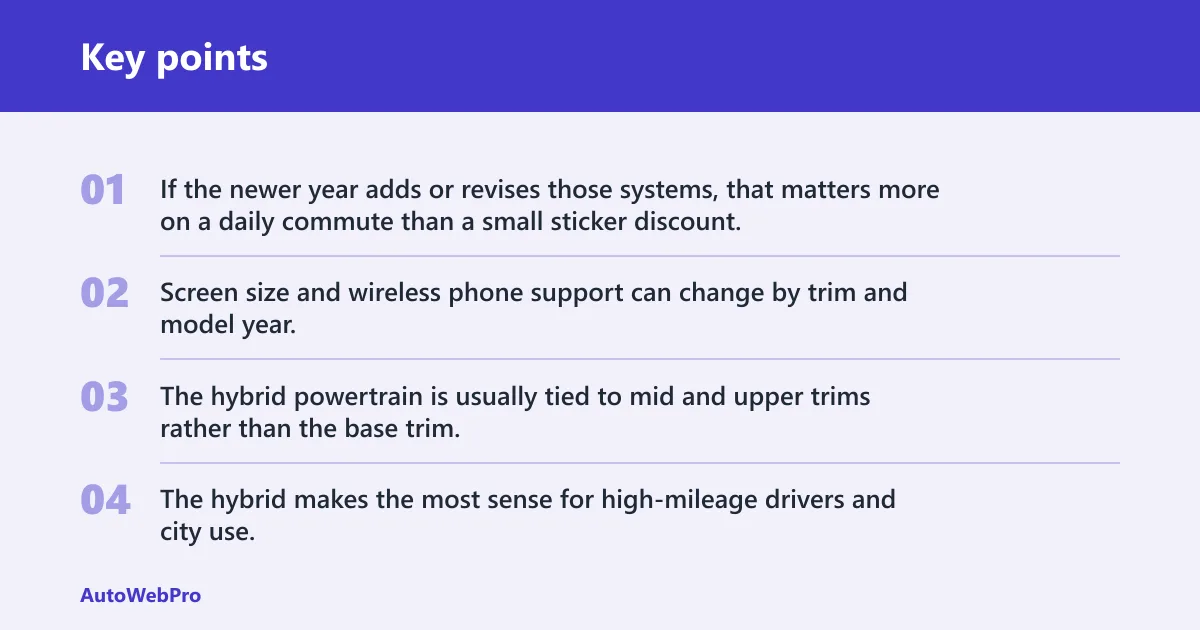
Honda Sensing is standard on the CR-V and typically includes driver-assistance features such as collision mitigation braking, road departure mitigation, adaptive cruise control, lane keeping assist, and traffic sign recognition. If the newer year adds or revises those systems, that matters more on a daily commute than a small sticker discount.
Infotainment and phone connectivity
Screen size and wireless phone support can change by trim and model year. On CR-V trims, the basic layout is usually smaller on LX and larger on upper trims such as EX and above, while wireless Apple CarPlay and Android Auto are often reserved for higher trims or later model years. That makes tech one of the easiest places to justify paying for the new model.
Hybrid availability and trim mix
The hybrid powertrain is usually tied to mid and upper trims rather than the base trim. That means a leftover hybrid can be a strong buy if you want fuel savings and the dealer has one on hand, but the premium over a gas model still needs to earn its keep through mileage and resale. The hybrid makes the most sense for high-mileage drivers and city use.
Exterior or interior updates that move the price
Model-year updates that touch the grille, lighting, seat trim, display size, or cabin materials can affect value more than a simple model-year label. Those changes do not always change resale much on their own, but they can change how long the vehicle feels current. That matters if you keep cars until the wheels fall off.
How much discount is enough?
Use the sticker only as a reference. The real question is how much lower the outgoing CR-V lands after destination, dealer fee, add-ons, and incentives are all counted. If the final OTD price is not clearly below the newest model, the leftover is just an older car with a shorter warranty clock.
MSRP, destination, and dealer fees
Honda prices the CR-V by trim, and destination charge is part of the sticker math before dealer fees begin. The gap between trims can be meaningful, especially when moving from LX to EX or from gas to hybrid. Once you know the base MSRP ladder, you can see whether the leftover discount is real or just a noisy ad.
Incentives versus advertised discounts
Some dealer ads fold incentives into the headline price and leave out the fees. Others advertise a larger discount that depends on financing, trade-in, or dealer-installed equipment. Treat every quoted savings number as unverified until you have a line-item out-the-door sheet.
- Request the full breakdown. Ask for MSRP, discount, incentive, documentation fee, tax, title, registration, and every add-on in writing. That lets you compare one dealer against another without guessing.
- Remove optional extras. Decline coating packages, etching, nitrogen fills, and prepaid accessories unless they are included in your target price. Those items often erase the savings you were promised.
- Compare the same trim. A leftover EX against a new EX is a clean comparison. A leftover EX against a new EX-L is not a price difference; it is a trim difference.
How to verify the real out-the-door number
A dealer quote is real only if the total due matches the line items. Ask for the final “cash due at signing” amount and check whether any rebate depends on financing you do not want. If the price changes after fees are added, the advertised discount is not the discount you are actually getting.
Trim and powertrain value ladder
CR-V value changes by trim faster than many shoppers expect. LX is the lowest-cost path into the model, EX usually adds a useful comfort jump, and EX-L often hits the best balance for buyers who want a nicer cabin without paying top-trim money. Sport, Sport-L, and Sport Touring make the hybrid and tech case stronger.
LX and EX value basics
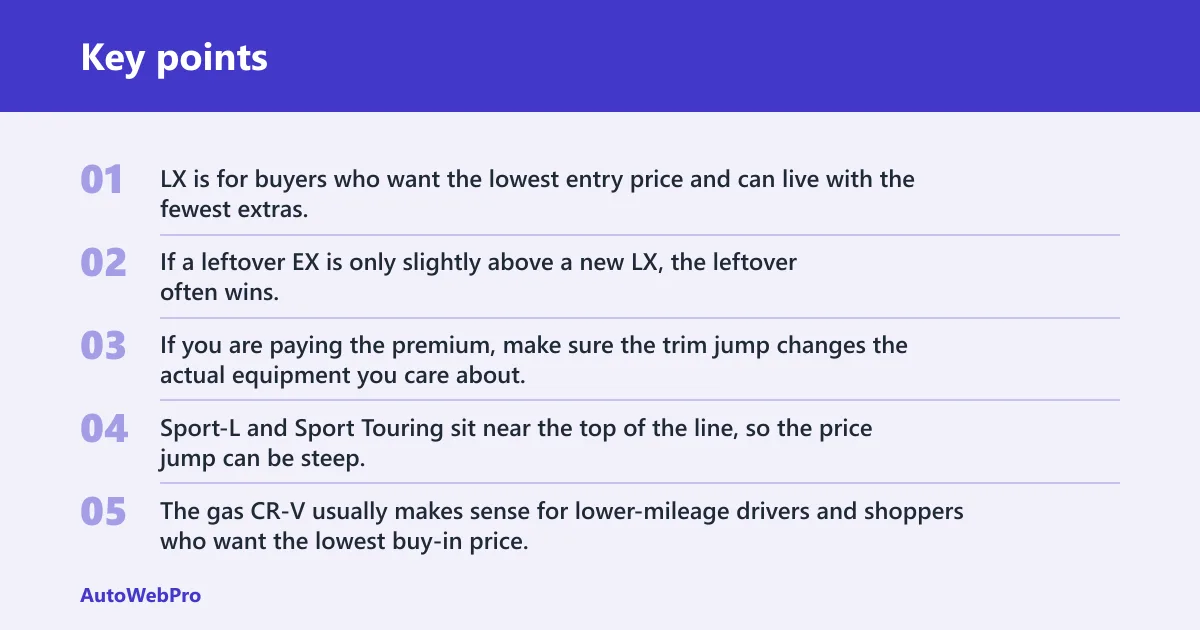
LX is for buyers who want the lowest entry price and can live with the fewest extras. EX is often the better everyday value because it tends to add the convenience features many drivers notice immediately, including a larger infotainment step and more standard driver-assistance content. If a leftover EX is only slightly above a new LX, the leftover often wins.
EX-L and Sport equipment jump
EX-L usually brings a more premium cabin, while Sport trims shift the value equation toward appearance and hybrid availability. The step up is worth it when you want features you will use every day, such as a bigger screen, more comfort, or a quieter-feeling cabin. If you are paying the premium, make sure the trim jump changes the actual equipment you care about.
Sport-L and Sport Touring premium
Sport-L and Sport Touring sit near the top of the line, so the price jump can be steep. The extra money often buys more tech and a more complete feature set, but the resale return on those items is never one-for-one. These trims make the most sense when you plan to keep the SUV for years and want the best-equipped version from day one.
Gas versus hybrid ownership fit
The gas CR-V usually makes sense for lower-mileage drivers and shoppers who want the lowest buy-in price. The hybrid usually fits drivers who spend more time in stop-and-go traffic or rack up enough miles to recover the higher sticker through fuel savings. If your commute is short and mixed, the gas model may be the better payback story.
All-wheel drive and regional use
All-wheel drive matters most in snowy regions, on steep driveways, or when you want extra traction confidence in rain and loose surfaces. It adds to the purchase price and can help resale in cold-weather markets, but it does not turn the CR-V into a different class of vehicle. Buy AWD for your conditions, not for an abstract spec sheet.
What do you lose by buying last year?
You usually give up time more than equipment. The leftover may be close to the current model in features, but the warranty clock starts earlier and the vehicle is older the moment you sign. If the current year added tech, safety tweaks, or a stronger trim mix, that gap also counts.
Warranty start timing
The warranty disadvantage is easy to miss because the odometer may still show delivery mileage. The real issue is the in-service date. A leftover that has been sitting for half a year can leave you with half a year less coverage, even if it looks brand new.
Latest tech and safety content
If the newest CR-V changed screen size, wireless phone support, camera quality, or driver-assistance tuning, those updates may be worth real money. The value is highest for drivers who rely on those systems daily. A leftover only wins here if the current-year changes are small or irrelevant to your use.
Depreciation and resale timing
Depreciation starts as soon as the vehicle is titled. A prior-year CR-V has less age runway than a current-year CR-V, so its future trade-in value may be lower at the same mileage. That does not erase a big discount, but it does mean the savings must be real, not cosmetic.
Choose prior-year CR-V if… / Choose new CR-V if…
Choose the prior-year CR-V if the verified OTD discount is about $2,000 to $3,000 or more, the trim and drivetrain match your needs, and the leftover still has enough warranty time for your planned ownership length. Choose the new CR-V if the discount is relatively small, the newer model adds equipment you want, or you plan to keep it long enough that later resale may matter more.
- Choose prior-year CR-V if… the dealer discount is real after fees and add-ons; the trim is the one you want; and the vehicle has not spent so long on the lot that the remaining warranty is meaningfully shortened.
- Choose prior-year CR-V if… you are comparing a higher leftover trim to a lower new trim and the feature gap matters more than the model-year gap.
- Choose new CR-V if… the current model adds the safety, infotainment, or hybrid content you wanted anyway.
- Choose new CR-V if… you keep cars a long time, want the freshest warranty start, or care about the cleanest resale position after five years.
Frequently asked questions
Is it better to buy a leftover Honda CR-V or wait for the new model?
It is better to buy the leftover only when the out-the-door discount clearly beats the value of the newer model’s extra features, later warranty start, and stronger resale. If the savings are modest, waiting is usually the cleaner value play because the newer CR-V starts its ownership clock later.
How much money can I save on a prior-year Honda CR-V?
A practical target is $2,000 to $3,000 off the verified out-the-door price. Less than that can disappear quickly once you account for fees, taxes, and the older model-year hit to future trade-in value. Bigger savings matter most if the leftover is the same trim and drivetrain you wanted anyway.
What do I lose by buying an outgoing CR-V trim?
You can lose warranty time, newer tech, and some resale value. If the outgoing trim is a carryover with no meaningful content loss, the main penalty is age. If Honda moved equipment around, the older trim may also miss the infotainment or convenience features that make the current model easier to live with.
Does the newest Honda CR-V have better safety or tech than last year?
Sometimes yes, sometimes no. Honda Sensing is standard across the line, but model-year changes can still alter screen size, wireless phone connectivity, or driver-assistance tuning. The newest model only wins on safety and tech if the updated equipment is actually different, not just newer on paper.
Should I choose a higher trim from last year or a lower trim on the new model?
Choose the higher prior-year trim if the feature jump is meaningful and the price gap still stays within your budget after fees. Choose the lower new trim if the newer model gives you the warranty timing, safety, or tech you want and the leftover savings do not close the equipment gap.
When does it make sense to order the newest model instead of buying a leftover?
Order new when the leftover discount is small, the current model has the features you want, or you plan to keep the SUV for many years. It also makes sense when the dealer’s advertised savings depend on fees or add-ons that make the real price gap much smaller than it first appears.