RAV4 Prime Trims Explained: SE vs XSE and How to Choose
Choose the RAV4 Prime SE if you want the lowest-cost path into the model. Choose the XSE only if you will use its extra comfort, tech, and premium details every day. Pick the wrong trim and you either pay for features you will ignore or skip equipment you wanted from the start. This guide compares the SE and XSE, the real differences, and which buyer each trim fits best.
SE vs XSE at a glance
The Toyota RAV4 Prime SE is the value-first pick. The Toyota RAV4 Prime XSE makes sense only if you will notice and use the nicer cabin, added convenience gear, and extra tech on a daily basis. Both trims use the same plug-in hybrid setup, with all-wheel drive and quick acceleration, so the choice is mostly about equipment and use case rather than basic capability. EPA figures for range and Toyota’s published model details are the best starting point for comparing them.
| Factor | SE | XSE and how to choose | Winner |
|---|---|---|---|
| Price / cost | Lower MSRP and the simplest trim path; best if you care most about monthly payment and total cash outlay. | Higher MSRP with more standard comfort and tech; worth it only if the added equipment is worth the higher sticker price to you. | SE |
| Cabin comfort | Simpler cabin; practical, but not the nicer daily experience. | More premium daily experience with richer cabin presentation and comfort features. | XSE and how to choose |
| Tech / infotainment | Core infotainment setup with the less premium feel. | More upscale display experience, richer tech presentation, and better fit for bigger-screen or easier-phone-integration shoppers. | XSE and how to choose |
| Seat materials | More basic seat materials. | More premium seat trim and a richer cabin feel. | XSE and how to choose |
| Performance / drivetrain | Same plug-in hybrid setup with standard all-wheel drive and quick acceleration. | Same plug-in hybrid setup with standard all-wheel drive and quick acceleration; no meaningful performance gap versus SE. | Tie |
| Charging and EV range | Same charging basics as XSE; Level 1 120V or Level 2 240V depending on equipment, and EPA range is shared, not trim-specific. | Same charging basics; package content can affect convenience equipment, but the powertrain and charging logic are shared. | Tie |
| Winter confidence / AWD | All-wheel drive helps in snow and slush; traction advantage is shared. | All-wheel drive helps in snow and slush; may feel nicer in cold weather if comfort gear is equipped. | Tie |
| Camera / parking aids | Core safety and visibility features, with package-dependent extras. | More likely to bundle the camera and parking aids shoppers want. | XSE and how to choose |
| Package availability | Fewer upgrade paths, which keeps the trim straightforward. | More likely to offer the equipment combinations buyers cross-shop for. | XSE and how to choose |
| Best-fit use | Best value-first choice for buyers who want the lowest-cost path, lower ownership cost, and basic space and all-weather capability. | Best for buyers who will use the extra comfort, tech, and premium details every day and want a nicer cabin. | Tie |
Price sensitivity
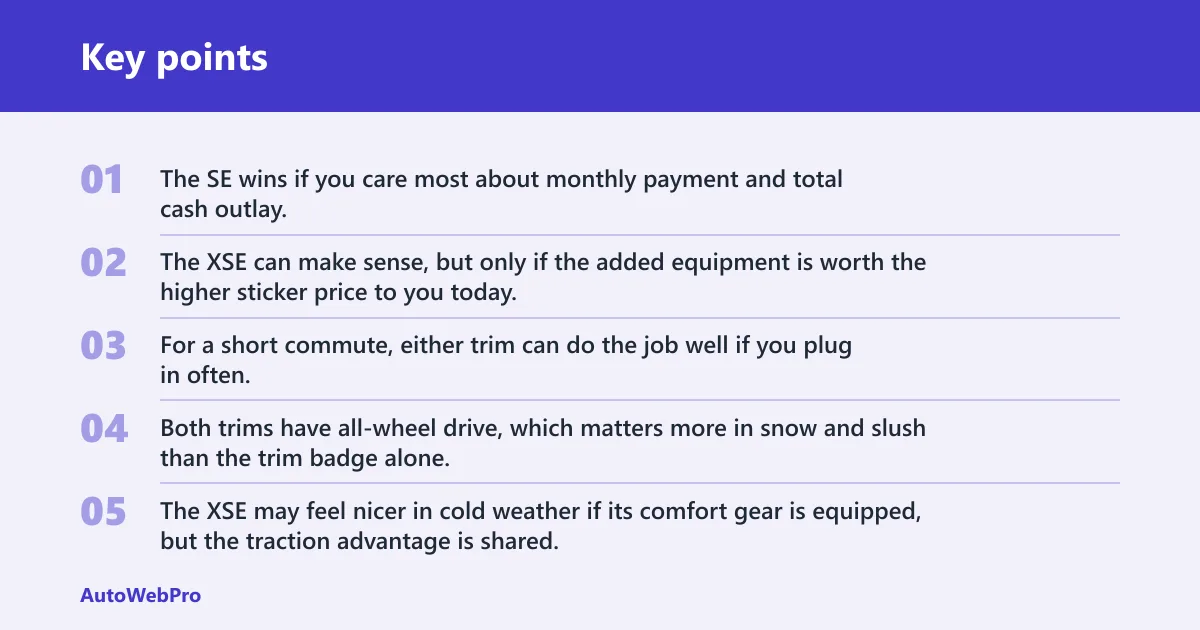
The SE wins if you care most about monthly payment and total cash outlay. The XSE can make sense, but only if the added equipment is worth the higher sticker price to you today.
Commuter efficiency
Both trims use the same plug-in hybrid formula, so efficiency comes from your charging habits more than the badge on the tailgate. For a short commute, either trim can do the job well if you plug in often. EPA range is shared, not trim-specific.
Winter confidence
Both trims have all-wheel drive, which matters more in snow and slush than the trim badge alone. The XSE may feel nicer in cold weather if its comfort gear is equipped, but the traction advantage is shared.
Cabin comfort
The XSE is the trim that usually delivers the more upscale cabin experience, while the SE keeps the price down. If you are fine with a simpler cabin, the SE is the straightforward choice.
Tech appetite
If you care about the biggest screen, easier phone integration, or a more upscale infotainment setup, the XSE is the better place to shop. Some features can be package-dependent, so verify the exact vehicle rather than assuming every XSE gets the same gear.
Charging convenience
Charging convenience depends more on the onboard charger and equipment than on the badge alone. That is why the winner here is a tie until you verify the vehicle’s charging hardware on the window sticker or build sheet.
Family practicality
Both trims are still the same RAV4 Prime underneath, so the core family utility is similar. The SE keeps costs lower without giving up the basic space and all-weather capability that matter most to many families.
Long-term value
The SE is the cleaner value play if you want to keep ownership costs lower. The XSE can hold appeal if you genuinely want the comfort and tech upgrades, because paying for features you use every day is easier to justify than paying for shiny extras you ignore.
What the RAV4 Prime powertrain gives you
Both the RAV4 Prime SE and XSE use the same plug-in hybrid system, standard all-wheel drive, and the same quick-hitting performance that separates the RAV4 Prime from a regular RAV4 hybrid. Toyota’s model information and EPA data show the core mechanical setup is shared, so trim choice is mainly about equipment, not whether one version is materially faster or more capable.
Plug-in hybrid system and AWD
The RAV4 Prime pairs electric driving with a gasoline engine, so you can cover short trips on electricity and still have the backup of hybrid operation for longer drives. Standard AWD helps in wet, snowy, or gravel-heavy conditions, and both trims benefit from that same layout.
Electric driving range and commuting use
The RAV4 Prime’s EPA-rated electric range is about 42 miles on some model years, which can cover a lot of round-trip commuting without using gasoline. Actual range changes with temperature, speed, hills, tires, and cabin heat or A/C use, so cold-weather commutes usually see less electric distance than the EPA number suggests.
Performance difference between trims
Do not expect a performance gap between SE and XSE that changes the buying decision. The strong acceleration comes from the shared powertrain, not from one trim having a different mechanical setup.
How do charging and EV range affect daily use?
Charging matters because it determines how often you can actually use the plug-in part of the RAV4 Prime. Level 1 charging from a household outlet is convenient but slow, while Level 2 charging at home or work is much more practical if you want to start each day with a full battery. EPA range and Toyota’s charging guidance point to the same conclusion: the plug-in benefit is best when you recharge often.
-
Check your charging setup.
Level 1 uses a standard 120-volt outlet and is the slowest option. Level 2 uses 240 volts and is the better match for daily plug-in use, especially if you want overnight replenishment.
-
Confirm the onboard charger.
Charging speed can change with the vehicle’s onboard charger and any package-specific hardware, so do not assume every SE or every XSE charges the same way. Check the exact listing for the vehicle you are considering.
-
Plan for real-world range.
Wind, cold weather, fast highway travel, steep terrain, and cabin HVAC use can all trim electric miles. A 42-mile EPA range may be enough for a commute on paper, yet the margin gets smaller once winter and highway speeds enter the picture.
Say your daily driving is mostly short school runs and errands, so a RAV4 Prime SE with regular home charging covers nearly all of it in EV mode. In that case, either trim can often cover the round trip on electricity alone, but a cold January morning may shorten that buffer enough that gasoline kicks in before you expected.
A common first-timer mistake is assuming a 120-volt outlet will refill the battery as quickly as a public DC fast charger. It will not; the RAV4 Prime is a plug-in hybrid, so home AC charging is the normal use case, and the exact refill time depends on the charger and the vehicle’s equipment.
Which trim feels better inside?
The XSE is the better interior pick if you want the cabin to feel nicer every day. The SE gets the core RAV4 Prime formula, but the XSE is where Toyota usually adds the more upscale materials and convenience features that you notice on every drive.
Seat materials and comfort features
Seat material is one of the clearest separators between the trims, with the XSE generally aiming for a more premium feel. Heated seats are common on well-equipped versions, while ventilated seats, a moonroof, or a panoramic-style roof can depend on model year and package, so confirm the exact build.
Cabin noise and daily feel
The XSE is the trim that makes more sense if you spend a lot of time in the vehicle and care about a calmer, richer-feeling cabin. The SE is still practical, but it is the more straightforward value choice rather than the nicer one.
Roof, visibility, and convenience
Roof equipment varies by trim and package, so do not assume every XSE gets the same glass roof or every SE is stripped down. If visibility, light, and an airy cabin matter to you, check those details before you compare prices.
How different is the tech and safety gear?
Both trims bring the safety core most shoppers expect, but the XSE is the better match for buyers who want more premium infotainment and convenience features. Toyota Safety Sense is the relevant driver-assistance suite to look for, though exact camera or parking aids can vary by build and model year. Toyota’s published equipment lists are the safest way to verify what is standard on a given vehicle.
Infotainment and smartphone integration
Screen size and phone integration can differ by model year and package, so verify the actual car rather than assuming the brochure summary tells the whole story. Wireless smartphone integration may be included on some versions, but that feature is not safe to treat as universal across every SE and XSE listing.
Navigation and audio
Built-in navigation and premium audio can also be package-dependent. If you care about those extras, the XSE is the trim to inspect first, but the safest move is to confirm the exact equipment list before you pay for it.
Toyota Safety Sense and driver aids
Toyota Safety Sense adds the active safety set most buyers want: adaptive cruise control, lane tracing or lane keeping support, and related driver aids that reduce fatigue on long drives. Camera and parking features vary by trim and package, so check whether the vehicle you are shopping includes the view or parking assistance you want.
-
Verify the safety package.
Look at the window sticker or build sheet for the exact driver-assistance content. That matters because the core Toyota Safety Sense suite is shared, while some comfort and camera features change with equipment level.
-
Match features to your routine.
If you park in tight garages or city spaces, camera coverage may matter more than a bigger screen. If your commute is mostly highway miles, adaptive cruise and lane support are the features you will notice most.
RAV4 Prime decision matrix
This is the shortest path to the right trim. If the XSE’s extras will not change your daily routine, the SE is the smarter buy; if you want the nicer cabin and better tech every single day, the XSE is the one that earns its keep.
| Buyer priority | SE score | XSE score | Choose this trim if… | Winner |
|---|---|---|---|---|
| Price sensitivity | 5 | 3 | you want the lower MSRP and the least expensive route into the RAV4 Prime. | SE |
| Commuter efficiency | 4 | 4 | you care about charging often and maximizing EV miles more than trim dress-up. | Tie |
| Winter confidence | 4 | 4 | you mainly want AWD and shared plug-in hybrid capability in bad weather. | Tie |
| Cabin comfort | 3 | 5 | you want the more premium seats, trim, and daily cabin feel. | XSE |
| Tech appetite | 3 | 5 | you want the richer screen, audio, and convenience story when equipped. | XSE |
| Charging convenience | 4 | 4 | you will verify the charger and package content before buying. | Tie |
| Family practicality | 5 | 4 | you want the same utility at the lowest sensible price. | SE |
| Long-term value | 5 | 4 | you want to avoid paying for features you may not use every day. | SE |
Price sensitivity: the SE wins
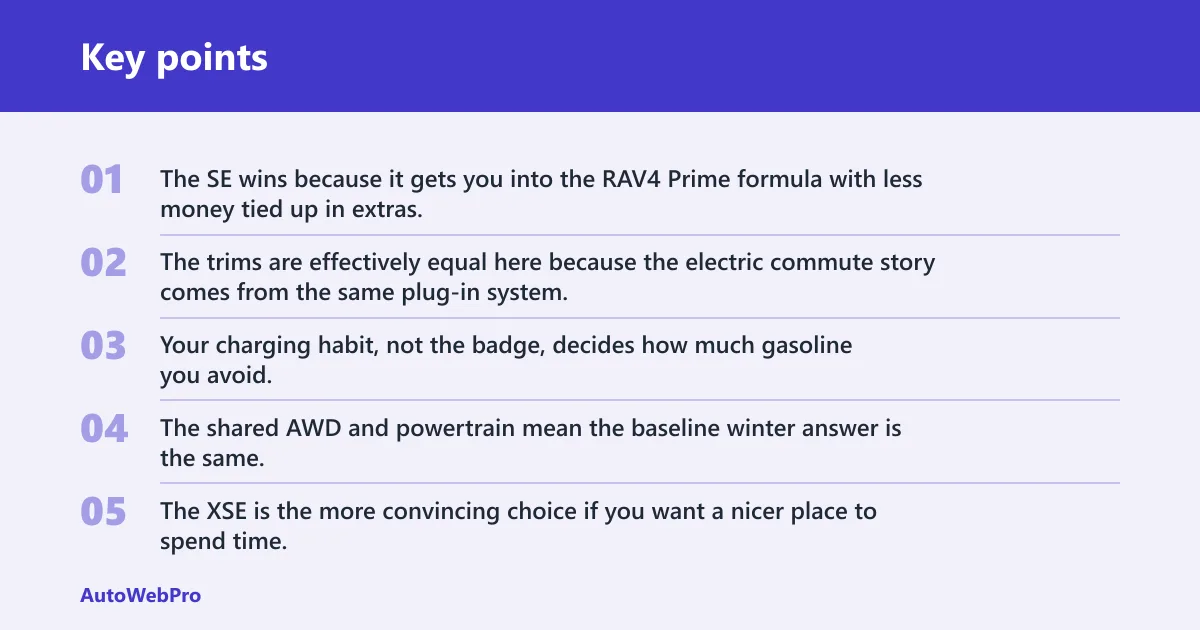
The SE wins because it gets you into the RAV4 Prime formula with less money tied up in extras. That matters even more once you factor in insurance, taxes, and registration, which often rise with a higher sticker price.
Commuter efficiency: the trims are effectively equal
The trims are effectively equal here because the electric commute story comes from the same plug-in system. Your charging habit, not the badge, decides how much gasoline you avoid.
Winter confidence: the shared AWD and powertrain
The shared AWD and powertrain mean the baseline winter answer is the same.
Cabin comfort: the XSE is the more
The XSE is the more convincing choice if you want a nicer place to spend time. If you view the RAV4 Prime mainly as a tool, the SE is enough.
Tech appetite: tech-focused buyers are the most
Tech-focused buyers are the most likely to appreciate the XSE. That said, some high-end items can depend on model year and package, so the only honest way to shop is to verify the exact vehicle rather than assume every XSE has the same equipment.
Charging convenience: charging convenience is mostly
Charging convenience is mostly a home-infrastructure question. If you have easy access to Level 2 charging, either trim works well; if you do not, the trim badge will not change the math much.
Family practicality: families that want strong utility
Families that want strong utility at the lowest sensible price usually land on the SE.
Long-term value: the SE has the cleaner
The SE has the cleaner value story because you avoid paying for features you may not use daily. The XSE can still be smart if its extra comfort and tech will matter on every school run, commute, and weekend trip.
Choose SE if… / Choose XSE if…
Choose the SE if you want the lower-cost RAV4 Prime, plan to charge mostly for commuting, and do not care about premium cabin extras. Choose the XSE if you will use the comfort and tech upgrades every day, want the nicer-feeling interior, and are happy to pay more for features you will notice on every drive.
Choose SE if…
- You want the best value and the lowest sensible trim cost.
- You mainly care about plug-in efficiency, AWD, and family utility.
- You do not need the more upscale cabin or premium convenience gear.
Choose XSE if…
- You will use the comfort upgrades every day, not once in a while.
- You want the cabin to feel more premium on every commute.
- You are willing to confirm the exact equipment list so you know which tech and charging items are actually on the vehicle.
Frequently asked questions
What is the difference between the RAV4 Prime SE and XSE?
The SE is the value-focused trim, while the XSE adds more comfort and tech features that appeal to buyers who want a nicer daily experience. Both share the same plug-in hybrid setup and all-wheel drive, so the real gap is equipment and cabin feel rather than basic capability.
Is the RAV4 Prime XSE worth the extra money?
It is worth the extra money only if you will use the added comfort and technology every day. If you mostly want the plug-in powertrain and AWD, the SE usually makes more financial sense because it delivers the core RAV4 Prime benefits at a lower price.
Which RAV4 Prime trim has better comfort features?
The XSE is the stronger comfort choice. It is the trim more likely to get the nicer seat materials and premium cabin touches, although some comfort items can depend on package and model year, so you should verify the exact vehicle before buying.
How far can the RAV4 Prime go on electric power alone?
Many model years are EPA-rated at about 42 electric miles. Actual range changes with temperature, speed, terrain, and climate control use, so a cold highway commute will usually deliver less than the EPA number while gentle city driving may come closer.
Does the SE or XSE have better tech and safety features?
The XSE is the better pick for tech shoppers, but safety tech is shared at the core level. Toyota Safety Sense is the key suite to look for, and extra infotainment or camera features can depend on the exact package.
Which RAV4 Prime trim is better for daily commuting?
Either trim can work well for commuting because the same plug-in hybrid system is doing the heavy lifting. The SE is the better value if you just want the efficient commute, while the XSE makes sense if you want the nicer cabin for those miles every day.
How do I choose between RAV4 Prime SE and XSE?
Choose SE if you want the lowest-cost path to the RAV4 Prime powertrain, all-wheel drive, and electric commuting. Choose XSE if the added comfort and tech will matter on every drive, because paying for features you use regularly is easier to justify than paying for extras you barely notice.