What Does Regenerative Braking Mean in a Car?
Regenerative braking slows an EV or hybrid with its electric motor and turns that motion into battery charge. You usually feel stronger lift-off deceleration, and the effect can be limited when the battery is cold or full. Ignore how it works and you can misread the car’s slowing behavior, waste energy, and get caught off guard in traffic. This guide explains what it feels like, when the car reduces it, and what that means for daily driving.
Quick answer

Regenerative braking slows the vehicle while recovering energy that would otherwise turn into heat in the brake system. The driver still eases off the accelerator or presses the brake pedal, but the drivetrain helps slow the car before the friction brakes step in.
From the driver’s seat, the point is simple: the car slows with less waste. In an EV or hybrid, that recovered energy goes back into the high-voltage battery for later use. Mazda says its i-ELOOP system can improve fuel efficiency by up to 10 percent, and Mazda also describes it as the world’s first passenger vehicle regenerative braking system using a capacitor.
How regenerative braking works
When you lift off the accelerator or press the brake pedal lightly, the electric motor can reverse roles and act as a generator. That generator action creates resistance, and that resistance slows the car while producing electricity. Honda says regenerative braking converts kinetic energy into electrical energy and returns it to the battery.
Kinetic energy is the energy of a moving vehicle. In a conventional car, that energy is mostly lost as heat in the brake rotors and pads. In a regen-equipped car, some of it is captured first, then stored in the high-voltage battery for later driving or assist.
The same source says some cars can activate regenerative braking while coasting, and Honda also says smoother stopping in traffic can improve regen efficiency. The same source says i-ELOOP operates whenever the vehicle decelerates, and Mazda says it can fully charge its capacitor in seconds. Those details vary by system design, but the basic path is the same: motion becomes electrical energy, then stored energy.
What regenerative braking feels like?
Most drivers notice a lift-off drag that feels like the car is gently holding back as soon as the accelerator comes up. In stronger settings, that drag can feel substantial enough that the car slows hard without much brake-pedal use. One-pedal driving can stop the car without using the conventional brake pedal, but it is a feature on some cars, not all of them.
Brake lights may come on during stronger deceleration from regeneration, even if you are not pressing the brake pedal hard. That matters for following traffic. The car is slowing, and the lamps should help signal that slowdown to drivers behind you.
Say your hybrid is descending a steep ramp in traffic, and easing off the accelerator lets the motor slow the car while sending energy back to the battery. The car can slow firmly enough that you may need less brake-pedal input at the next stop, but the brake lights may still illuminate because the deceleration is real.
What regenerative braking means in a hybrid car
In a hybrid, regen usually works during deceleration and light braking, but the amount you feel depends on the vehicle’s calibration and battery state. The engine and motor share duties, so the handoff can feel different from one hybrid to another. Some hybrids place more of the slowing work on the friction brakes sooner than a full EV would.
Hybrid drivers should expect useful energy recovery, but not an identical feel across all models. Mild hybrids are different again: they often use a starter-generator system for assist and energy recovery, but they usually cannot provide the same strong slowing feel or one-pedal behavior that many full hybrids and EVs can.
What does regenerative braking mean in hybrid cars? It means the car uses available motor assist hardware to recover energy during slowing, then stores it for later use. The car still relies on the conventional brakes for stronger stops and full-stop control.
What regenerative braking means in an electric car
In an electric car, regen is a core part of daily driving. The motor can do more of the decelerating work because the vehicle’s drivetrain is built around electric propulsion, so lift-off feel is often more noticeable. Many EVs also offer stronger regen settings, paddles, or one-pedal driving.
What does regenerative braking mean in an electric car? It means the car can recover a larger share of everyday slowdown energy, especially in stop-and-go driving. Auto Express says some cars let you set regeneration strength to off, low, or standard, and some cars let you use paddles behind the steering wheel to adjust regeneration. Those controls are common examples, not universal equipment.
Regenerative braking mean checklist
When regen feels weak, the car may be behaving normally. This checklist helps you sort out expected limits from a possible fault. A weak regen warning is not the same as a broken system.
| Symptom | Likely cause | What to do next |
|---|---|---|
| Regen is low right after a full charge | High-voltage battery has little room to accept more energy | Drive a short distance first, then recheck after the state of charge drops |
| Regen is weak on a cold morning | Cold battery protection limits charging and slowing force | Drive normally and let the battery warm; if the warning stays on after warm-up, check for a fault message |
| Regen feels reduced in rain or on loose pavement | Wet roads or low grip reduce how much decel the tires can accept | Expect the car to soften regen to protect traction; use the brake pedal gently |
| Regen drops while towing or carrying a heavy load | Added weight and heat make the system limit recovery | Allow extra stopping room and watch for dash warnings about braking or battery temperature |
| Regen fades on a long downhill | Battery or motor protection against overheating | Use friction brakes as needed and follow the vehicle’s grade-handling guidance |
| Regen changes after a drive-mode switch | Selected mode is set for lower or higher regen | Check the mode, B-Mode, or paddle setting; Auto Express says some cars allow off, low, or standard regen |
Normal vs abnormal decision tree
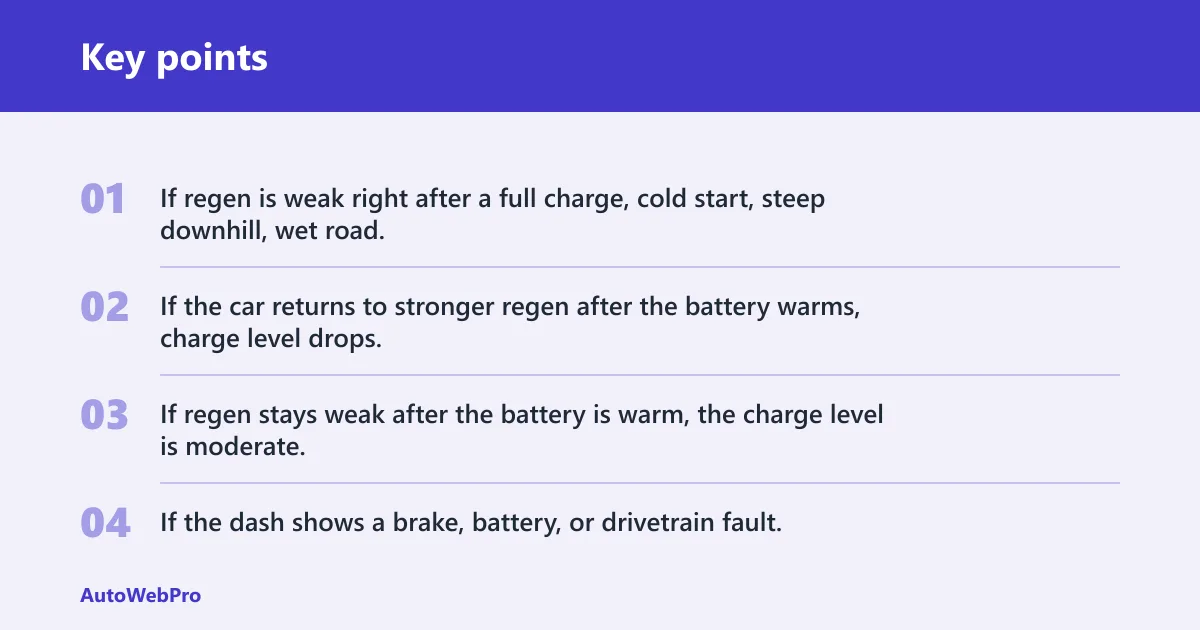
- If regen is weak right after a full charge, cold start, steep downhill, wet road, or towing event, treat it as likely normal.
- If the car returns to stronger regen after the battery warms, charge level drops, or the road dries, no repair is usually needed.
- If regen stays weak after the battery is warm, the charge level is moderate, and no drive-mode limit is active, check for a warning light or message.
- If the dash shows a brake, battery, or drivetrain fault, stop guessing and have the car inspected.
Picture a driver leaving a charger at 100 percent state of charge, then heading into traffic. Regen may feel light for the first few miles because the battery has little room to accept more energy. That is expected behavior, not a defect.
Does regen work with the brakes?
Yes. Most cars use blended braking, which means regenerative braking and friction brakes share the job. Light to moderate slowing may rely heavily on regen, but harder stops need the conventional pads and discs to finish the job. The handoff changes with braking demand and the vehicle’s calibration.
That handoff matters. If you press the pedal lightly, the car may favor the motor generator first. If you press harder, the friction brakes take over more of the work. In a panic stop, the conventional brakes still do the heavy lifting because stopping distance and tire grip matter more than energy recovery.
SEAT says regenerative braking reduces brake wear and tear, and that benefit is most noticeable in city driving with frequent stops and starts. The tradeoff is that brakes used less often can still corrode or stick. Pads and discs still need periodic inspection, even when regen is doing much of the slowing.
Why regen matters for range
Regenerative braking helps efficiency because it recovers some motion energy instead of throwing it away as heat. That recovered energy can help an EV go farther on a charge and can help a hybrid use less fuel in stop-and-go driving. The same source says regen is especially useful in city driving with frequent stops and starts.
The gain is not fixed. It depends on speed, traffic, battery temperature, road grip, and how full the battery is. HybridElectric says stronger regeneration is not the same as free energy, which is why the headline benefit changes from one drive to the next. A better way to think about it is this: regen helps most when the car would otherwise waste a lot of braking energy.
What matters more than a single range claim is where you drive and how the car is set up. Smooth urban driving usually gives the system more chances to recover energy than repeated high-speed braking or a fully charged battery with no room left to store it.
B-Mode, paddles, and one-pedal driving
Some cars give you a stronger regen setting such as B-Mode, often adjusted through the touchscreen, a console selector, or steering-wheel paddles. That can make the car slow more aggressively when you lift off. It can also make city driving easier because fewer brake-pedal inputs are needed.
One-pedal driving is a stronger version of that idea. The same source says one-pedal driving can stop the car without using the conventional brake pedal, but that feature is not available on every hybrid or EV. Even where it exists, the friction brakes still matter for sudden or hard stops.
Frequently asked questions
What is regenerative braking?
Regenerative braking is a system that slows an EV or hybrid while turning some of the car’s motion into stored electrical energy. The motor acts like a generator, the battery receives the recovered energy, and the car relies less on heat-wasting friction during everyday slowing.
How does regenerative braking work?
When you lift off the accelerator or press the brake pedal lightly, the electric motor changes role and creates resistance. That resistance slows the car, and the electrical output goes to the high-voltage battery. Stronger pedal input shifts more of the job to the regular brakes.
What does regenerative braking mean in a hybrid car?
In a hybrid car, it means the vehicle recovers energy during deceleration and stores it for later use, usually to support the drivetrain or electrical systems. The feel and strength vary widely, because hybrids blend motor recovery with engine and friction-brake control in different ways.
What does regenerative braking mean in an electric car?
In an electric car, it means the motor can slow the vehicle and recover energy every time you ease off the pedal or brake gently. Many EVs make this feel stronger than most hybrids, and some allow adjustable regen or one-pedal driving settings.
Does regenerative braking charge the battery?
Yes, but only within the limits the car allows. Regen returns recovered energy to the high-voltage battery, yet the system may reduce charging when the battery is cold, already full, or under protection from heat or traction limits. It does not charge at the same rate every time.
Why is regenerative braking temporarily reduced?
Temporary reduction is often normal. A full battery, cold battery, wet road, low grip, towing load, downhill heat protection, or a selected drive mode can all limit regen. If the system comes back as conditions change, that is usually expected behavior rather than a fault.
Why is my regenerative braking not working?
If regen seems absent, first check for a full battery, cold battery, or a mode that lowers regen. If none of those fit and the car stays in low-regen behavior after warm-up, look for warning lights or messages. A persistent change is worth inspection.