Is Blind Spot Monitoring Mandatory on New Cars?
No, blind spot monitoring is not broadly mandatory on new cars. In the U.S., it is usually optional or tied to trim level, and the same basic pattern holds in many other markets unless a local rule says otherwise. This guide separates required safety equipment from optional driver-assist features so you can read spec sheets and ads correctly.
That matters because “new car” does not mean “fully equipped.” A base trim can leave out blind spot monitoring while higher trims include it, and some markets regulate other systems instead. The legal question comes first: blind spot monitoring is usually a choice, while several other safety systems are required by law in specific jurisdictions and vehicle classes.
Is blind spot monitoring mandatory on new cars?
Short answer: no, not as a general rule. Blind spot monitoring is a driver-assistance feature, not a universal legal requirement for ordinary new passenger cars, so availability still varies by make, model, trim, and market. Many new cars include it, but many still do not, especially on lower trims.
Why the answer changes by market: regulations can require some safety systems in one region and leave blind spot monitoring out of the list. In the EU, the main rules cited below require other advanced safety equipment, and for some heavy-vehicle categories they can also include blind-spot-related systems. That is not the same thing as a blanket requirement for all new passenger cars, and it is not the same as the rules that apply in the UK after Brexit.
What blind spot monitoring does
Blind spot monitoring warns you when a vehicle is in the adjacent lane where mirrors can miss it. The usual cue is a light in the side mirror, sometimes with an audible or steering-wheel alert if you signal a lane change. It helps reduce lane-change collisions, but it does not replace mirror checks or looking over your shoulder.
Most systems use cameras or radar. Camera-based systems watch the area beside the car and react to changes between frames, while radar-based systems use reflected radio waves to detect vehicles in the warning zone. Either way, the goal is the same: alert the driver before a lane change becomes risky.
How to verify on a spec sheet
Look for these naming variants: blind spot monitoring, blind spot detection, BLIS, side assist, rear cross-traffic alert, and the sensor type. If the sheet names only one of these, confirm whether the system covers both sides of the vehicle and whether the hardware is camera-based, radar-based, or mixed.
Why it is still an assist feature
Blind spot monitoring supports your judgment. It does not make lane changes automatic, and it cannot see every hazard. A motorcycle closing quickly, a vehicle at an angle, or a blocked sensor can still leave you responsible for checking mirrors and blind spots before moving over.
Suppose a compact hatchback has a mirror warning light on the left side. If the sensor sees a car in the next lane, the light comes on, but the driver still needs to confirm the lane is clear before changing lanes. The warning is a cue, not permission.
Blind spot monitoring explained
Blind spot monitoring is a warning system for vehicles in adjacent lanes. It is widely available on many new cars, but it is not standard fitment across all trims. Automakers may bundle it with other convenience or safety packages, which is one reason shoppers can mistake “common” for “mandatory.”
Camera and radar setups
Camera-based systems use image processing to spot vehicles in the blind-zone area. Early versions could be sensitive to weather and visibility, because they depend on seeing a clear change between frames. Radar-based systems are common because they can be more reliable in poor weather, and many manufacturers moved to radar or added it alongside cameras.
That mix matters to buyers. A car may have blind spot monitoring, but the sensor type affects how it behaves in rain, fog, slush, or snow. If a trim sheet lists the feature without naming the sensor type, check the manufacturer’s listing for your model.
Why it was invented and who pioneered it
Volvo introduced Blind Spot Information System in 2003. The original system used cameras mounted beneath the wing mirror and monitored blind spots continuously. Volvo’s own safety material describes it as a camera-based warning system designed to alert the driver when a vehicle enters the monitored area.
That first Volvo system took 25 pictures a second. That is enough to detect changes between frames and warn the driver when a vehicle enters the monitored zone. Modern systems may use different hardware, but the core idea remains the same: detect a vehicle beside you and alert you fast enough to matter.
How the feature evolved
Manufacturers moved beyond camera-only systems because camera visibility is not constant. Fog, snow, spray, and grime can reduce the system’s confidence, so radar became a common addition or replacement. The result is better consistency, especially when visibility drops and the driver most wants help.
The shift also reflects cost and packaging. Some brands fit the feature only on higher trims, while others include it in safety packs. That is why two versions of the same model can look alike on the outside and still differ on blind spot monitoring.
Why manufacturers moved beyond camera-only systems
Camera systems can struggle in fog or snow. That is the key limitation shoppers should remember. If the camera lens is partially blocked, dirty, or obscured by weather, detection can become less reliable and the warning may arrive late or not at all.
Radar can improve reliability in poor weather, though it is still subject to sensor placement and vehicle design. For buyers, the practical takeaway is simple: blind spot monitoring is a help feature, not a substitute for a clear mirror setup and proper lane checks.
Which safety systems are mandatory?
The EU examples below are about other required systems, not a blanket blind spot mandate for ordinary new passenger cars. Regulation (EU) 2019/2144 is the EU type-approval framework for motor vehicles and trailers, and it introduces mandatory advanced driver-assistance systems for defined vehicle categories and market dates. That is different from saying every new car must have blind spot monitoring.
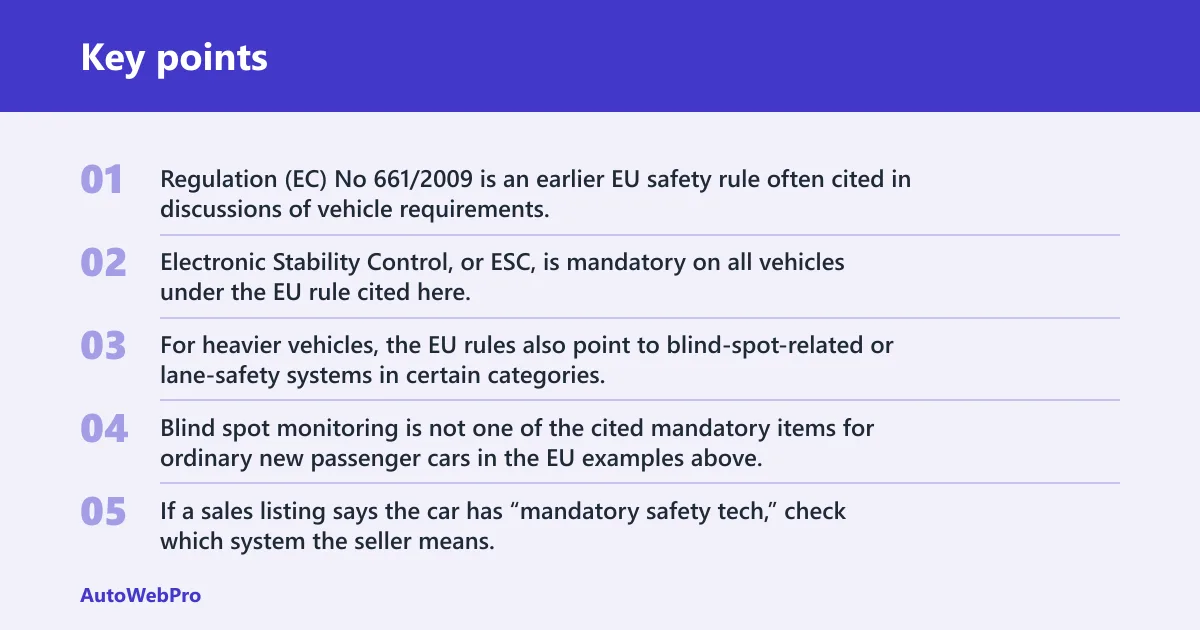
Regulation (EC) No 661/2009 is an earlier EU safety rule often cited in discussions of vehicle requirements. It made electronic stability control mandatory under the dates already widely quoted in the market: 1 Nov 2011 for new types of vehicle and 1 Nov 2014 for all new vehicles. That is a good example of a broad requirement that many shoppers confuse with blind spot monitoring, but it is a different system entirely.
UK applicability is separate from EU law. After Brexit, EU regulations do not apply in the UK as EU law simply because they exist; the UK may mirror, adapt, or require different approval rules through its own regime. So when comparing a European model with a UK model, it is important to distinguish EU type-approval language from UK approval and market-fit language.
EU rules that do require other systems
Electronic Stability Control, or ESC, is mandatory on all vehicles under the EU rule cited here. It is a stability aid with large injury and fatality reduction potential, and it is one of the clearest examples of a safety feature that is required across the board in the EU context cited here.
For heavier vehicles, the EU rules also point to blind-spot-related or lane-safety systems in certain categories. Lane Departure Warning Systems are mandatory on heavy-duty vehicles from 1 Nov 2013 for new types of vehicle and 1 Nov 2015 for all new vehicles.
Where blind spot monitoring fits in those rules
Blind spot monitoring is not one of the cited mandatory items for ordinary new passenger cars in the EU examples above. Some heavy-vehicle categories can have blind-spot-related requirements, but that is a narrower rule set than the one shoppers usually mean when they ask about passenger cars on a dealer lot.
| System | Mandatory status | Scope / market | Blind-spot notes |
|---|---|---|---|
| Blind spot monitoring | Not generally mandatory for ordinary new passenger cars | U.S. and many other passenger-car markets; trim and market dependent | Usually optional or package-based; availability varies by make, model, trim, and market |
| ESC | Mandatory | EU under Regulation (EC) No 661/2009; 1 Nov 2011 for new types of vehicle and 1 Nov 2014 for all new vehicles | Separate stability system, not blind spot monitoring |
| Lane Departure Warning | Mandatory for certain heavy-duty vehicles | EU heavy-duty vehicle rules; 1 Nov 2013 for new types of vehicle and 1 Nov 2015 for all new vehicles | Lane-safety requirement, not a general passenger-car blind spot requirement |
| Advanced Emergency Braking | Mandatory for certain heavy-duty vehicles | EU heavy-duty vehicle rules; 1 Nov 2013 for new types of vehicle and 1 Nov 2015 for all new vehicles | Braking assistance, not blind spot monitoring |
| Other ADAS named in Regulation (EU) 2019/2144 | Mandatory for defined vehicle categories | EU type-approval framework for motor vehicles and trailers | Mandatory ADAS are not the same thing as a universal blind spot monitoring mandate for all new passenger cars |
Plain-English takeaway: the EU rules cited here require some safety systems, but they do not make blind spot monitoring a universal mandatory feature on ordinary new passenger cars. If a sales listing says the car has “mandatory safety tech,” check which system the seller means. In the UK, do not assume EU wording carries over unchanged.
Why many new cars still leave it optional
Blind spot monitoring costs money to fit and calibrate, so manufacturers often reserve it for higher trims or option packages. That keeps the base price down and lets buyers choose whether they want the feature. It also explains why two versions of the same model can differ on safety equipment even when the body shell is identical.
Market rules add another layer. In some regions, a feature may be common because the market expects it, while in others it stays optional unless a local regulation requires it. That is why shoppers should compare the exact trim and the exact market version, not just the model name.
Trim and price differences
A base trim might omit blind spot monitoring while a mid-level trim includes it. Some brands also reserve the feature for a package that adds parking aids, rear cross-traffic alert, or a larger infotainment screen. The badge on the tailgate does not tell you that.
A common first-timer mistake is assuming every new SUV has the same safety kit. Picture two versions of the same crossover on one lot: one has a mirror indicator and one does not. The difference is often trim content, not a legal failure.
Market-by-market equipment spreads
Do not assume the U.S., EU, and UK rules are identical. Even where the same model name is sold, equipment can differ by region because of local approval rules, trim structure, and brand pricing strategy. The legal requirement may sit with one system, while blind spot monitoring remains a paid option.
Check the trim sheet. Look for blind spot monitoring, blind spot detection, blind spot information, BLIS, side assist, or rear cross-traffic alert on the exact trim you plan to buy. If the sheet does not name it, assume it is not included and verify with the manufacturer’s listing for your model.
Separate law from equipment. Read the regulation name and the system name separately. ESC, lane departure warning, and advanced emergency braking are not the same feature as blind spot monitoring, and a regulation that mandates one does not automatically mandate the other.
Ask about the sensor type. If blind spot monitoring matters to you, ask whether the car uses camera-based, radar-based, or mixed sensing. That helps you judge how the system may behave in fog, snow, or heavy spray.
Does blind spot monitoring work in snow or fog?
Sometimes, but not as well as in clear conditions. Camera-based systems can struggle in fog or snow, and that matters because the sensor has to identify vehicles by comparing frames. Radar-based systems are often used to improve reliability in poor weather, which is one reason many manufacturers moved toward them.
The practical implication is simple: do not treat the warning light as guaranteed coverage when the road is slushy or visibility is poor. Clean sensors matter. So do mirror checks and shoulder checks, because the feature can fail or miss edge cases when weather interferes.
Say your crossover has camera-based blind spot monitoring and the rear quarter is coated with road salt. The warning may arrive late or not at all until the lens is clear. If the same car uses radar instead, the system may hold up better in that weather, but it is still not a substitute for checking the lane yourself.
Frequently asked questions
Which safety systems are actually mandatory on new cars?
The EU also has Regulation (EU) 2019/2144 for mandatory advanced driver-assistance systems, but not as a blanket blind spot monitoring rule for ordinary passenger cars. In the UK, the legal picture must be checked under UK rules rather than assumed from EU text alone.
Do all new cars come with blind spot monitoring now?
No. Many new cars offer it, but many do not include it as standard equipment. It is common on higher trims and in safety packages, so a shopper can still find new cars without it on the window sticker or spec sheet.
Is blind spot monitoring required in the EU or UK?
Not as a universal passenger-car requirement in the EU examples discussed here. EU rules do require some safety systems, and certain heavy-duty vehicle categories can have blind-spot-related requirements, but blind spot monitoring itself is not one of the cited mandatory items for ordinary new passenger cars. UK approval should be checked separately from EU type-approval wording.
Why do some new cars still not have blind spot monitoring?
Because manufacturers package features by trim and price. A base car may meet the legal equipment list while omitting blind spot monitoring to keep costs down, then add it only on higher trims or option groups. Market rules also differ, so the same model can be equipped differently in another region.