Is Blind Spot Monitoring Worth It?
Blind spot monitoring can be worth paying for if you drive a larger vehicle, spend time on multi-lane roads, or want lane-change warnings that can help catch traffic beside you. For a small car with easy visibility, it is often optional. Skip it and you may miss a vehicle, clip another lane, or pay extra for a feature you rarely notice. This guide breaks down when the option earns its price, what warning-only systems do, and when active lane intervention is worth the upgrade.
When the feature makes sense
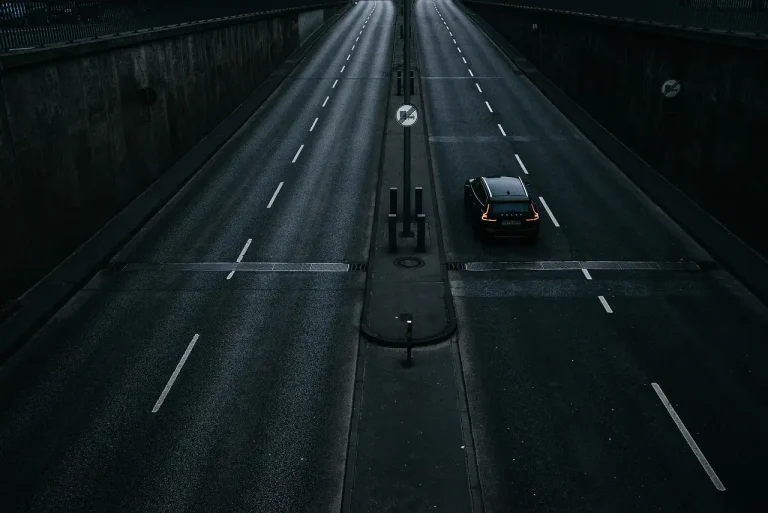
Blind spot monitoring is worth it when the feature matches the vehicle and the drive cycle. It tends to pay off most in SUVs, minivans, pickups, and commutes with frequent lane changes or dense traffic. On a compact sedan with clear sightlines, the value is lower unless you want the extra warning margin.
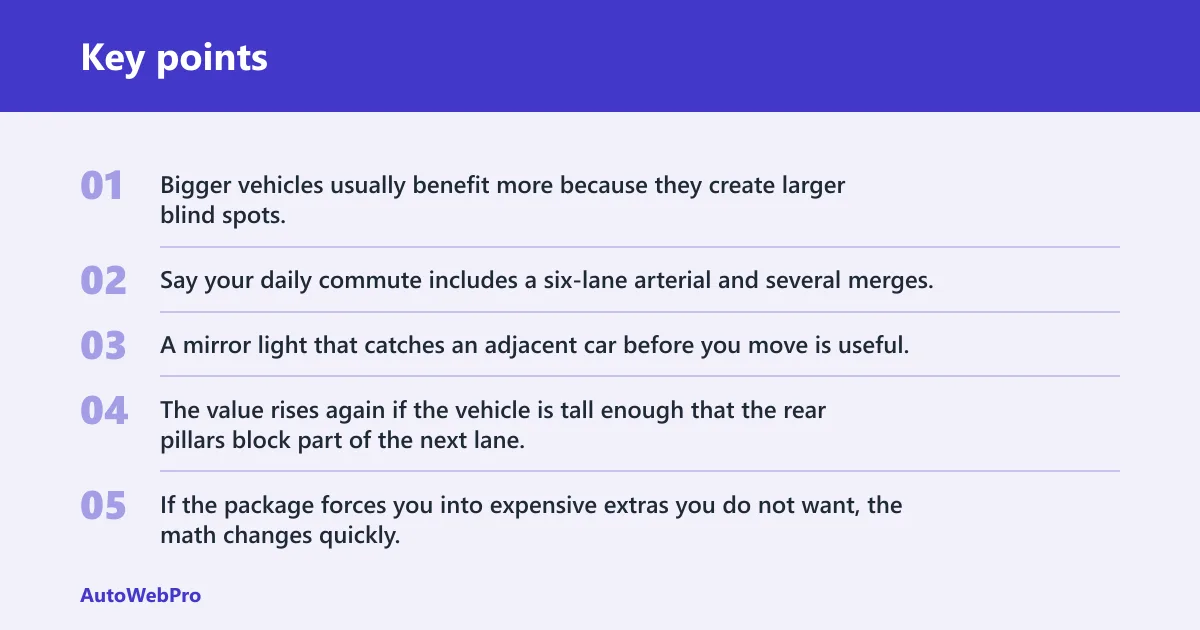
In practical terms, the system uses radar or similar sensors to detect vehicles in the next lane, then gives a mirror light, cabin message, chime, or steering-wheel vibration. Bigger vehicles usually benefit more because they create larger blind spots.
When the feature is worth paying
Pay for it when you regularly merge, change lanes in traffic, back out of tight spaces, or drive a vehicle with poor rear-quarter visibility. It is also easier to justify when the feature is bundled with rear cross-traffic alert, because that adds value in parking lots and driveways.
Say your daily commute includes a six-lane arterial and several merges. A mirror light that catches an adjacent car before you move is useful. The value rises again if the vehicle is tall enough that the rear pillars block part of the next lane.
When you can skip it
You can usually skip it on a small car with good mirror coverage, light traffic, and a trim jump that raises the price too much. If the package forces you into expensive extras you do not want, the math changes quickly. In that case, better mirrors and careful checks may be the smarter spend.
Pros and cons
Blind spot monitoring is a warning aid, not a substitute for mirrors or shoulder checks. The tradeoff depends on how much blind-zone risk you actually face and whether the system only warns or can also intervene.
Pros
- Helps detect vehicles in adjacent lanes.
- Can warn through a mirror light, cabin message, or chime.
- Often bundled with rear cross-traffic alert, which helps in parking lots.
- More common now across the market, not just on luxury cars.
- Can be especially helpful on taller vehicles with larger blind spots.
Cons
- Not every system includes rear cross-traffic alert.
- Some systems are still limited to high-end trims.
- Sensors can be blocked by dirt, snow, tow equipment, or damage.
- Alerts can create false confidence if you stop checking mirrors and traffic.
- Active steering or braking is not universal.
Who it’s for
This feature suits buyers who want a better lane-change warning on larger vehicles, or who spend a lot of time in traffic, parking lots, and multi-lane commuting. It is less compelling for drivers who mostly use a small car on low-traffic roads and do not want to pay for a higher trim.
Compact sedan buyers
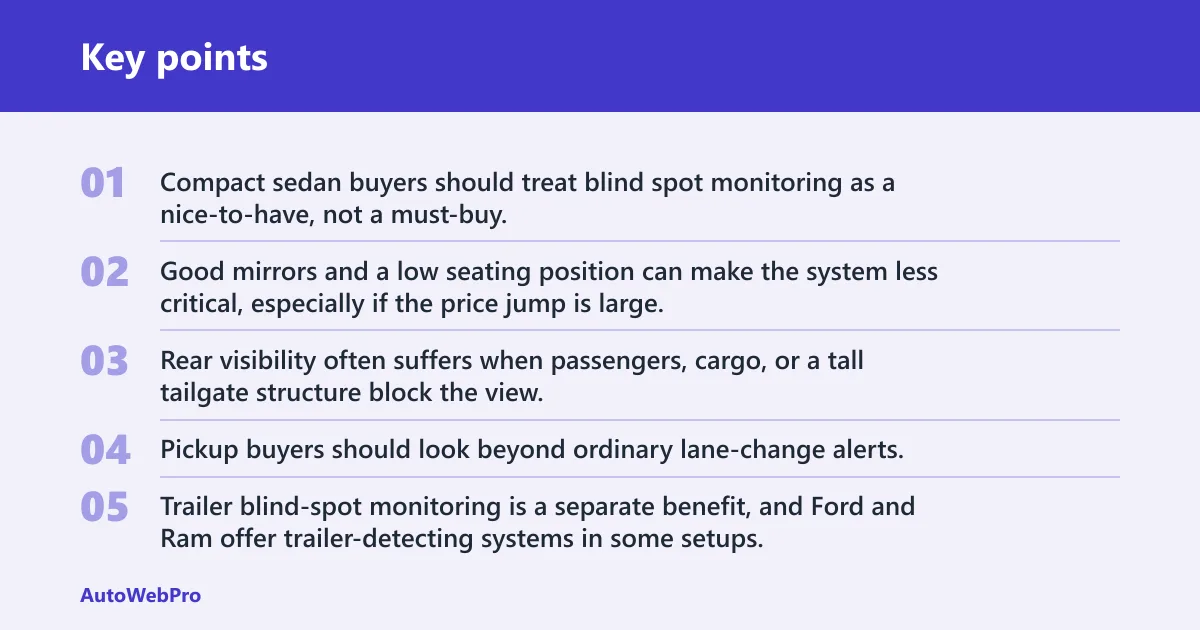
Compact sedan buyers should treat blind spot monitoring as a nice-to-have, not a must-buy. Good mirrors and a low seating position can make the system less critical, especially if the price jump is large. It becomes more valuable if the sedan has thick rear pillars or a narrow rear window.
SUV and minivan buyers
SUV and minivan buyers usually get more value from the feature because the body height and cabin shape can widen blind zones. Rear visibility often suffers when passengers, cargo, or a tall tailgate structure block the view.
Pickup and towing buyers
Pickup buyers should look beyond ordinary lane-change alerts. Trailer blind-spot monitoring is a separate benefit, and Ford and Ram offer trailer-detecting systems in some setups. That matters when the trailer blocks the rear view and creates a longer blind zone beside the trailer itself.
Urban parking-heavy drivers
Urban drivers get extra value when the package includes rear cross-traffic alert. In tight parking lots, that feature detects vehicles when reversing. If your routine includes curb parking, crowded garages, or frequent backing out, this side of the system may matter as much as lane-change help.
Blind spot monitoring buyer table
Use this table to judge where the feature earns its price. The score reflects blind-spot size, merge frequency, reversing risk, and whether rear cross-traffic alert or active intervention materially changes the use case.
| Scenario | Blind-spot size | Merge frequency | Reversing risk | Value drivers | Worthiness score |
|---|---|---|---|---|---|
| Compact sedan | Low to moderate | Moderate | Moderate | Useful if the trim price is modest or rear cross-traffic alert is included | 6/10 |
| Midsize SUV | Moderate to high | High | Moderate | Strong lane-change value; better if mirror alerts are clear and bright | 8/10 |
| Large SUV or minivan | High | High | High | Clear fit for warning plus rear cross-traffic alert, especially in family hauling | 9/10 |
| Pickup with trailer | High | Moderate to high | High | Worth it mainly when trailer blind-spot detection is included | 9/10 |
| Urban parking-heavy driving | Moderate | Moderate | High | Rear cross-traffic alert can matter more than lane-change alert alone | 8/10 |
Does it work beyond lane changes?
Yes, on many vehicles it does. Rear cross-traffic alert is often bundled with blind spot monitoring, and that changes the value in parking lots and driveways. Active blind-spot intervention is another step up, but it is available only on some vehicles and only on certain trims or packages.
Rear cross-traffic alert
Rear cross-traffic alert detects vehicles when reversing. That makes it useful when backing out of a parking space with blocked sightlines. It is different from lane-change blind spot monitoring, which watches adjacent lanes while moving forward. (Motortrend)
Active blind-spot intervention
Some systems do more than warn. On certain vehicles, active blind-spot intervention can add steering correction or braking input to help reduce the chance of a lane-change collision. That adds collision-prevention functionality, but it is not universal, and buyers should confirm the exact behavior before they assume the car will correct itself.
What it does not do
It does not replace mirrors, shoulder checks, or careful lane positioning. It also does not guarantee detection in every condition. Dirt, snow, tow gear, or a hidden sensor can reduce effectiveness, and a loud alert can still be ignored if the driver is inattentive.
Suppose a pickup is towing a camper on a wet highway. A trailer-detecting system can help spot cars beside the trailer, but a dirty sensor or a blocked rear corner can reduce detection. The feature still helps, but it does not remove the need to verify the lane.
What should I compare on a test drive?
Compare the alert format, the placement of the warning, and whether the system feels clear in real traffic speeds. Also check whether the system is warning-only or includes steering or braking intervention. Those details matter more than the badge or feature name on the brochure.
Check alert placement. Look for the indicator in the side mirror, the cabin display, or both. The warning should be visible without demanding your attention away from the road for more than a quick glance.
Listen for the chime. If the system uses an audible alert, ask whether the chime volume can be adjusted. Some systems allow that change, and it matters if the warning is too quiet over road noise or too loud for your preference.
Confirm intervention behavior. If the vehicle offers active blind-spot intervention, find out whether it steers, brakes, or both. That distinction changes how much collision-prevention support you actually get.
Inspect sensor packaging. Ask where the sensors are mounted and whether the system is designed to monitor beside the trailer, not only beside the truck body.
How automakers package blind spot monitoring
Availability varies by automaker and trim. Some brands make it standard on upper trims or include it in a safety package, while others keep it optional. MotorBiscuit notes that the feature is now available across the market, not just on luxury cars, but some automakers still restrict it to high-end vehicles.
Standard on upper trims
This is the easiest setup to evaluate. If you already want the higher trim for other reasons, blind spot monitoring can be a sensible extra. Ford and Nissan also include safety tech as part of standard safety technologies on some models, so buyers should check how much of the package is already included.
Optional safety package
Optional packages can be good value if they also add rear cross-traffic alert, parking aids, or lane-change assistance. The problem is price creep. If the package pushes you past your budget for features you will not use, skip it and keep the car simpler.
Brand naming differences
Automakers use different names for the same core idea. Toyota and Lexus call it Blind Spot Monitor. Mercedes-Benz uses Blind Spot Assist or Active Blind Spot Assist. The name matters less than the hardware list: sensors, alert type, and whether the system only warns or can intervene.
Frequently asked questions
Is blind spot monitoring worth it?
Yes, especially on SUVs, minivans, pickups, and cars that see lots of lane changes. It is less valuable on small vehicles with good visibility, unless the price is low or the package also includes rear cross-traffic alert. The feature is best treated as a targeted aid, not a universal must-have.
How important is blind spot monitoring?
Its importance depends on vehicle size and driving pattern. On a larger vehicle or in heavy traffic, it can add a useful warning before a lane change. On a compact car used mostly on low-traffic roads, it is helpful but not essential.
What does blind spot monitoring actually detect?
Blind spot monitoring uses sensors to detect vehicles in adjacent lanes. Some systems also watch for activity near the rear corners, which is why the warning can come from the mirror or the cabin. Radar sensors are common, and the alert may be visual, audible, or both.
Does blind spot monitoring work when changing lanes only, or also when reversing?
It can do both only if the vehicle includes rear cross-traffic alert. That feature detects vehicles when reversing. Standard blind spot monitoring is aimed at adjacent-lane traffic, so do not assume the parking-lot function is included.
Is blind spot monitoring worth paying extra for on a cheaper car?
Only if the price increase is small or the package adds other safety tech you want. On a budget car, a large trim jump can erase the value fast. If the car already has good visibility and the system is optional, it is easy to skip.
Can blind spot monitoring actively brake or steer the car?
Some systems can, but many cannot. MotorTrend says certain setups can actively steer or brake to avoid a collision. If that capability matters to you, verify it on the exact trim and package, because warning-only systems are still very common.