Does Lane Keeping Assist Recognize Bicycles?
Lane keeping assist usually does not recognize bicycles, motorcycles, or parked vehicles; it tracks lane markings or road edges, so it cannot judge clearance to those objects. If you treat it like object detection, you can end up with sideswipes, clipped handlebars, or a lane departure into something stopped near the line. This guide explains which lane features lane keeping assist can read, what it ignores, and which other systems handle vehicles and vulnerable road users.
What lane keeping assist actually detects
Basic lane keeping assist is a lane-tracking aid rather than an object-recognition system, so it typically reads painted lines and road edges instead of identifying bicycles, motorcycles, or parked cars as hazards. That distinction matters most when the object sits near the lane line, because the system may still focus on the marking instead of the obstruction.
What the system is actually reading
Most lane keeping systems use a forward-facing camera, often mounted near or behind the rearview mirror, to locate lane markings ahead of the vehicle. Bosch describes the function as using a video camera to detect lane markings, then intervening when the vehicle’s distance to lane markings falls below a defined minimum.
That means the core task is geometric. The system looks for lane boundaries, not the shape, speed, or intent of nearby traffic, cyclists, or roadside vehicles. A parked van on the shoulder is a spatial hazard for you to avoid, but it is not the lane marker input the system is built around.
Why nearby objects are different from lane markings
A bicycle near the stripe can be in the same camera frame as the lane line, but lane keeping assist is not making a clearance decision. It may see contrast, shadow, or a white edge line. It does not turn that into “move away from the bike.”
That is why you still have to judge the space to the side. If a cyclist is partly over the lane edge or a motorcycle is filtering beside the car, the steering aid may stay focused on staying within the lane boundary rather than protecting side clearance.
How the camera reads lane markings
The camera looks for visible paint and road edges, then uses image processing and, in some systems, AI methods to separate lane lines from surrounding pavement. Some systems recognize both solid and dashed lines. Performance drops when the marking is faded, dirty, covered, or hard to distinguish from the road surface.
Forward-facing camera location and role
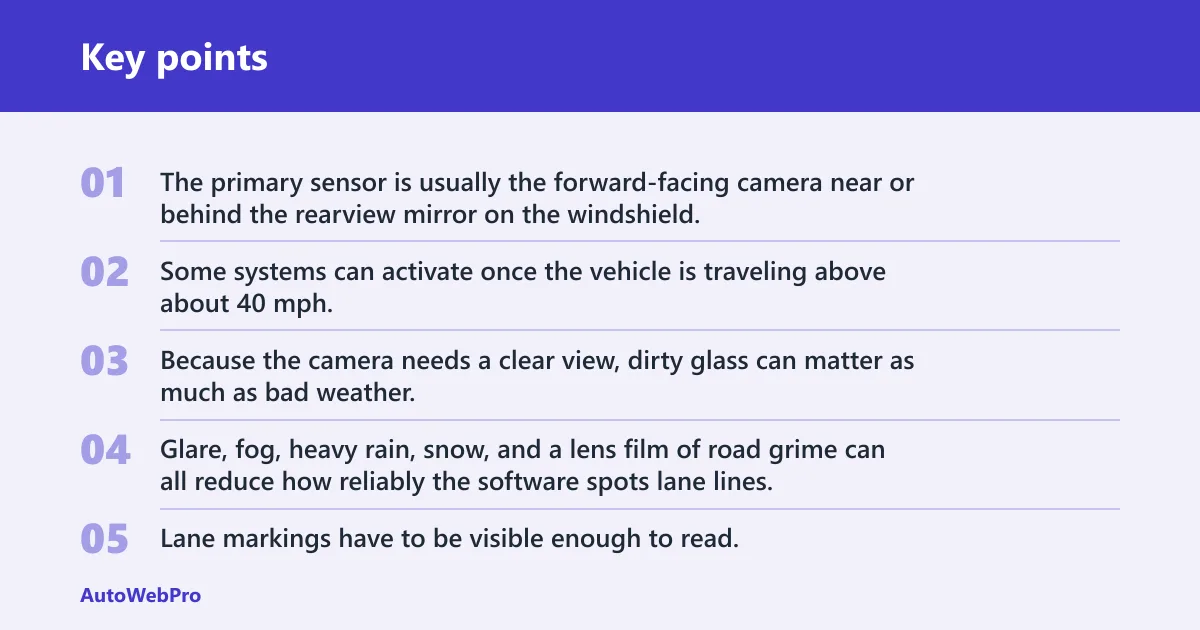
The primary sensor is usually the forward-facing camera near or behind the rearview mirror on the windshield. Some systems can activate once the vehicle is traveling above about 40 mph. Make and model matter here.
Because the camera needs a clear view, dirty glass can matter as much as bad weather. Glare, fog, heavy rain, snow, and a lens film of road grime can all reduce how reliably the software spots lane lines.
Paint quality, contrast, and visibility limits
Lane markings have to be visible enough to read. Faded paint, poor contrast, and broken or illegible lines make the job harder, especially on older roads or freshly patched pavement. If the markings disappear under slush or glare, the system may stop intervening or warn less reliably.
Suppose a road has pale, worn lane paint and a bright low sun. The camera may still detect a boundary in one lane and lose it in the next. In that case, you cannot assume the system will track the center the same way all the way through the stretch.
Lane keep assist versus lane departure warning
Lane departure warning alerts the driver; lane keeping assist may add steering correction. The warning can come as sound, vibration, or a visual cue. The assist function goes a step further by nudging the wheel or, in some designs, using steering or brake intervention to push the vehicle back toward the lane edge or center. (Consumerreports)
Alerts without steering correction
Lane departure warning is the simpler of the two. It tells you that the vehicle is drifting toward a line, but it does not try to steer the car. That makes it useful as a notice system, especially on roads where lane markings are clear but the driver is distracted or tired.
Steering nudge or brake input
Lane keeping assist is the active counterpart. The same source says the system may use electric power steering or brake individual wheels via ESP. Bosch also says drivers can override lane keeping assist at all times, so any correction remains subordinate to the driver’s input.
Lane centering is not the same
Lane centering is related, but it is more continuous than basic lane keep assist. It tends to hold the vehicle between visible lines rather than waiting for a near-edge event and then nudging back. That is a different behavior from a simple line-avoidance correction.
Continuous lane holding compared with edge correction
Basic lane keep assist often acts when the vehicle drifts near a boundary. Lane centering tracks both sides when lane markings are visible and keeps the vehicle more actively positioned. The name on the screen can mislead here, so read the owner’s manual rather than assuming all lane aids behave alike.
A common mistake is assuming lane keeping assist will automatically steer around a parked delivery van or notice a motorcycle riding close to the lane line. It may only be ready to correct a drift, and that is a narrower job.
What lane keep assist can see vs. what it cannot decide
The table below separates what the camera can likely recognize from what the steering aid can actually decide. That difference matters on bikes, motorcycles, parked vehicles, and work zones, where the system may detect lane paint or edge contrast without understanding the hazard beside it.
Lane keep assist decision table
| Scenario | What the camera likely recognizes | Whether steering assist may intervene | Driver action required |
|---|---|---|---|
| Bicycles near the lane line | Lane paint, edge contrast, bicycle shape as background context | Maybe, if the car drifts toward the line | Judge clearance and move over if needed |
| Motorcycles beside your lane | Lane markings and roadside motion cues | Maybe, if lane departure is detected | Maintain space and avoid side-swipe risk manually |
| Parked cars on the shoulder | Vehicle outline, shoulder edge, nearby lane line | Only if lane drift triggers correction | Steer around the parked vehicle with full judgment |
| Construction barrels | Cones, barrels, temporary markings, if visible | Unreliable; may react inconsistently | Follow work-zone controls and steer actively |
| Faded paint | Poor or broken lane contrast | Less likely | Expect weaker support and rely on visual steering |
| Curves | Bent lane geometry, changing lane angle | Sometimes, depending on map of lines and speed | Hold lane position yourself through the bend |
| Lane changes with turn signals | Signal input plus lane boundary movement | Often suppressed during intentional change | Complete the lane change with normal steering |
What happens when you signal a lane change
Most systems suspend or reduce intervention when you activate the turn signal for a deliberate lane change or turn. The same source says the system does not intervene when the driver activates the turn signal to change lanes or turn. That behavior helps it distinguish intentional movement from drift.
Intentional lane changes and intervention suppression
The turn signal is a cue that the move is planned. Without that logic, the steering aid might fight a proper lane change. With it, the system usually backs off so the driver can merge or turn without resistance from the lane boundary logic.
Why the driver still controls the move
Even when the signal suppresses intervention, you still have to check mirrors, blind spots, and surrounding traffic. A turn signal does not make the car aware of a cyclist beside the rear quarter, a motorcycle filtering past, or a truck filling the next lane.
Say your car is drifting toward the dashed line at 45 mph with lane keep assist active. If you signal left before moving over, the system may stop nudging the wheel. That does not mean it has cleared the lane for you; it just means it has stepped out of the way for the chosen maneuver.
When lane keeping assist may miss the mark
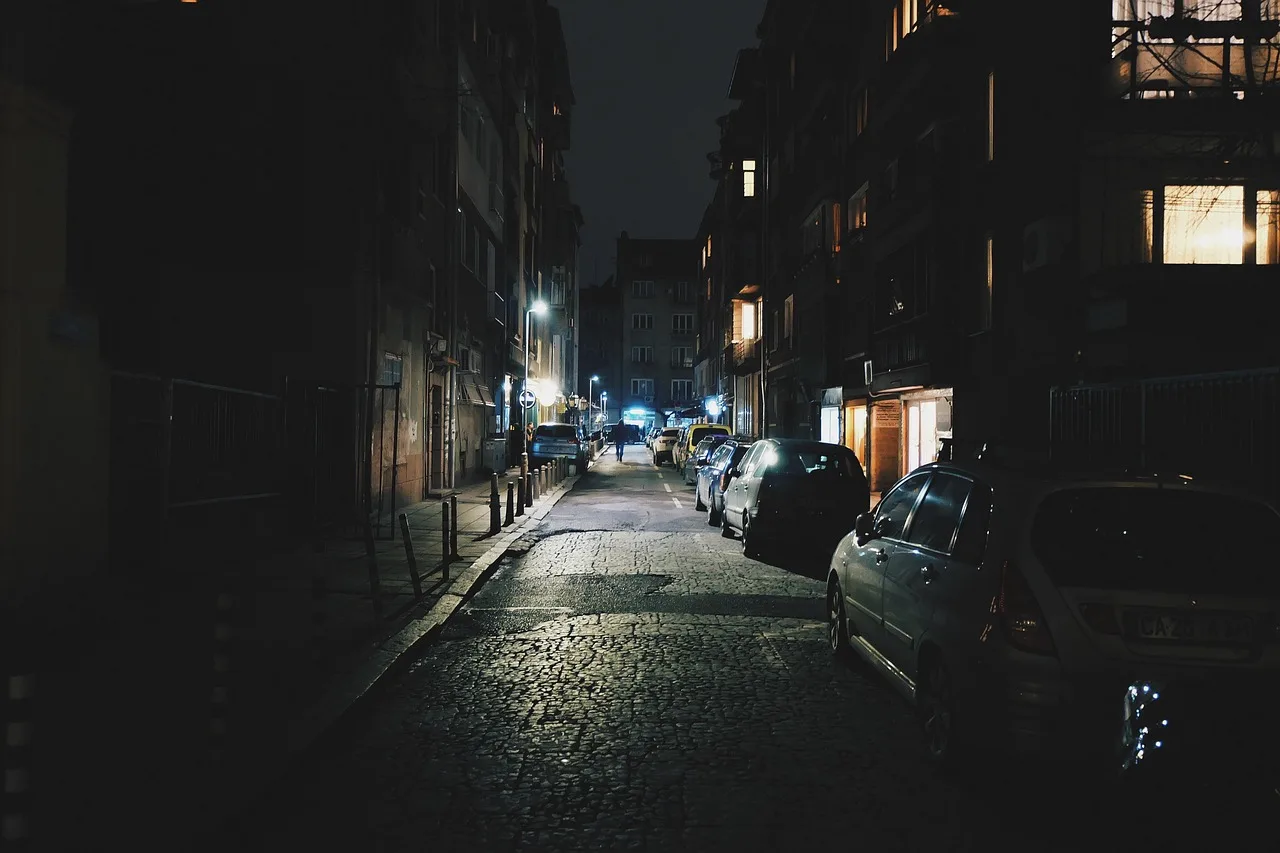
Rain, snow, fog, glare, dirty glass, poor markings, curves, construction zones, and narrow roads all reduce performance. Some systems simply lose the line; others keep working but with weaker confidence. The result is the same for you: do not expect consistent correction in bad conditions.
Rain, snow, fog, glare, and dirty glass
Weather changes how the camera sees contrast. Heavy rain can wash out paint edges, snow can hide the stripe, and fog can flatten the scene. Dirty windshield glass or a dirty camera zone near the mirror can do the same thing even on a clear day.
If the lane lines disappear, the system cannot keep centering on what it cannot read. That is why a visual check of the windshield area matters before blaming the software.
Curves, construction zones, narrow roads, and faded paint
Curves create a moving target. Construction zones add temporary markings, barrels, tapers, and lane shifts that may not match normal lane geometry. Narrow roads leave less room for correction, so even a small nudge can feel abrupt or become the wrong move.
Faded paint is a separate problem. VW-group Lane Assist recognizes both solid and dashed lines, but only when the lane markings are readable enough for the camera to interpret them. If the line is worn to the point of being illegible, recognition drops with it.
Speed thresholds and model differences
Some lane keeping systems only activate above 40mph. Others have different thresholds entirely. VW-group Lane Assist, for example, can automatically activate when speed exceeds 65 km/h and does not react below 60 km/h again. That is why the dashboard behavior can differ from one car to the next.
- Check the activation speed. Look in the owner’s manual for the minimum speed and any reset speed. The system may not wake up until you pass its threshold, and it may drop out again below the lower limit.
- Inspect the camera view. Clean the windshield area near the rearview mirror and remove film, bugs, or road salt. The camera needs contrast to read lane markings.
- Verify the lane lines. Look for faded paint, snow cover, heavy glare, or construction tapers before relying on the system. If the markings are weak, reduce dependence on lane assist.
Picture a two-lane road with worn center paint, a right-hand curve, and a parked sedan partly on the shoulder. Lane keep assist may still try to read the curve, but it is not deciding whether the parked car leaves enough room. That choice stays with you.
Frequently asked questions
Does lane keeping assist recognize bicycles near lane lines?
Usually no. Basic lane keeping assist is built to track lane markings and road edges, not to identify a bicycle as an object that requires clearance. If a bike sits near the line, you still have to judge spacing and steer around it.
Does lane keeping assist see motorcycles beside my lane?
It may see the lane line next to the motorcycle, but that is different from deciding what to do about the motorcycle itself. Lane keeping assist is not a side-object clearance system. Keep your attention on the mirror checks and the space beside the car.
Will lane keeping assist avoid parked cars on the shoulder?
No. A parked car on the shoulder is a hazard the driver must decide to avoid. Lane keeping assist may only care about the lane boundary. If the shoulder narrows or the parked car sits close to the stripe, manual steering judgment matters.
Does lane keep assist work if I signal a lane change?
Usually it backs off when the turn signal is on. The same source says the system does not intervene when the driver activates the turn signal to change lanes or turn. That helps the car distinguish a deliberate lane change from an accidental drift.
Why does lane keeping assist stop working in rain or snow?
Because the camera loses clean lane contrast. Rain, snow, fog, glare, and dirty glass can hide or blur the markings the system needs. If the lines are hard to read, the assist function may weaken, warn less, or stop steering correction altogether.
Is lane keeping assist the same as lane centering?
No. Lane keeping assist usually corrects near a lane edge or drift event. Lane centering is more continuous and tries to hold the vehicle between the lines when they are visible. The dash label can sound similar, but the behavior is not the same.